Chapter 3
Campfire Light, Story Glow
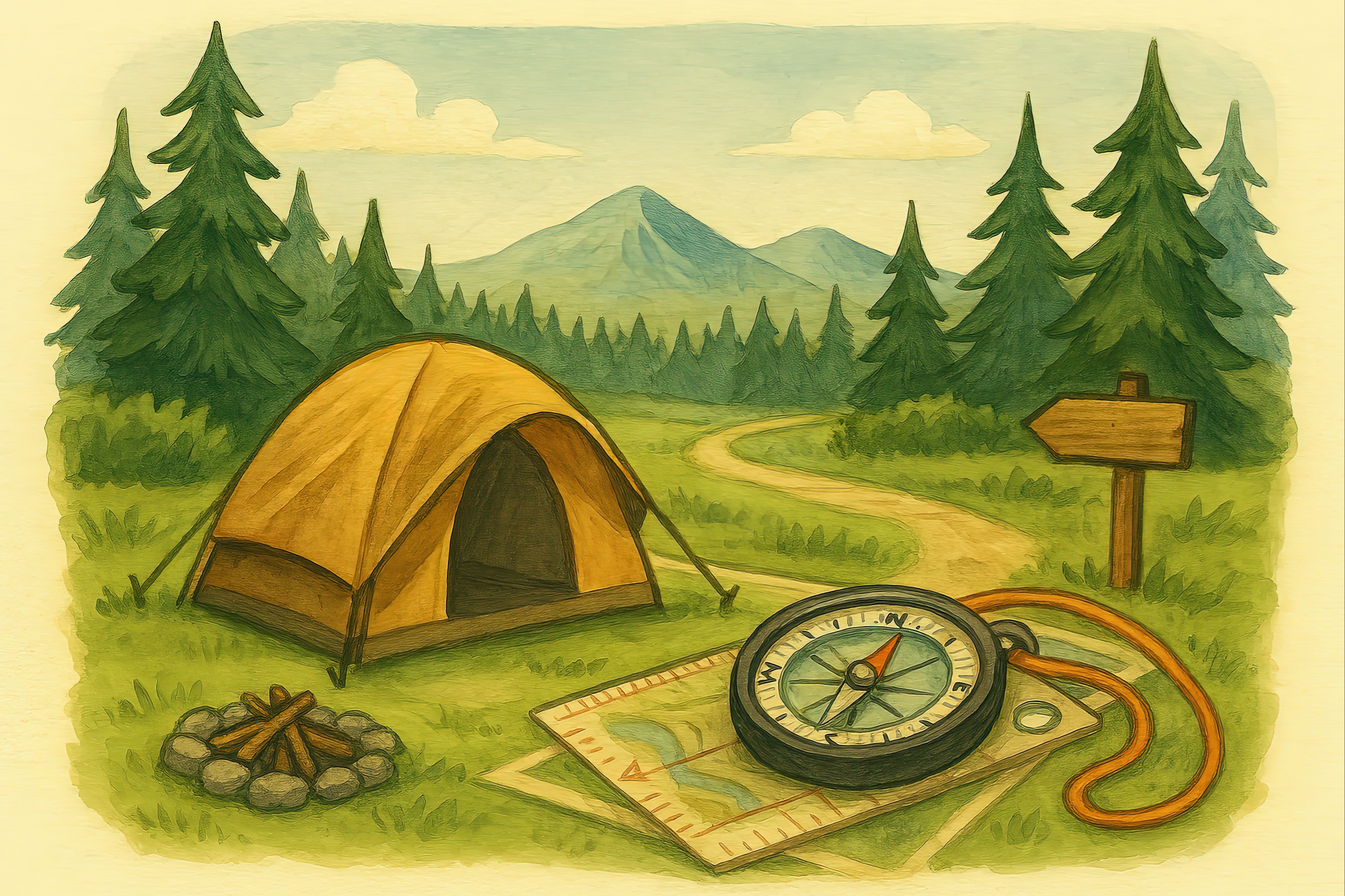
Here we are!
Suddenly the low shrubs opened to the view of a crystal-clear blue mountain lake surrounded by forests on the far side and a soft green meadow before them. A sandbar on the shoreline invited their curiosity.
Feeling free from the constraint of the forest trail, as one, the children raced to be the first one there.
“It’s so beautiful,” Justine said as she breathed deeply of the clear mountain air. “And it smells like nothing else I’ve ever smelled. It’s so clean and… and undisturbed by anything other than the trees and lake—and those mountains,” she added, pointing across Mirage Lake.
Mr. and Mrs. W. smiled broadly.
“This is why we do this,” Jess said. “We love helping kids and families who may never have another chance to experience this—see what we see—and understand how important it is. In an ever-changing, technologically advanced culture, we want to value this and show kids how vital it is to our survival, as well as our happiness.”
“I see it now,” said Justine. “And I think Malcolm is really getting the idea, too. Even though we’re from a culturally rich part of the country—around the Blue Ridge Mountains—our family is busy. We don’t go exploring anywhere! I think that’s going to change now.”
Miles’ mom, Betsy, added, “Miles and I explore occasionally, but we go to very local places around Calgary. Because it’s just Miles and me, we haven’t gone very far into the wilderness, but there are hiking tours that we could take there, and I think we will begin to do more of that now that this door to explorer side has opened up. We’re both learning so much—how to explore, what to look for, and how to be safe while we’re on an adventure!”
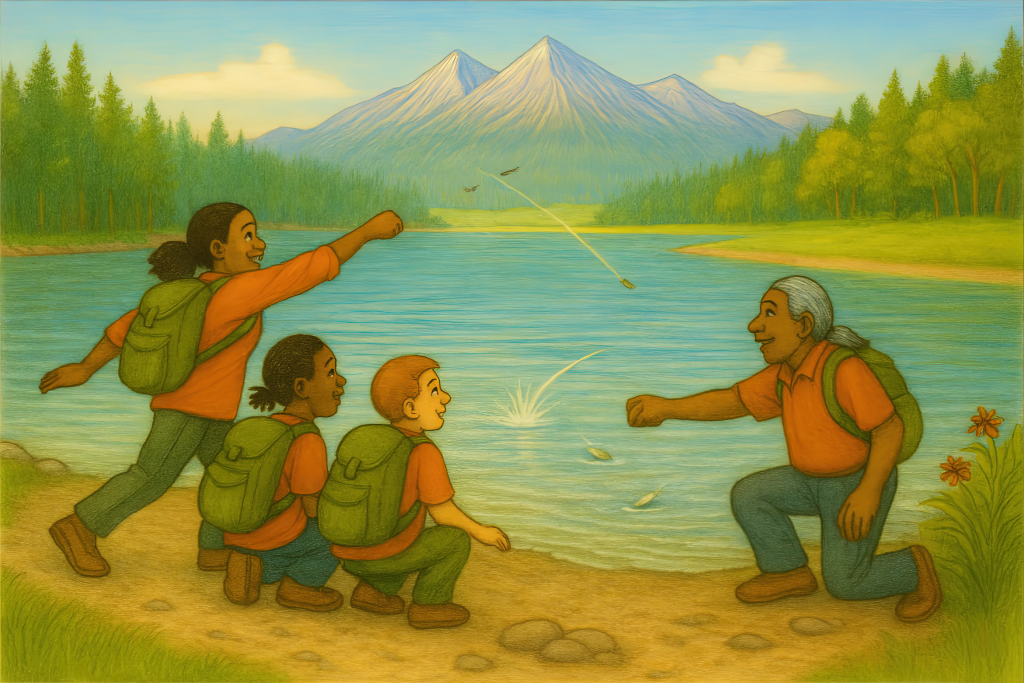
George Talltree stood quietly and watched from a distance as the three children picked up a few pebbles and threw them, one by one into the lake. Their game seemed to be to see who could throw the farthest.
“We’d better get our tents up pretty soon—it’s getting late,” said Mr. W. “But I believe there are three children down there who’ve never skipped a pebble across a lake before… another teaching moment, George?” He smiled at Nia’s grandfather.
“I believe you’re right, Steve. We should go teach them another lesson,” he replied. And off the two men strode to join the kids. Soon all heads were down, searching the shoreline as Mr. W. and Mr. G. taught them how to select the perfect, smooth, flat pebble, and how to angle the pitch to make their stone skip once, twice, three times and more across the surface of pristine, mostly undisturbed Lake Mirage.
“Well, moms,” Jess said with her gaze focused on the playful group by the lake, “drop our packs here and start pitching the tents—or join them? Your choice.”
“Are you kidding?” Betsy chortled as the pack on her back landed with a thud. She sprinted toward the kids’ happy laughter and the skipping stones.
Justine eyed her pack already on the ground, “Nothing here that can’t wait a few minutes,” she said and she and Jess launched their own twenty-yard dash.
Pitching our tents
The play soon ended as if on cue and the tired bunch walked together back to the backpacks scattered here and there as if holding the spot for them until they returned.
“Okay, team,” Jess called out, “time to pitch our tents!”
Malcolm held a tent pole as if it were a javelin. “Okay, Mrs. W. is it time to give our tents a good toss, or should we set them up?”
Jess chuckled as she unstrapped a sleeping bag and pad from Justine’s pack.
“Let’s go with ‘set them up,’ unless we want our sleeping bags in the trees.”
Miles whispered to Nia, “I’d rather not journal from a branch.”
“Unless it’s a really poetic branch,” Nia replied with a smile.
With some guidance from Jess and the rest of the grownups, the kids unrolled their tents, figured out the poles, and slowly transformed the meadow into a cozy little village of canvas and nylon, with a campfire ring in the center.
“Where’d the iron ring come from, Mr. W.?” asked Miles.
“The Park Service placed it here in the clearing for us and other campers to use, and for safety, Miles,” Mr. W. answered. “They maintain our trails, keeping them clear of fallen trees or obstacles. We would have a really hard time getting here if they hadn’t built the trail we followed or the bridge we used to walk across Briar Creek. We’re responsible for cleaning up after ourselves, but the Park Service people make sure it’s clean and tidy for everyone. A Park Ranger may even stop by while we’re here to make sure we’re all okay and that we’re all following the rules. I’m always happy to see them. They do a very good job, but it can be a hard job, as well.”
“I’d like to be a Park Ranger,” said Nia.
“You would be a fine Park Ranger,” Jess smiled. “The way you observe everything and keep your journal—those are already great qualities for a Ranger.
“There are so many fields of study in colleges and universities that relate to Park Service—whole studies focused on forests and forestry management, and all kinds of sciences related to nature and environmental studies,” she said.
“There are many colleges and universities across the country that offer studies in biology, geology, and ecology. There’s even a study called ichthyology—all about fish,” added Mr. W.
“That’s a lot of -ologies, Mr. W.,” Malcolm interjected. “How do I know which one is for me?”
“Well, Malcolm,” Mr. W. said, “you may not know right now, and it may not be what you choose to do later, but at least now, after our hiking adventure, you’ll know more about what’s out here, and what some of the possibilities are. You still have time to decide, but now is the time to explore those possibilities.”
“That makes sense,” Malcolm concluded. “I think I’ll make a list in my journal about all the -ologies and see if I really like any of them.”
They all smiled.
“I love this,” Nia affirmed. “I think being out here in nature is what I really want to do. I love the plants and birds and streams and the big lake. I love those mountains too, and I want to go see them soon. Can we, Grandfather?”
“Yes, ʔəshəliʔ. That should be our next place we go to learn more,” her grandfather, George, replied.
“What’s that word—uh-shuh-lee—you just said, Mr. G.?” asked Miles.
“It’s my native language word for ‘my daughter’,” said George. “It tells her with one word how much I respect her and love her,” he said.
“What’s the same word but for a son, Mr. G.?” Miles’ curiosity was sparked.
“It’s ʔəsx̌il,” George replied in his own language.
“It sounds like un-SHEEL to me,” Miles said. “I’m going to write that word in my journal this evening,” said Miles. “I want to remember it because it’s such a nice word…”
“You may become a linguist or language instructor someday, Miles,” Betsy said.
When Mr. W. made the final rounds to inspect everyone’s tent setup, he noticed that Miles’ tent leaned a little to the left, but Miles stood back proudly. “It’s got character,” he said.
“It does, Miles,” Mr. W. agreed. “And it’s standing. That’s what counts.”
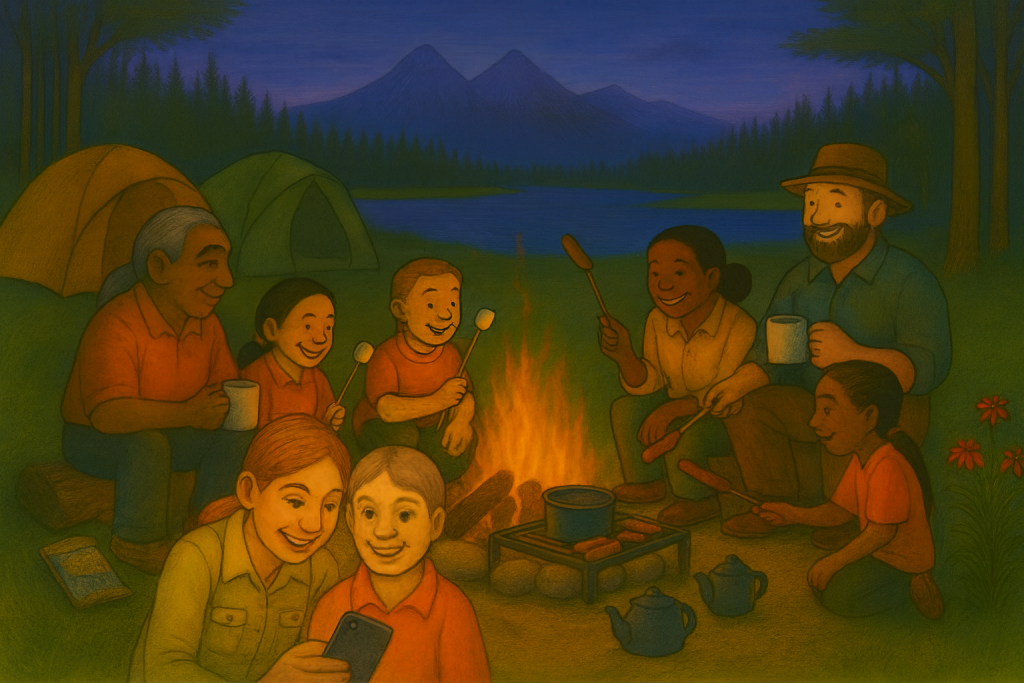
The light was beginning to fade quickly now as all the tents were finally set up and the wood stacked carefully into the campfire ring. The children watched and learned how to begin with kindling consisting of small twigs, dried moss, and even a few small, dry pinecones included. Mr. W. with the help of Mr. G. hand the kindling blazing almost instantly, then carefully place the dry wood needed to keep it fueled. They talked about the process and fire starters and cautioned about the critical attention to safety needed whenever a fire was built anywhere in the wilderness. As soon as the campfire was going, Mr. W. unpacked the hot dogs, baked beans and corn chips they had all helped pack in. He lined them up on the fire grate, enough for everyone to have two if they wanted. Jess placed a kettle of water alongside and soon enough, the water began to boil as hot dogs sizzled and sweet baked beans bubbled. Slightly flattened hot dog buns appeared along with small camp bottles of ketchup, mustard, and relish.
Conversation ceased as hungry hikers munched and crunched their chips, devouring everything on their plates.
“Those were the best hot dogs ever!” Malcolm announced. “They were so good, I’ll never eat another one,” he said, rubbing his full stomach.
“And I know that won’t last until we get home, Malcolm!” Justine said.
Everyone agreed that they felt the same as Malcolm.
Next packets of hot chocolate came out, and, as darkness surrounded them, Jess passed out sticks for marshmallow toasting with graham crackers and chocolate bars on the side for smores. Laughter and happy chatter filled the camp as sticky fingers built delicious campfire treats.
Finger and trash cleanup completed, their meal ended with mugs of hot chocolate and mini marshmallows.
As the fire crackled, a slight chill crept in, and jackets came on. The lake whispered nearby accompanied by a far-off owl and frog-chorus from the lake’s edge.
Campfire Caution
“Nia, you won our Trailblazer Game today. How would you like to lead our discussion tonight?” Mr. W. asked.
“Well…,” Nia began shyly. “To me, the forest walk was beautiful and peaceful, but it also seemed very big—like it was powerful. I felt like I was part of it, but it was still much bigger than me. Even though I knew I was with everyone, and Mr. and Mrs. W. know the way, I got a scared feeling once on the trail. If I were alone—in the woods, away from the trail—I don’t think I’d be able to find my way.
“That’s how I felt for just a little bit, like I was lost in those very big trees. Then I remembered my grandfather was with me, and Mr. and Mrs. W. both knew the way. I want to be like them. I want to know what it’s like to find my way.”
The group paused, reflecting on her words. Malcolm visibly shivered at the thought of being lost, before other voices chimed in with their own thoughts and experiences.
Mr. W. listened quietly, then leaned in toward the fire.
“You’re right about the forest being a powerful place, Nia. There’s so much going on around us when we’re out there that we’re not always aware of its ability to take charge. That’s why we have some rules—tried and tested over time—to help us find our way.”
“If you’re ever lost in the woods, whether with a group or hiking alone, the first thing you need to do is stop.”
“S.T.O.P.—easy to remember.”
S is for Stop. Don’t keep walking. You need that quiet moment.
T is for Think. What do you remember about where you were last?
O is for Observe. Take a breath. Look around. Do you see a familiar landmark? Can you hear your group? A stream?
P is for Plan. Stay put, make yourself visible, and wait for help.
“Let’s go over it one more time,” Mr. W. said.
“S stands for?”
“Stop!” everyone shouted.
“T means…”
“Think!”
“O is for…”
“Observe!”
“And P tells us to…”
“Plan!”
“Remember, you’re not alone here. So don’t panic. We always look for each other. Nia led us to this discussion so beautifully. Thank you, Nia. Good job!”
Everyone clapped.
“Thanks, Mr. W. I think I’ll feel a little safer now—like I can find my way if I have to,” Nia said.
“I’m going to remember S.T.O.P.,” Malcolm added. “I think I’ll write it in my journal tonight.”
Story of the Forgotten Flight
“This talk of getting lost reminds me of a story told to me by a good friend on one of our river adventures when we were young—just a little older than you,” George said. “Stories are important in our culture. This one is a reminder to plan before you go into the wilderness. Would you like to hear it?”
“Yes!” they all echoed.
“This really happened many years ago, now. It’s about a boy named Jerry. At the time, he was a little older than you three young people are, and very brave—but maybe a little too brave. One winter, he had someone fly him deep into the Alaskan wilderness with all the supplies he thought he’d need to stay the winter trapping season in an old trapper’s cabin. He had his ingress planned—the way in. But he forgot something important: he didn’t plan his egress—the way out.”
“Is that a word from your language, Mr. G.?” Miles asked.
“No, that’s Latin, used in English,” George replied.
“Jerry forgot something very important—he forgot to ask the pilot to come back for him in the spring. And since he hadn’t hiked in, there was no trail to follow home. He didn’t bring a map or compass. He knew roughly where he was, but not how far from anyone else.
“The snow came. He hunted and trapped through the winter. But as spring arrived, his supply of food ran out. The game was scarce. Jerry was stuck, hungry, and alone. He realized he hadn’t planned well. He told himself that if he survived, he’d never let it happen again.”
Mr. W. poked the fire. “So how did Jerry survive?”
“It was during what the Native Alaskans call the starving time—when even wild animals are hungry—that a boy from a nearby village saw a puff of smoke from the cabin. He didn’t know Jerry was there, but he went to check.
“That boy’s name was Kevin, a member of the Athabaskan Den’ani people. Young Kevin and his family saved Jerry’s life. They took him in and taught him how, over many generations, they had learned to survive in wild Alaska. They made him part of their family.”
“Jerry learned a big lesson that winter. And now I’m passing his story on to you, so you’ll remember what he forgot: always have a plan to get to safety before you go into the wilderness.”
“That’s part of being oriented,” Jess said. “What a great story. Thank you, Mr. G. Does Jerry have other stories to tell?”
“Yes. He has so many, that he wrote a book…”
“I don’t know about anyone else,” Betsy yawned, “but I am very tired.”
“I think we’re all a little tired,” Mr. W. agreed, as yawns spread around the fire. “Time to bank the campfire and call it a night. We’ve got short day hikes tomorrow and a lot to see.”
“Goodnight, everyone!”
Jackets rustled. Sleeping bags unrolled. The fire crackled low.
The lake whispered, and the stars blinked on.