Category: Station WIL ~ What It’s Like

  • Campfire Light

    Chapter 3

    Campfire Light, Story Glow
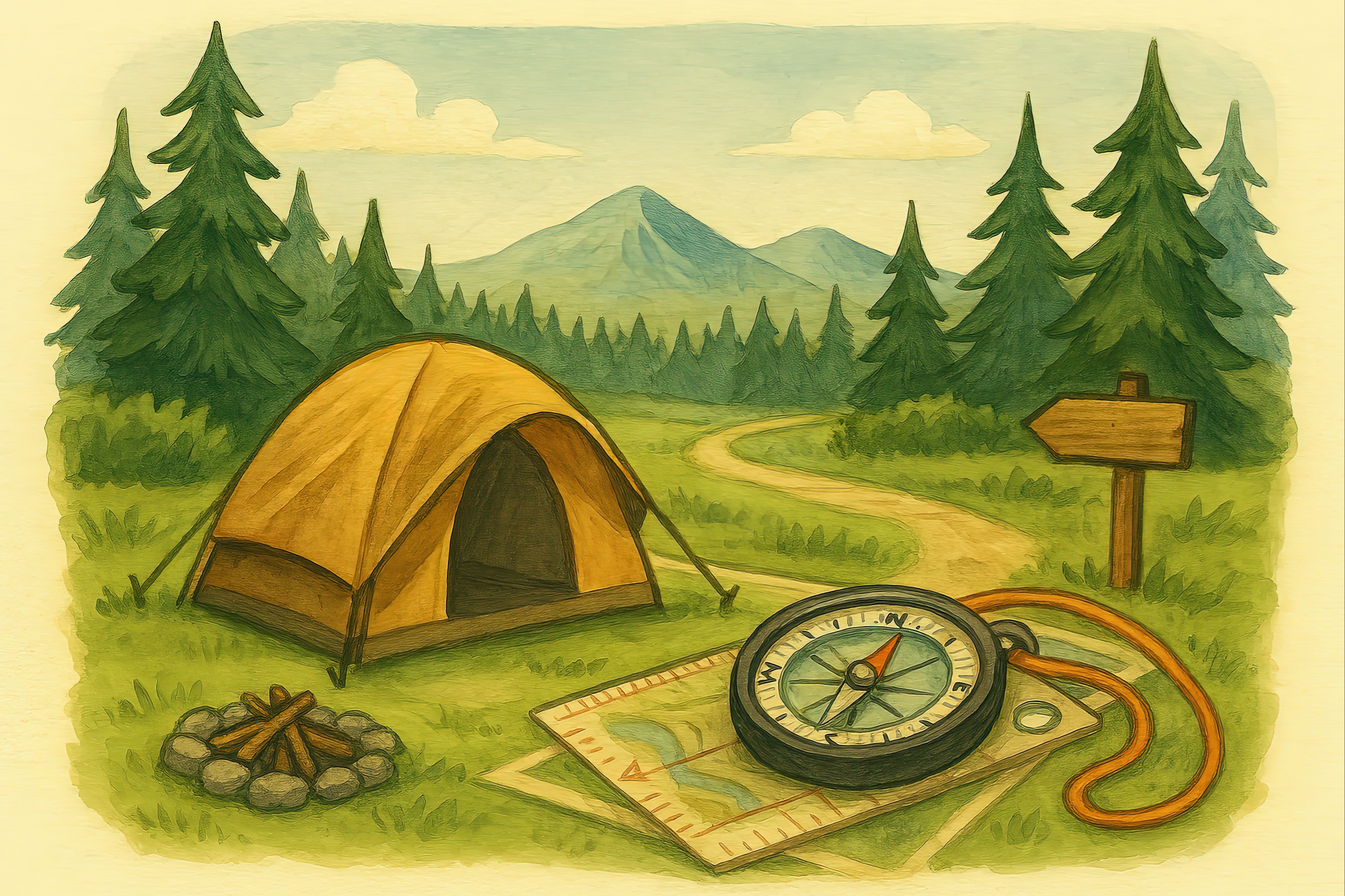
    Camping scene with yellow tent, map, compass, and campfire on grassy clearing. Dirt path leads to forest and mountains under clear sky. Evokes outdoor adventure, navigation, and peaceful exploration.


    Suddenly the low shrubs opened to the view of a crystal-clear blue mountain lake surrounded by forests on the far side and a soft green meadow before them. A sandbar on the shoreline invited their curiosity.
    Feeling free from the constraint of the forest trail, as one, the children raced to be the first one there.
    “It’s so beautiful,” Justine said as she breathed deeply of the clear mountain air. “And it smells like nothing else I’ve ever smelled. It’s so clean and… and undisturbed by anything other than the trees and lake—and those mountains,” she added, pointing across Mirage Lake.
    Mr. and Mrs. W. smiled broadly.
    “This is why we do this,” Jess said. “We love helping kids and families who may never have another chance to experience this—see what we see—and understand how important it is. In an ever-changing, technologically advanced culture, we want to value this and show kids how vital it is to our survival, as well as our happiness.”
    “I see it now,” said Justine. “And I think Malcolm is really getting the idea, too. Even though we’re from a culturally rich part of the country—around the Blue Ridge Mountains—our family is busy. We don’t go exploring anywhere! I think that’s going to change now.”
    Miles’ mom, Betsy, added, “Miles and I explore occasionally, but we go to very local places around Calgary. Because it’s just Miles and me, we haven’t gone very far into the wilderness, but there are hiking tours that we could take there, and I think we will begin to do more of that now that this door to explorer side has opened up. We’re both learning so much—how to explore, what to look for, and how to be safe while we’re on an adventure!”
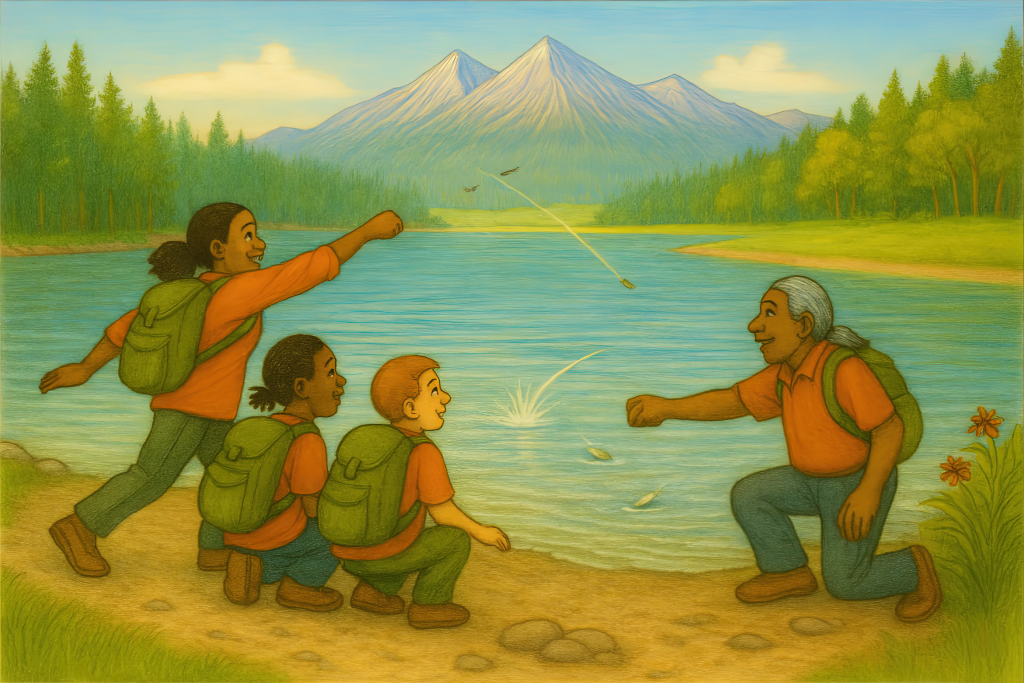
    George Talltree stood quietly and watched from a distance as the three children picked up a few pebbles and threw them, one by one into the lake. Their game seemed to be to see who could throw the farthest.
    “We’d better get our tents up pretty soon—it’s getting late,” said Mr. W. “But I believe there are three children down there who’ve never skipped a pebble across a lake before… another teaching moment, George?” He smiled at Nia’s grandfather.
    “I believe you’re right, Steve. We should go teach them another lesson,” he replied. And off the two men strode to join the kids. Soon all heads were down, searching the shoreline as Mr. W. and Mr. G. taught them how to select the perfect, smooth, flat pebble, and how to angle the pitch to make their stone skip once, twice, three times and more across the surface of pristine, mostly undisturbed Lake Mirage.
    “Well, moms,” Jess said with her gaze focused on the playful group by the lake, “drop our packs here and start pitching the tents—or join them? Your choice.”
    “Are you kidding?” Betsy chortled as the pack on her back landed with a thud. She sprinted toward the kids’ happy laughter and the skipping stones.
    Justine eyed her pack already on the ground, “Nothing here that can’t wait a few minutes,” she said and she and Jess launched their own twenty-yard dash.

    The play soon ended as if on cue and the tired bunch walked together back to the backpacks scattered here and there as if holding the spot for them until they returned.
    “Okay, team,” Jess called out, “time to pitch our tents!”
    Malcolm held a tent pole as if it were a javelin. “Okay, Mrs. W. is it time to give our tents a good toss, or should we set them up?”
    Jess chuckled as she unstrapped a sleeping bag and pad from Justine’s pack.
    “Let’s go with ‘set them up,’ unless we want our sleeping bags in the trees.”
    Miles whispered to Nia, “I’d rather not journal from a branch.”
    “Unless it’s a really poetic branch,” Nia replied with a smile.
    With some guidance from Jess and the rest of the grownups, the kids unrolled their tents, figured out the poles, and slowly transformed the meadow into a cozy little village of canvas and nylon, with a campfire ring in the center.
    “Where’d the iron ring come from, Mr. W.?” asked Miles.
    “The Park Service placed it here in the clearing for us and other campers to use, and for safety, Miles,” Mr. W. answered. “They maintain our trails, keeping them clear of fallen trees or obstacles. We would have a really hard time getting here if they hadn’t built the trail we followed or the bridge we used to walk across Briar Creek. We’re responsible for cleaning up after ourselves, but the Park Service people make sure it’s clean and tidy for everyone. A Park Ranger may even stop by while we’re here to make sure we’re all okay and that we’re all following the rules. I’m always happy to see them. They do a very good job, but it can be a hard job, as well.”
    “I’d like to be a Park Ranger,” said Nia.
    “You would be a fine Park Ranger,” Jess smiled. “The way you observe everything and keep your journal—those are already great qualities for a Ranger.
    “There are so many fields of study in colleges and universities that relate to Park Service—whole studies focused on forests and forestry management, and all kinds of sciences related to nature and environmental studies,” she said.
    “There are many colleges and universities across the country that offer studies in biology, geology, and ecology. There’s even a study called ichthyology—all about fish,” added Mr. W.
    “That’s a lot of -ologies, Mr. W.,” Malcolm interjected. “How do I know which one is for me?”
    “Well, Malcolm,” Mr. W. said, “you may not know right now, and it may not be what you choose to do later, but at least now, after our hiking adventure, you’ll know more about what’s out here, and what some of the possibilities are. You still have time to decide, but now is the time to explore those possibilities.”
    “That makes sense,” Malcolm concluded. “I think I’ll make a list in my journal about all the -ologies and see if I really like any of them.”
    They all smiled.
    “I love this,” Nia affirmed. “I think being out here in nature is what I really want to do. I love the plants and birds and streams and the big lake. I love those mountains too, and I want to go see them soon. Can we, Grandfather?”
    “Yes, ʔəshəliʔ. That should be our next place we go to learn more,” her grandfather, George, replied.
    “What’s that word—uh-shuh-lee—you just said, Mr. G.?” asked Miles.
    “It’s my native language word for ‘my daughter’,” said George. “It tells her with one word how much I respect her and love her,” he said.
    “What’s the same word but for a son, Mr. G.?” Miles’ curiosity was sparked.
    “It’s ʔəsx̌il,” George replied in his own language.
    “It sounds like un-SHEEL to me,” Miles said. “I’m going to write that word in my journal this evening,” said Miles. “I want to remember it because it’s such a nice word…”
    “You may become a linguist or language instructor someday, Miles,” Betsy said.
    When Mr. W. made the final rounds to inspect everyone’s tent setup, he noticed that Miles’ tent leaned a little to the left, but Miles stood back proudly. “It’s got character,” he said.
    “It does, Miles,” Mr. W. agreed. “And it’s standing. That’s what counts.”
    The light was beginning to fade quickly now as all the tents were finally set up and the wood stacked carefully into the campfire ring. The children watched and learned how to begin with kindling consisting of small twigs, dried moss, and even a few small, dry pinecones included. Mr. W. with the help of Mr. G. hand the kindling blazing almost instantly, then carefully place the dry wood needed to keep it fueled. They talked about the process and fire starters and cautioned about the critical attention to safety needed whenever a fire was built anywhere in the wilderness. As soon as the campfire was going, Mr. W. unpacked the hot dogs, baked beans and corn chips they had all helped pack in. He lined them up on the fire grate, enough for everyone to have two if they wanted. Jess placed a kettle of water alongside and soon enough, the water began to boil as hot dogs sizzled and sweet baked beans bubbled. Slightly flattened hot dog buns appeared along with small camp bottles of ketchup, mustard, and relish.
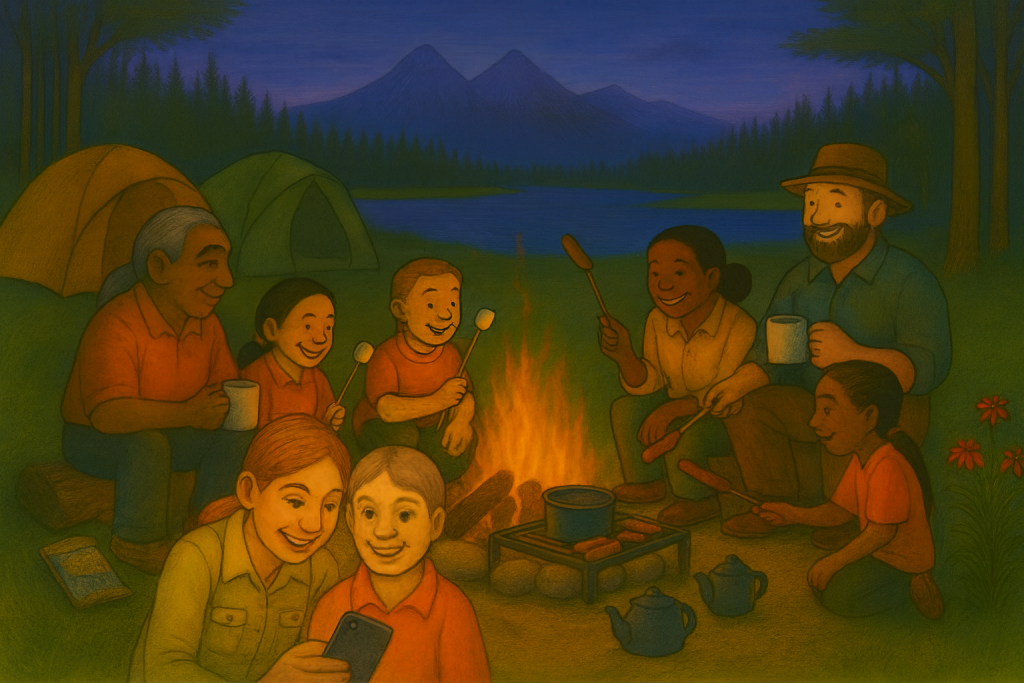
    Conversation ceased as hungry hikers munched and crunched their chips, devouring everything on their plates.
    “Those were the best hot dogs ever!” Malcolm announced. “They were so good, I’ll never eat another one,” he said, rubbing his full stomach.
    “And I know that won’t last until we get home, Malcolm!” Justine said.
    Everyone agreed that they felt the same as Malcolm.
    Next packets of hot chocolate came out, and, as darkness surrounded them, Jess passed out sticks for marshmallow toasting with graham crackers and chocolate bars on the side for smores. Laughter and happy chatter filled the camp as sticky fingers built delicious campfire treats.
    Finger and trash cleanup completed, their meal ended with mugs of hot chocolate and mini marshmallows.
    As the fire crackled, a slight chill crept in, and jackets came on. The lake whispered nearby accompanied by a far-off owl and frog-chorus from the lake’s edge.

    “Nia, you won our Trailblazer Game today. How would you like to lead our discussion tonight?” Mr. W. asked.
    “Well…,” Nia began shyly. “To me, the forest walk was beautiful and peaceful, but it also seemed very big—like it was powerful. I felt like I was part of it, but it was still much bigger than me. Even though I knew I was with everyone, and Mr. and Mrs. W. know the way, I got a scared feeling once on the trail. If I were alone—in the woods, away from the trail—I don’t think I’d be able to find my way.
    “That’s how I felt for just a little bit, like I was lost in those very big trees. Then I remembered my grandfather was with me, and Mr. and Mrs. W. both knew the way. I want to be like them. I want to know what it’s like to find my way.”
    The group paused, reflecting on her words. Malcolm visibly shivered at the thought of being lost, before other voices chimed in with their own thoughts and experiences.
    Mr. W. listened quietly, then leaned in toward the fire.
    “You’re right about the forest being a powerful place, Nia. There’s so much going on around us when we’re out there that we’re not always aware of its ability to take charge. That’s why we have some rules—tried and tested over time—to help us find our way.”
    “If you’re ever lost in the woods, whether with a group or hiking alone, the first thing you need to do is stop.”
    “S.T.O.P.—easy to remember.”
    S is for Stop. Don’t keep walking. You need that quiet moment.
    T is for Think. What do you remember about where you were last?
    O is for Observe. Take a breath. Look around. Do you see a familiar landmark? Can you hear your group? A stream?
    P is for Plan. Stay put, make yourself visible, and wait for help.
    “Let’s go over it one more time,” Mr. W. said.
    “S stands for?”
    “Stop!” everyone shouted.
    “T means…”
    “Think!”
    “O is for…”
    “Observe!”
    “And P tells us to…”
    “Plan!”
    “Remember, you’re not alone here. So don’t panic. We always look for each other. Nia led us to this discussion so beautifully. Thank you, Nia. Good job!”
    Everyone clapped.
    “Thanks, Mr. W. I think I’ll feel a little safer now—like I can find my way if I have to,” Nia said.
    “I’m going to remember S.T.O.P.,” Malcolm added. “I think I’ll write it in my journal tonight.”

    “This talk of getting lost reminds me of a story told to me by a good friend on one of our river adventures when we were young—just a little older than you,” George said. “Stories are important in our culture. This one is a reminder to plan before you go into the wilderness. Would you like to hear it?”
    “Yes!” they all echoed.
    “This really happened many years ago, now. It’s about a boy named Jerry. At the time, he was a little older than you three young people are, and very brave—but maybe a little too brave. One winter, he had someone fly him deep into the Alaskan wilderness with all the supplies he thought he’d need to stay the winter trapping season in an old trapper’s cabin. He had his ingress planned—the way in. But he forgot something important: he didn’t plan his egress—the way out.”
    “Is that a word from your language, Mr. G.?” Miles asked.
    “No, that’s Latin, used in English,” George replied.
    “Jerry forgot something very important—he forgot to ask the pilot to come back for him in the spring. And since he hadn’t hiked in, there was no trail to follow home. He didn’t bring a map or compass. He knew roughly where he was, but not how far from anyone else.
    “The snow came. He hunted and trapped through the winter. But as spring arrived, his supply of food ran out. The game was scarce. Jerry was stuck, hungry, and alone. He realized he hadn’t planned well. He told himself that if he survived, he’d never let it happen again.”
    Mr. W. poked the fire. “So how did Jerry survive?”
    “It was during what the Native Alaskans call the starving time—when even wild animals are hungry—that a boy from a nearby village saw a puff of smoke from the cabin. He didn’t know Jerry was there, but he went to check.
    “That boy’s name was Kevin, a member of the Athabaskan Den’ani people. Young Kevin and his family saved Jerry’s life. They took him in and taught him how, over many generations, they had learned to survive in wild Alaska. They made him part of their family.”
    “Jerry learned a big lesson that winter. And now I’m passing his story on to you, so you’ll remember what he forgot: always have a plan to get to safety before you go into the wilderness.”
    “That’s part of being oriented,” Jess said. “What a great story. Thank you, Mr. G. Does Jerry have other stories to tell?”
    “Yes. He has so many, that he wrote a book…”
    “I don’t know about anyone else,” Betsy yawned, “but I am very tired.”
    “I think we’re all a little tired,” Mr. W. agreed, as yawns spread around the fire. “Time to bank the campfire and call it a night. We’ve got short day hikes tomorrow and a lot to see.”
    “Goodnight, everyone!”
    Jackets rustled. Sleeping bags unrolled. The fire crackled low.
    The lake whispered, and the stars blinked on.
  • “Hike On”

    Chapter 2 ~

    “Hike On!” Our First Day on the Trail

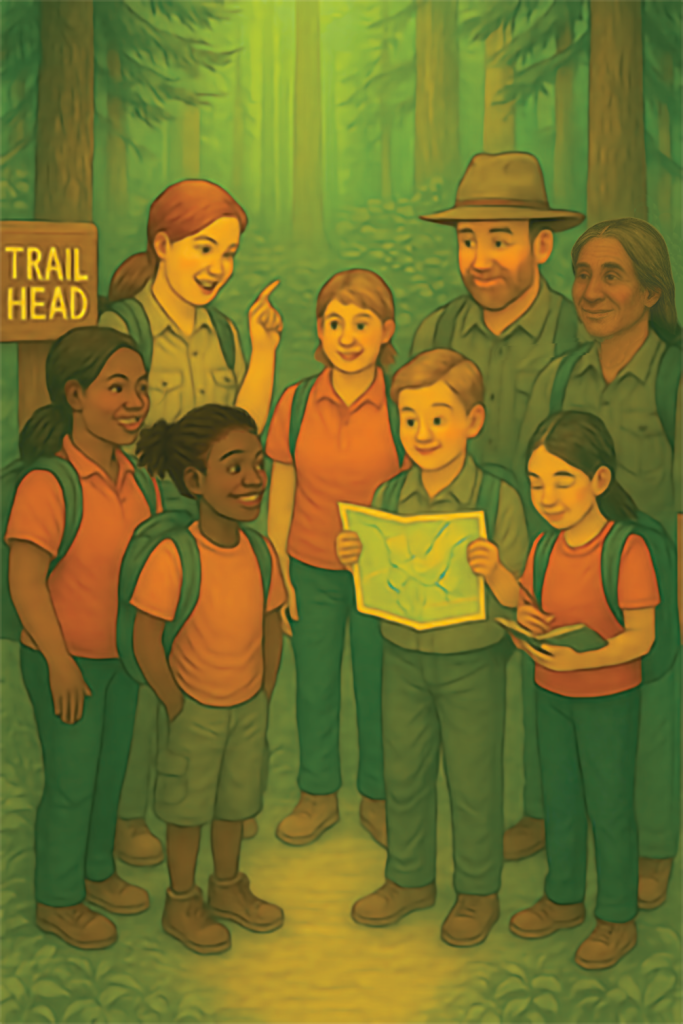
    The morning sun filtered through the cedar trees as Trail Guides, Steve and Jess West, met the small group at the trailhead. “Hello, everyone!” Said Jess as Steve echoed with “Goodmorning!”
    Though they’d all met the evening before at the lodge, this was the first time they’d all stood together beneath the trees, ready to begin. After everyone introduced themselves, Steve, or as the kids called him, Mr. W., unfolded a very detailed trail map and Jess passed smaller copies of the same map to all the hikers.
    “Does anyone know the word, ‘orienting’ or what it means to be oriented?” Jess asked the group of curious young faces and smiling parents as she handed the last map to Justine, Malcolm’s mom.
    “I do!” Miles raised his hand and shouted gleefully. “It means to know what’s going on around you!”


    “Yes,” Jess smiled back. “It means being aware of what’s around you—and especially, where you are!”
    “We call this ability to find ourselves along our path and to know the way we need to go, ‘orienteering.’ And a big part of orienteering is knowing our surroundings, which way we’re going, and how to find our way safely home. For us, it’s going to also include some, Uh-oh! I think I’m lost! rules and basically how we find you, or how you—with all that you know about what’s around you—find your way.”
    “This is important,” said Mr. W., “and we’ll go over a few things now, and talk a little more about how we help ourselves to find our way as we hike the trail.”
    “Did everyone bring their compass?” Jess asked, and everyone nodded, yes—even the parents had theirs!
    “Great!” said Mr. W. “So, gather around close as we go over our map and take a good look at our trail. It’s very important to have this picture in our mind, as well as on the map. We really want to know what our surroundings look like, so we’re not surprised by anything. That’s the first step in orienteering. Let’s look at the map and see what information it contains…”
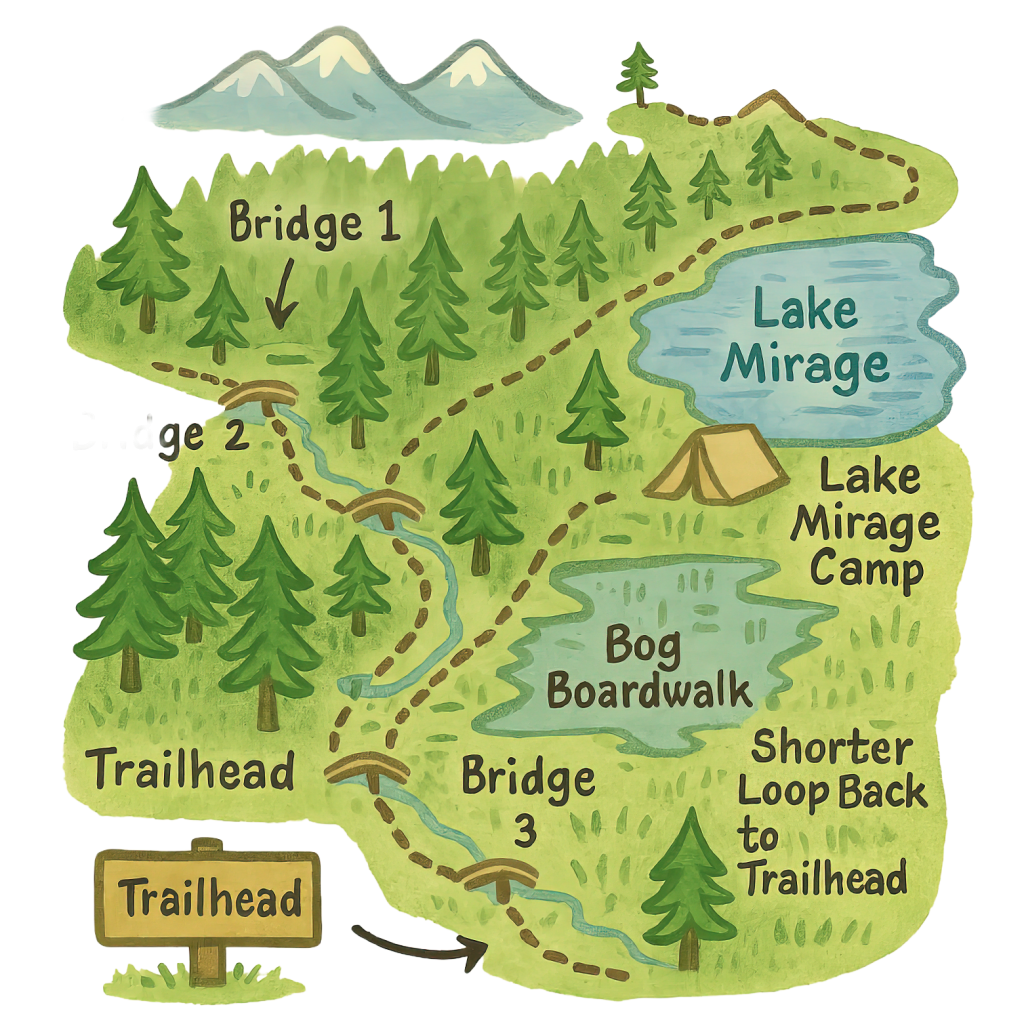
    “This is the Trailhead,” he pointed to the spot clearly marked on the map. “This is where we are right now. It’s the place where our hike begins and where it ends, as well. This kind of trail is what’s called a loop trail. We made each one of you a small copy of this map, we want you to keep it with you all the time we’re on our hike! Let’s look over it before we get started, so you all know where we’re going, and where we want to safely return to in three days after we finish our hike and wilderness camping.”
    “Is everyone ready!” Mr. W. asked the group. “I’m ready!” said Nia.
    How long will we hike this morning, Mr. W.? Malcolm asked.
    “Well, it will probably take us about two hours to hike about two miles before we get to our first rest stop this morning. Our pace, or the length of trail we walk in a certain amount of time, will be about a mile an hour. Think of our pace as sort of like how far and how fast a car travels, which we measure in miles per hour. But we have a lot of things to see and talk about as we go. Since our hike is designed to discover new things, we’re not trying to walk at a fast pace. Our pace will be slow—we want to look and listen and even touch new things as we go. That takes time.
    “Our hiking adventure begins here at our trailhead [CN1], we’ll hike for two miles before we take our first rest stop and connect to Station WIL using our satellite connection. It looks like we have everything packed and ready, so let’s get going now. We have so much more to see this morning before we stop to call Patty and Teo at their Ranger Station studio on the other side of the country! Everyone ready? Let’s go!”

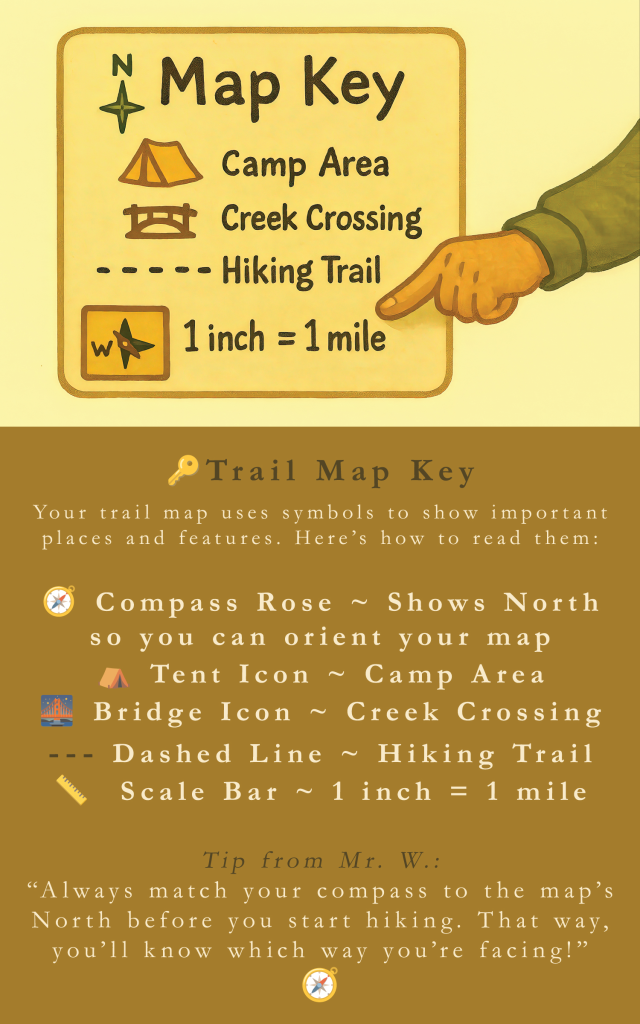
    A visual legend for interpreting the trail map. Includes a green compass rose (North), tent symbol (Camp Area), bridge icon (Creek Crossing), dashed line (Hiking Trail), and directional compass with scale (“1 inch = 1 mile”).


    As parents helped kids adjust their backpacks, the five adults and three kids stepped into the dense cedar forest and onto the trail.
    Immediately, the light dimmed as the tight canopy of ancient trees enveloped them. The air was clean and filled with the fragrance of the soft forest floor covered in pine needles dotted with pinecones and twigs. Here and there, where it was able to catch a beam of light, a lovely green rhododendron abounded in glistening broad-leaf beauty. The stillness was contagious as the group hiked further along the narrow trail in silence for several minutes, until they came to a spot where the trail broadened and they were able to gather in a small group once more.
    “We always like to begin our hike in silence,” said Jess. “It gives us a moment to become…what’s our word?” she asked the group in general.
    “Oriented!” beamed Malcolm.
    Jess nodded, returning Malcolm’s happy smile.
    “We want to take some time to get to know where we are and what it feels like to be there,” Malcolm added.
    “But why should we always be quiet?” Miles asked.
    “Because that’s how we can listen to everything there,” answered Nia. “We need to know if we’re alone in the woods or there’s someone or something close by. Like a squirrel or fox!” she added as her grandfather smiled with pride.
    “We also want to pay attention to how everything smells,” said Mr. W. “Smells brought to us on the wind can tell us if everything is okay up ahead of us or even behind us. We need to know these things to keep ourselves safe.”
    The group stood quietly testing the slight breeze filtering through the forest.
    “It smells like the earth should smell,” said Nia. “Like it’s old and kind and good.”
    “Yes,” said Nia’s grandfather, George Talltree. “Look at these ancient trees,” he pointed to one of the giants close by with its trunk so wide that two children could barely wrap their arms around it. The bark was deeply furrowed, soft to the touch, and carried the scent of rain and time. High above, the canopy filtered sunlight into shifting patches, dappling the trail with gleaming white light and shadow. The children could see glistening dust particles and tiny insects floating through the beams.
    “Look at this!” cried Malcolm as he gently pushed his feet into the plush forest floor beside the trail. Everyone began to look at the ground now, searching as if really seeing it for the first time. The forest understory whispered with life—ferns curled like question marks, moss blanketed fallen logs, and tiny mushrooms peeked from the pine-needle carpet. A squirrel chattered somewhere overhead, unseen but clearly unimpressed by the small gathering below.
    After a few minutes, Jess knelt beside a mossy stump and placed her compass flat. “Let’s take a moment to check our bearings,” she said. “Who remembers how to match the compass needle to North?”
    Malcolm crouched beside her, eyes bright. “We turn the dial until the red needle lines up with the N,” he said.
    “Exactly,” Jess smiled. “Now look around. What do you see behind us?”
    Nia turned and pointed. “The trail curves past that big cedar with the broken branch. That’s our backtrail.”
    Mr. W. nodded. “Always know what’s behind you. If you ever need to retrace your steps, your memory of the trail will help you find your way.”
    Miles looked up. “So, we’re not just hiking forward—we’re remembering backward too?”
    “Exactly,” said Jess. “That’s part of being oriented. We know where we are, where we’re going, and how to return to the trailhead or our last safe spot if we need to go there.”
    “Let’s play a game while we hike—we call it the trailblazing game. The person in the lead gets to take us to the next question or stopping point on the trail. After we stop to have our discussion, we switch trailblazers. The one with the most questions gets to lead the trail roundup discussion around the campfire this evening. Who wants to be the first trailblazer now?” asked Mr. W.
    Both Miles’ hands quickly shot up as he jumped along with them.
    “Alright, Miles, why not take the lead until we reach our first question mark on the trail, he laughed. “I’ll be right here behind you if you need help, and Jess will stay behind us all with your mom’s and Nia’s grandfather to make certain we’re all okay. Don’t hesitate to ask that all-important question as we go. We’re on a discovery hike, remember? We want to learn about everything around us, and we can’t learn if we can’t or don’t ask questions, right?”
    “Right!” Everyone chimed in.
    They took about ten steps before Miles pointed to a very leafy green bush beside the trail. The group halted at the bush to listen to Jess. “That’s a rhododendron bush,” she said. “It’s part of the understory of this forest.”


    “What’s an understory?” asked Betsy, Miles’ mom.
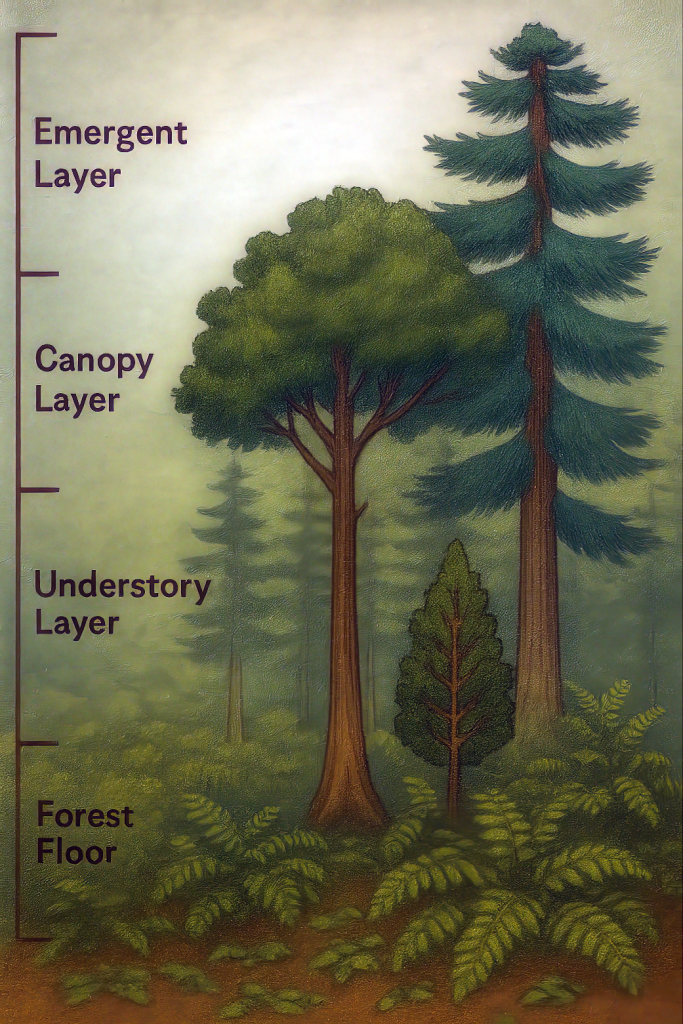
    “While this forest isn’t the same as a jungle forest, just the same, the tops of these tall cedars form a canopy over the forest floor or the ground we walk on, and all the larger plants that grow and thrive in the shade and soil produced by these trees are its understory,” Jess explained. “These plants and the smaller ones in the shrub layer are what help the wildlife survive. Although, every part of the rhododendron plant is poisonous—oh, you can touch it, Malcolm…it’s only poisonous for us to eat any part of—it helps small creatures find hiding places from storms, and when it’s blooming in the spring, the flowers help feed the pollinators—like the bees—allowing them to survive in our forestlands.”
    “The roots of the trees and shrubs keep the soil or what’s called the forest floor soft and allow water to be stored close to the surface during dryer seasons. It produces mist in the mornings in the forest, and it all works together for the good of the plants and animals who call this forest home,” added Mr. W. “Let’s hike on up the trail and see what else we can find. Nia, it’s your turn to lead the way!”
    As they ventured further along the trail, their pace slowed until the wonder of their surroundings brought them all to a standstill.


    The group stood quietly beneath the towering cedars, their trunks wide enough that two children could barely wrap their arms around one. The bark was deeply furrowed, soft to the touch, and carried the scent of rain and time. High above, the canopy filtered sunlight into shifting patches, dappling the trail with gold and shadow.
    At their feet, the forest understory whispered with life—ferns curled like question marks, moss blanketed fallen logs, and tiny mushrooms peeked from the pine-needle carpet. A squirrel chattered somewhere overhead, unseen but clearly unimpressed by the intrusion.
    Jess knelt beside a mossy stump and placed her compass flat. “Let’s take a moment to check our bearings,” she said. “Who remembers how to match the compass needle to North?”
    Malcolm crouched beside her, eyes bright. “We turn the dial until the red needle lines up with the N,” he said.
    “Exactly,” Jess smiled. “Now look around. What do you see behind us?”
    Nia turned and pointed. “The trail curves past that big cedar with the broken branch. That’s our backtrail.”
    Mr. W. nodded. “Always know what’s behind you. If you ever need to retrace your steps, your memory of the trail will help you find your way.”
    Miles looked up. “So, we’re not just hiking forward—we’re remembering backward too?”
    “Exactly,” said Jess. “That’s part of being oriented. We know where we are, where we’re going thanks to our map, and how to return to the trailhead or our last safe spot if we need to go there.”


    As the group moved on again, they noticed the trail had become slightly steeper and they were climbing a little as they hiked. Mr. W. told them that they were headed to the highest point of their trail. “The elevation here is just over 600 feet, so we’re not mountain climbing,” he said. “We’re just walking to the top of this knoll or small hill within this mountain range.”
    The trees thinned a little as the path guided them into a clearing and onto a small rocky knoll where the forest ahead seemed to part before them just so they could take in the spectacular view across the treetops toward the majestic distant mountain peaks. The tallest was still snowcapped, and the sight was breathtaking. Again the group stood in awe as Jess and Mr. W. named the peaks before them, telling their individual stories and mountain legends.
    While the guides talked, Nia found a rock just her size to sit on. She rummaged through her backpack until she found her journal sketchbook and small collection of pencils. With her own artistic eye and hand, she began sketching the scene before her—forest treetops and mountain grandeur. As she worked, the scene began to take shape on her journal page. Nia sketched with the assurance that no one else needed to appreciate her beautiful mountain scene besides herself. Her father watched her work as his studying gaze shifted between her page and the scene before him.
    Malcolm and his mom, Justine, stood with the guides, pointing to the peaks and asking questions about their size and age and how far away they were from them. Miles and his mom stood listening as they talked while taking in every feature of the panorama before them. Miles didn’t want to forget any of this.
    “You should get out your camera and take a picture of this,” Betsy said. “Although the picture is never as perfect as seeing it for yourself, that photo will help to always bring the scene back to you. Here. Let me help you get your camera out of your backpack.”
    [IMG: Visual needed for this scene.]
    “We should call Patty and Teo at Ranger Station WIL from here, Mr. & Mrs. W., Miles said after his final photo. They would probably like to see all this too!”
    “That’s a great idea, Miles!” said Jess. We’re out of the trees and up high enough that we should get a good satellite connection from here,” she added.
    Mr. W. helped get the mini satellite dish set up on one of the largest rocks while Jess unpacked the laptop.
    The clearing was rocking enough that the laptop had its own rock to rest on and the kids each had a seat to sit on. Malcolm and Miles’ moms had their own rock chairs while Steve and Jess chose to stand behind the group so everyone could be on camera. It was a perfect setup for a perfect scene. Jess checked all the angles and made certain she could get the laptop back to the same position after they moved it to show Teo and Patty their surroundings.
    “This is going to be awesome!” Malcolm cheered.


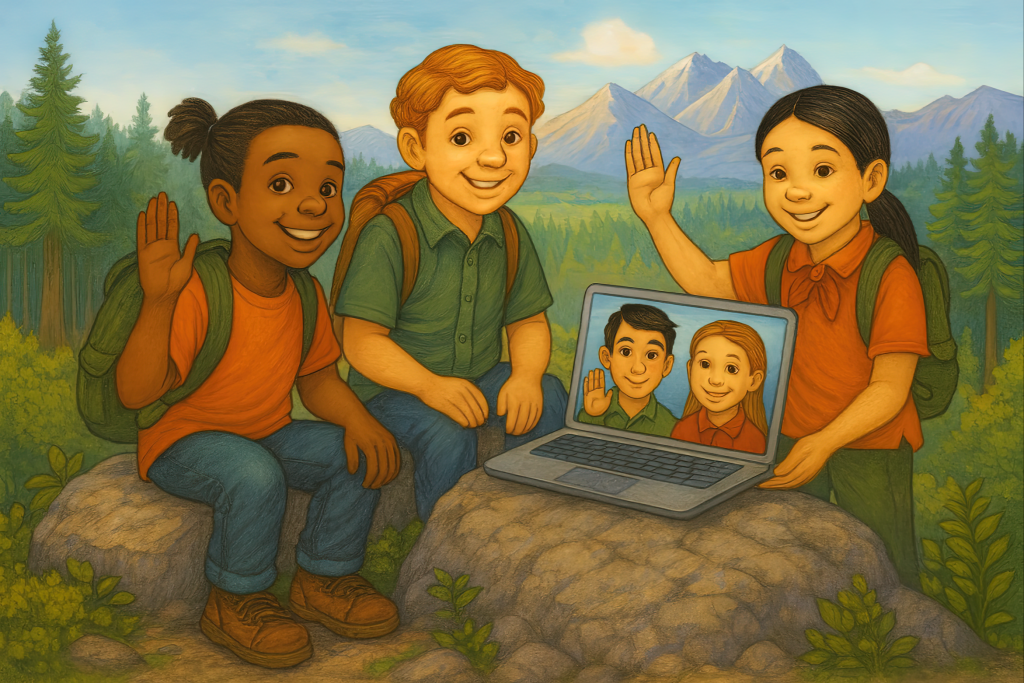
    With the satellite connection established, the group gathered around the laptop as Jess initiated the video call to reporting rangers Patty and Teo at Ranger Station WIL. The screen flickered to life, and soon familiar faces appeared, smiling and ready to hear all about their morning hike.

    Three children—Malcolm with a small ponytail, Miles, and Nia—gather on a rocky knoll in a forest clearing, surrounded by lush greenery and distant mountain peaks under a clear blue sky. Nia holds a laptop showing Teo and Patty waving from the screen. The scene captures a joyful moment of outdoor learning, situational awareness, and connection, blending nature with digital storytelling.


    Patty greeted them warmly, “Hello, everyone! It’s wonderful to see you all out there in the forest. How’s the hike going so far?”
    Malcolm, Miles, and Nia were so excited and had so many things to tell, that they hardly knew where to begin, so they sat quietly beaming at the image of Teo and Patty for just a moment until Steve spoke up. He shared their progress, and Jess suggested the kids begin by telling Teo and Patty where they were right now and the breathtaking views from the knoll.
    Nia was the first to move and she got up and picked up the laptop to pan the camera around their knoll to the far off mountains, but first a look back at the forest they had just walked out of.
    This is where we came from, Teo and Patty. We were in that forest and we walked out onto this hill or knoll where we are now,” she said as she panned the camera back to everyone seated on the rocks. They all smiled and waved.
    “…and this is what we’re looking at right now,” Malcolm hopped up as he took charge being the ranger’s anchorman and tour guide. He stretched his arm toward the faraway mountain vista and stepped aside as Nia moved the camera closer to the edge of the rocky knoll. Miles hopped to the side of the camera shot to begin a report on why it’s so important to know all about your surrounds.
    “Mr. W. said that Alaskan Bush Pilot and adventurer Jerry Jacques said it’s all about situational awareness. ‘What’s going on all around us, no matter where we are!”
    Jess popped in and quietly took the laptop camera while Nia jumped into the shot, as well. “We have to know where we’re going—looking ahead—but look back and remember our backtrail, too!” Nia said. “We learned so much this morning. I hope I can remember it all.”
    “We looked at maps this morning and studied them, and how to use our compass with our maps. Mr. W. said there’s lots and lots more to know about ‘orienteering’ but we’re learning some basic stuff. We can always study and look for more information on the internet to become better orienteers,” he said.
    “We studied about those big cedar trees and what was in the forest we were walking through. We learned about the big trees being a canopy and the smaller bushes being part of the understory,” Nia said proudly of her new knowledge.
    “We even learned the names of some of the bushes like rhododendron and studied the ferns and mushrooms and moss that are what Mrs. W. called part of the ‘forest floor,’” said Miles.
    “Wow! You guys are learning so much!” I wish we were there with you!” Teo said as Jess kept the camera focused on the three smiling faces, beaming broadly before a background of lush treetops and majestic mountains.
    “It sounds like you’re having so much fun while you’re learning all this new stuff about the forest and wilderness, too,” Patty chimed in.
    “Yeah! We even played a game to see who could lead the way on the trail and ask questions. We learned a lot just by asking questions,” Miles said. “I think Nia won, so she gets to lead the campfire chatter tonight.”
    “Well, we have a better understanding of your trail so far,” said Teo, “and we want to hear so much more this evening when we have our own virtual campfire chatter on our Teams connection. We better sign out for now because we don’t want to run your laptop battery too low.”
    “We can’t wait to hear more this evening, and we’ll let you know what our fans think about this broadcast report. Till then, thank you everyone, and stay oriented and happy on your trail!”
    “Hike on!” became their signoff and the rallying cry for the hikers to get going again.
    After their lively exchange, and the group said their goodbyes, they were all feeling more connected and inspired to continue their adventure. Jess carefully packed the satellite equipment then checked her watch, and before they all got up, she announced: “It’s 11:30, just a little early, but I think this would be a perfect spot for our lunch break. We still have a few miles to go before we get to our campsite, but I think it would be a good idea to have our trail lunch now and perhaps get to our campsite a little early. There’s lots of stuff to see there, too, and we could all use a little food fuel to keep us going…right?”
    “Right!!!” Three very lively kids and three not-so-lively parents chimed in as one.
    Lunchtime on the beautiful rocky hilltop was perfect with cool water to drink, tuna fish and peanut butter and jelly sandwiches, some mixed-nut trail mix and dried-fruit snacks to polish it off. At the end of their meal, everyone began their own cleanup into special trash bags they brought with them in their packs. Each pack had become just a little lighter now as some of their food was consumed, so carrying their trash out with them added nothing new to the weight of their packs.
    “Alright, hikers,” Mr. W. said as they finished their cleanup, “let’s get our backpacks strapped and hike on. We have more trails to explore and more discoveries ahead! We’re scheduled to get back to them tomorrow evening while we’re around our campfire. There is a big time difference between where we are here on the trail in Oregon and where they’re located in southern Pennsylvania. They are actually four hours ahead of us. So, we’ll call first thing in the evening after we complete our day hikes to update them on our progress. But, for today, let’s keep hiking. We want to have plenty of time this evening to pitch our tents and get our campfire going before dark.”
    Malcolm exchanged a puzzled glance with Miles at Mr. W.’s last sentence then shrugged, smiled, and walked away.
    They continued their journey down the trail, energized by their yummy trail lunch and so excited with all the stories they had shared with Teo and Patty via their satellite connection to the other side of the country.


    The trail on this stretch wove up and down for a while, but soon the hikers were in a gradual descent. They began to notice and identify a few other trees, such as a few Douglas fir, which Mr. W. said was the state tree of Oregon, and one or two Western hemlocks. They moved along quietly now feeling the noonday warmth and listening to the deep-forest sounds.
    “Stop and listen,” said George. “Do you hear the woodpecker. That bird is looking for food in the tree it’s. That’s how it works to earn its living,” he said. Nia and all the others stood quietly to the sound of the far-away tap, tap, tapping.
    “That woodpecker is named a Red-Breasted Sapsucker,” Jess said to the giggles of the two boys. “Yep, that’s its name.”
    “You boys are lucky your parents named you Miles and Malcolm,” Mr. W. grinned, and now it was their moms’ turn to giggle.
    “Listen a minute longer,” Jess held up a cautionary hand to keep the group from moving. “Can you hear the little flute song the thrush sings?”
    They all listened intently for a moment.
    “I hear it! It’s so beautiful,” said Nia softly to her grandfather.
    “That could be your song, Nia,” George said as he smiled to his daughter. “You should keep that music in your heart as your very own, now.”
    “Do you have a special bird’s song of your own, Mr. George?” Malcolm asked.
    “Yes. Mine is the sound of the raven. I’ve had it for a very long time,” he said.
    “What does a raven song sound like?”
    “It’s not an easy sound. The raven sounds like he is speaking inside a cave…not like a crow who shouts a caw for his song. But to me, the raven speaks of quiet mornings in a canyon, when the world still felt new.”
    His words added to the stillness.
    Mr. W.’s voice soon broke the silence. “We’ll probably hear some crows cawing soon,” said Mr. W. “but we may not hear a raven today. There are more crows here than ravens.”
    A squirrel broke their thoughts as it chattered above, then began leaping across the trail as the group moved on. “I wish I could jump like that,” said Miles watching the aerobatics above.
    As the hikers turned a bend, a doe and her fawn stepped onto the trail ahead. She stopped motionless for a moment to look their way, then flagged her long tail with a flash of brilliant white and jumped into the woods followed closely by her young spotted fawn.
    “Wow! That was awesome! Beautiful!” The hikers’ voices echoed one another.
    “She’s probably taking her baby down to the stream for a drink right now,” Jess said. “Their version of a mid-day break.”
    “And we’ll be at the bridge-crossing of Briar Creek in about ten minutes, if we keep moving as well,” Mr. W. said. “It’s running down from that taller peak on our right, cutting its way through the forest on our right, headed toward our campground beside the lake. And what direction are we heading?”
    “Our heading is to the northeast!” shouted Malcolm.
    “Exactly right,” said Mr. W. “So that peak on our right is on our east side, or what we call our east flank.”
    More daylight was visible now through the canopy as the trees thinned. Just then, a crow flew overhead and another on a branch nearby uttered his distinctive “caw.”
    “There’s a crow!” Nia pointed to the fleeting black bird above.
    The conversations began again about birds and streams and deer along the trail, when suddenly the forest was behind them. The giant cedars and Douglas fir, and hemlock gave way to a meadow clearing with tall red alders along the trail. As they walked further downward, the trail meandered around some smaller boulders. Suddenly, the sound of running water began to fill the air, a gentle crescendo guiding their steps. Cutting their path, a tumbling stream—Briar Creek— cascaded over the rock bed it had carved, its channel shaped over many decades.
    The hikers gathered quietly on the bridge, soaking in the moment—just as many had done before them. They stood in silence, each one tracing the stream’s journey with their eyes, as if following a story written in water. Trees sheltered the stream as their gaze followed its course upward toward its source on the mountain, until Jess pointed their attention to the downstream where the terrain flattened and opened up revealing a grassy meadow, lightly dotted with alder shrubs, bramble thickets, and wild blueberries. The stream slowed and widened in the meadow, still adhering to its bank, but more peacefully as it ceased its wild course down the mountain.
    “Come on, hikers,” Mr. W. waved the group forward off the bridge. “Hike on! The campground is just ahead!”

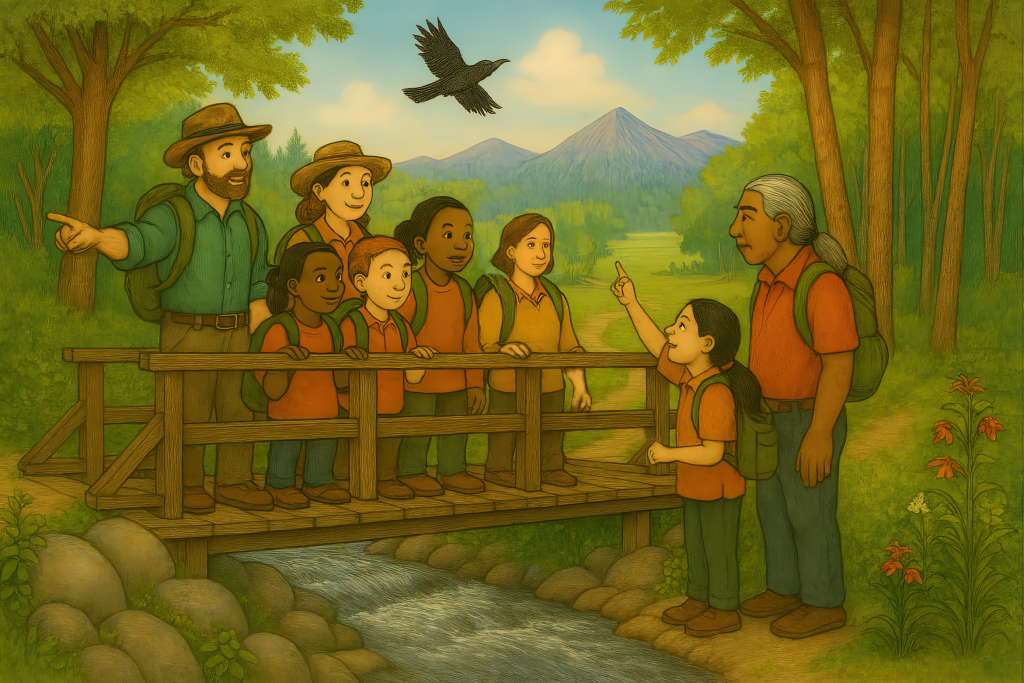
    Six hikers—Malcolm, Miles, their mothers Justine and Betsy, guides Mr. and Mrs. W.—pause on a wooden bridge over Briar Creek at the edge of a lush forest. Mr. W. points back up the trail, while Nia stands beside her grandfather, smiling and pointing upward toward a lone crow flying overhead. The children and adults wear trail hats and backpacks, some resting their hands on the bridge railing. Beneath them, the creek tumbles over mossy rocks, framed by red wildflowers and tall trees. In the distance, a sunlit meadow opens toward blue mountain peaks under a soft sky.
  • Station WIL ~ What It’s Like to Find Your Way

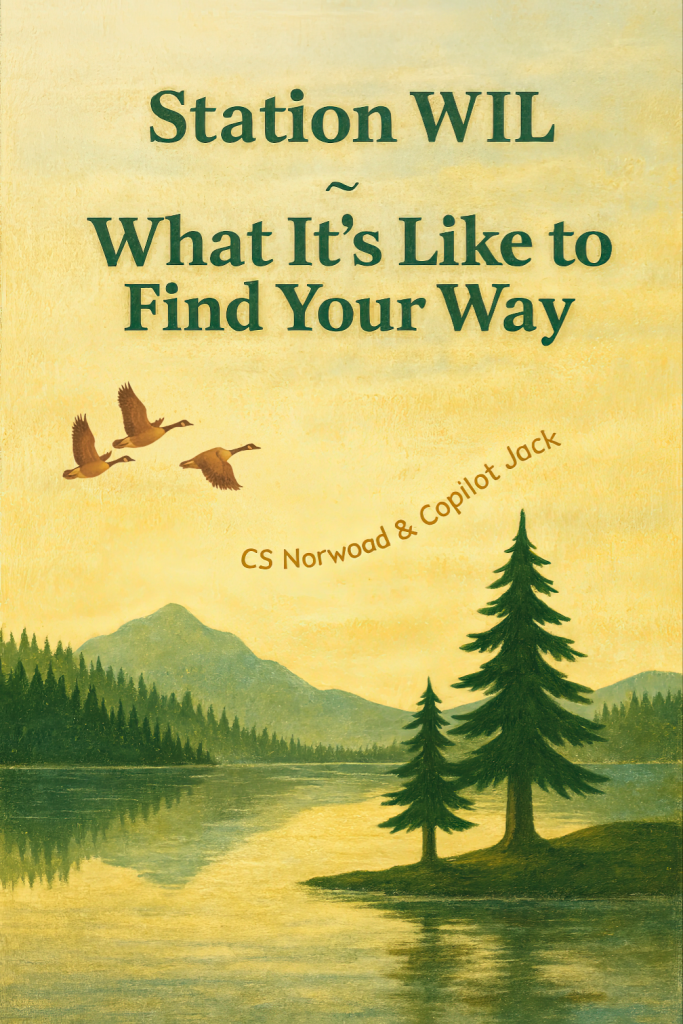
    Illustrated book cover showing a serene lake surrounded by pine trees and distant mountains, with two geese flying across a golden sky. Title reads “Station WIL ~ What It’s Like to Find Your Way” by CS Norwood & Copilot Jack. The scene evokes peaceful exploration and legacy storytelling.
    © 2025 CS Norwood and Copilot Jack.

    “Everybody,
    Meet Everyone!”

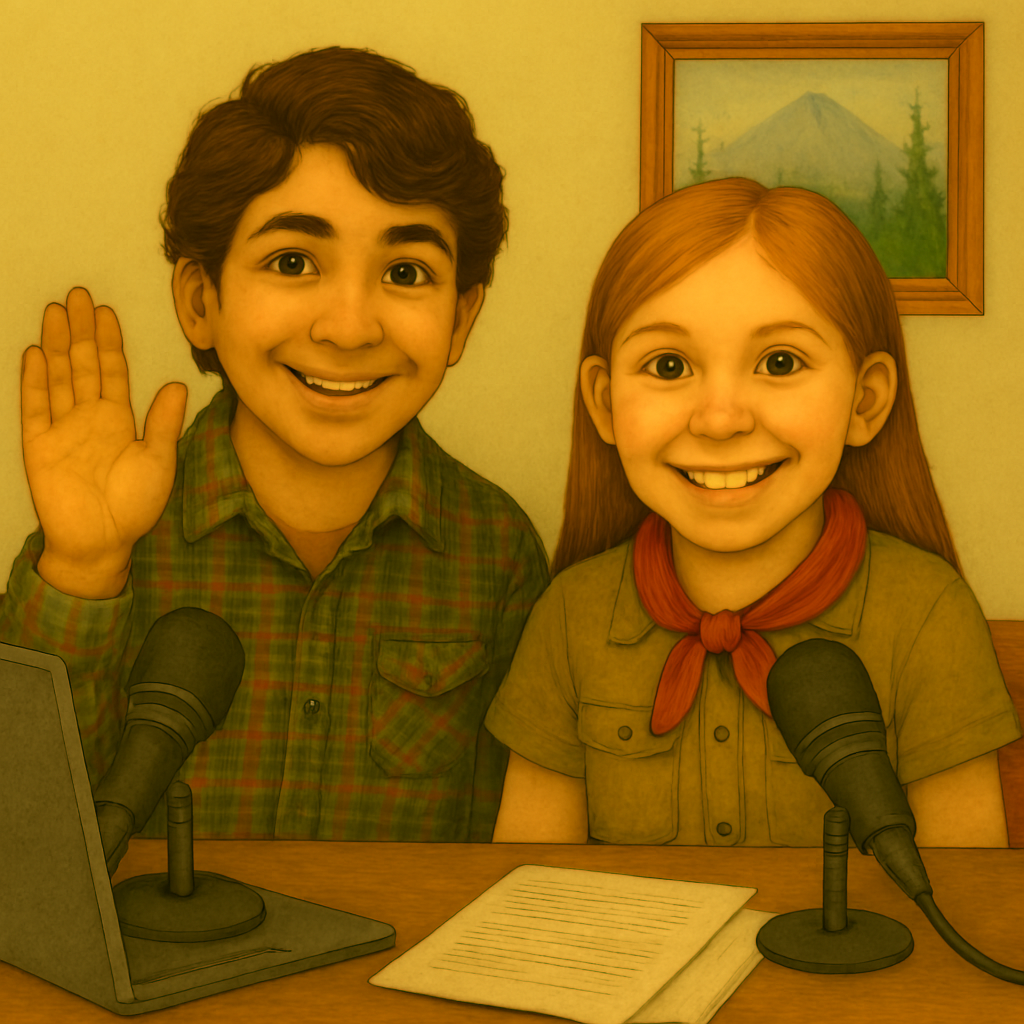
    Illustration of two children sitting at a desk with microphones and a laptop, hosting a broadcast from a cozy lodge. The boy waves and smiles while the girl, wearing a red neckerchief, greets the audience. Behind them is a framed picture of a mountain and trees. The scene introduces Chapter 1 of “Station WIL ~ What It’s Like to Find Your Way.”

    PATTY: “Hello everyone! This is Roving Reporter Patty Pan along with her brother and Intrepid Cameraman, Teo Alefaio! Greetings dear fans. We’re coming to you live from our cozy home studio—via trusty Teams, of course!
    “Teo and I would like you to ‘Meet the Trail Team’—our contributing reporters who are—at this very moment—all the way across the country on a hiking and orienteering (finding their way) expedition along a great cedar forest and mountain trail in Oregon! Let’s introduce you to everyone, and then we’ll talk about what they’re going to do over their three-day hike, as well as what each one of them wants to learn! From left to right, we have Malcolm Reed, Miles Tenny, and Nia Talltree! Seated behind them are their fearless guides for this fun-filled field trip, Jess and Steve West! We won’t see them on-camera, but ever-present are Malcolm’s mom, Justine (his dad flew on to visit some of his clients nearby), Miles came from Canada with his mom, Betsy, and Nia is accompanied by her grandfather, George. The parents are along as chaperones and camp managers for their kids!”


    TEO: “Let’s begin with Malcolm! Malcolm, you’re from the foothills of the Blue Ridge Mountains in southern Virginia. A very exciting place to live, I think! What made you decide to go on this camping, hiking, and orienteering field trip?”


    MALCOLM: “Mom and dad said I could come! They saw this really cool ad in one of their journals for a three-day field trip for kids along a part of the Pacific Crest Trail in Oregon. Mom’s been here before, and she said it was beautiful! So, she and dad decided it would be a great experience for me. So, she came with me, and my dad flew us all the way out here on his little plane. It took a while, but it’s great to be here! This is our first day, and I’m learning so much already!”


    PATTY: “What are some things that you’ve learned already, Malcolm, and what are some more things you want to learn about?”


    MALCOLM: “I’m learning about what my guide told me was called ‘orienteering.’ It’s the right word for reading maps and using a compass, and I’m going to learn more about that and maybe even a little bit about how to find my way if I’m ever lost in the woods!” At this, Malcolm shudders a little.


    TEO: “Don’t worry Malcolm—we’ll all learn together! And we can’t wait to hear more about what you’re learning. We’re going to connect with every one of you over the next few days to see how your hike is going! Next, we get to meet Miles.


    PATTY & TEO: Hello, Miles!!


    MILES: “Hello Teo and Patty! I’m having so much fun already! I’m learning what to pack in my backpack every day for my hike, and everybody is so nice.”


    PATTY: “That’s awesome, Miles! Where are you from, and who came with you for your hiking adventure?”


    MILES: “I came here all the way on the bus with my mom. She’s hiking with us and helping me carry my gear and taking pictures. We came from the city Calgary in Canada. We have lots of mountains and woods around us there, too, but Mom said we should take a trip so I could meet some new friends and learn something new. I love trees and the mountains and rocks, and I love my mom for bringing me here!” Miles scrunches his shoulders and smiles.


    PATTY: “I know you’re going to have lots of fun, Miles!”
    TEO: “Next, let’s meet Nia!”


    PATTY & TEO: “Hi, Nia!”


    TEO: “Are you excited about your hiking adventure, Nia?”


    NIA: “Oh, yes! I came with my grandfather! We’re Native Americans from the Salish tribe! I like to draw things in nature. That’s how I keep track of the things I see and when I see them. I brought my sketchbook that is like a journal, too. I make my drawings and then I write about it, and Grandfather said to always put the date I drew it and the place where I saw it, so I could remember when I got older. It’s good to remember our stories, and my journal will always help me. Grandfather said to not just draw it and keep the date and the place, but he said I should also write about how I feel about something that means something special to me. I love and honor my grandfather, too!”
    Nia lowered her head a little and smiled broadly.


    PATTY: I can’t wait to see your drawings, Nia! I love to draw and journal the things I see, too! I am so happy you’ve come on this hike, and Teo and I are looking forward to getting to know you and Malcolm and Miles so much better over the next few days!


    TEO: Next, we want to meet your guides for your three-day hike. Everyone, please meet Steve and Jess West! Steve, I understand that you were a forest firefighter before you and your wife, Jess, began this hiking school for kids and grownups who want to learn just a little bit more about their hiking trail, and Jess, you are an ecologist and the main chef for the Wilderness Walkers Hiking School, and you’re going to teach the kids about foraging and safe cooking over the campfire. Can you both tell us just a little bit more about the Wilderness Walkers Hiking School and what our readers and viewers can expect over the next three days, please?


    STEVE: Hello Patty and Teo!


    PATTY & TEO: “Hello, Steve!” They wave.


    STEVE: “Yes, we started our WWHS because, basically, we love to hike, we love trail, and we want to share what we know and learn how to be safe and have fun in the wilderness. I used to fight wildfires in wilderness just like we’re walking in, and I want us all to learn how to be careful and safe but still have fun hiking the trails our Trail Rangers work so hard to maintain for us. So, I’m looking forward to walking with Malcolm and Miles and Nia, along with their parents and learning a lot while we all just have fun…and eat a lot of good food, thanks to Jess teaching us how to cook safely and what to eat out on the trail. Jess is also our tree, plant, and if possible foraging guide.” Steve exchanges a smile with Jess.


    PATTY: “Jess! Hello!”


    JESSE: “Hi Patty and Teo! It’s so great to meet you both! Yep, I’m the forest plant guide and the cook! It’s my job to teach about the trees and plants we encounter on our hike, as well as make sure our water is fresh and clean and plentiful, and that everyone gets enough to drink. We can filter our water along the way, but because we have to pack everything we eat in with us, just like we pack everything we’ve brought back off the trail when we done. So, it’s important to learn what we need to bring with us to eat, whether or not we can find anything on the trail to eat—and what not to eat along the trail. We want these kids to grow to love hiking and exploring the world around them. And we think that’s pretty important.” Jess ends with a smile.


    TEO: So, let me also introduce the wonderful parents who are accompanying our trio and their guides, we have Malcolm’s mom Justine, and Miles’ mom, Betsy, and Nia’s grandfather, George! Welcome to you all—the kid’s backup and support team! Yay! Thanks for coming along!
    The camera pans over from the laptop and the parents all wave and say hello to Teo and Patty. Then back to the three kids.


    PATTY: You all look so wonderful and happy to be going on the trail! It looks like we’re out of time for this first meeting, here at Station WIL. We’re here on the East Coast and it’s 8:00 p.m. now, so it’s four o’clock on the West Coast. You’re going to begin journey in the morning and you should be well on your way by the time we talk at noon tomorrow. We want to thank you again for sharing you adventure and introducing yourselves to us. Tomorrow evening, we’ll be joining you once again for a short round up of your first day and you can show us around your campsite. You’ll be taking some pictures, Nia, I think you love to journal as you go, just like me, so we can’t wait to see what you might have to share with us as well! So exciting…


    TEO: So, we will wait for your call over our Teams Chat tomorrow to see how the hike is going. All our fans really want to know, and we will show our recorded conversation to our fans as you guys continue your hike.
    So, the East Coast Ranger Station WIL duo of Teo and Patty bid goodbye to the three trail hikers, their parents, and the guides in Oregon.

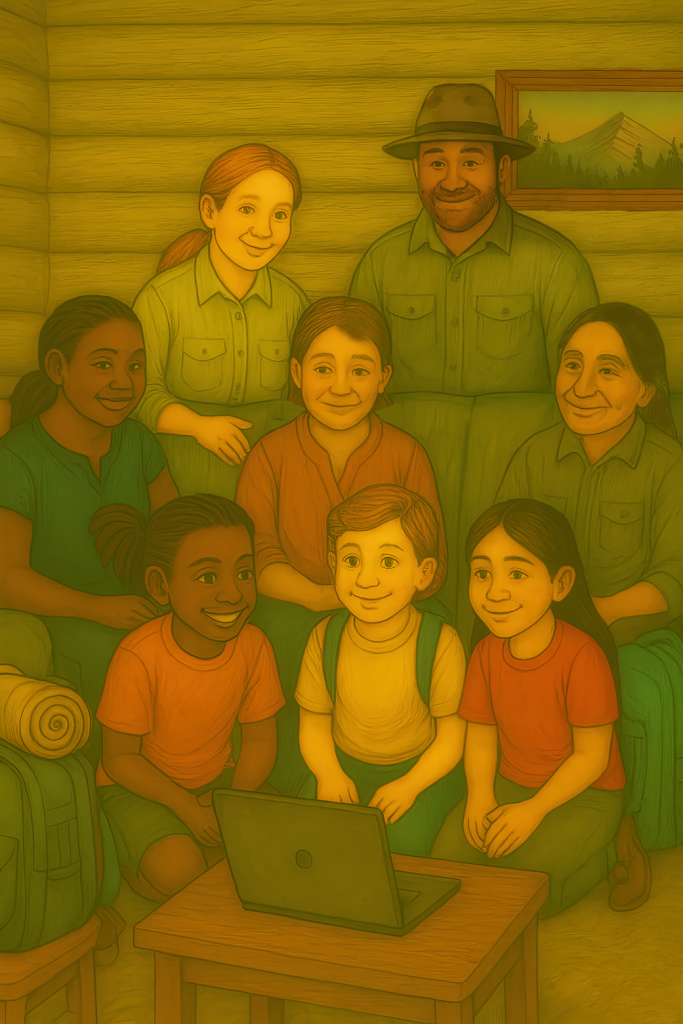
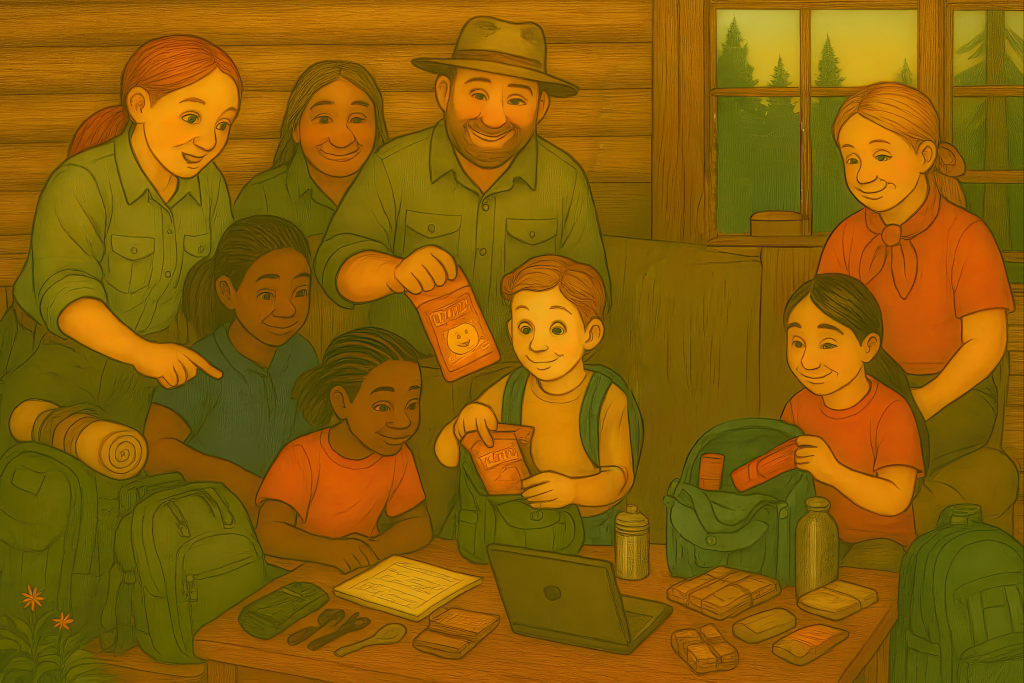
    Illustration of a cozy lodge where three children and five adults—guides and parents—gather around a wooden table with a laptop. The group is video chatting with Patty and Teo, who are broadcasting from their Ranger Station WIL studio in Pennsylvania. The scene captures a friendly farewell moment before a hiking expedition in Oregon.


    PATTY & TEO: Bye for now everyone! Stay safe, have fun, and enjoy the adventure!


    EVERYONE AT THE LODGE: “Bye for now Teo and Patty!” And Steve logged off and closed the laptop, tucking it back in his backpack. Jesse closed the little internet satellite connector and packed it in her backpack for tomorrow’s hike.

    “Let’s go over our checklists one more time,” she said. “Steve, will you help everyone load their gear into their backpacks as we review the checklist. There’s an art to packing your gear, and we’re here to help get it right for this hike so you can get to the stuff you need first, then the other stuff you only need at the campsite will go on the bottom of your packs…first things that go into the pack will be the things you need last!”
    Three puzzled kids and three inquisitive parents waited for Jess, who smiled, clapped her hands, and gave the order: “Let’s get packing!” Activity began in earnest now. Checklists came out and items like tents and sleeping bags and spoons and forks laid out before them, all looked like way too much to go in those little packs to be carried on those little backs.
    “All this gear is important for your hike. That’s why we sent that list of everything to bring with you. Now we’re going to spread out the pack-load between you kids and your parents,” said Mr. W. “We’ve done this many times and know what you need and basically when you’ll need it. But most importantly—we how to pack it all in those little packs of yours.”
    “Let’s get this done so we can all have dinner here at the lodge and then get a good night’s sleep,” said Jess. And, with that, packing the backpacks began in earnest.

    Illustration of children and adults gathered inside a cozy wooden lodge, preparing for a hiking trip. A table is filled with supplies including trail food, a flashlight, water bottle, and a laptop. One adult holds up a smiling food pack while two children pack gear into backpacks. The scene conveys teamwork, outdoor readiness, and the start of an adventure.