Tag: AWI Old Brands

  • AWI Old Brands – Amelia’s Legacy

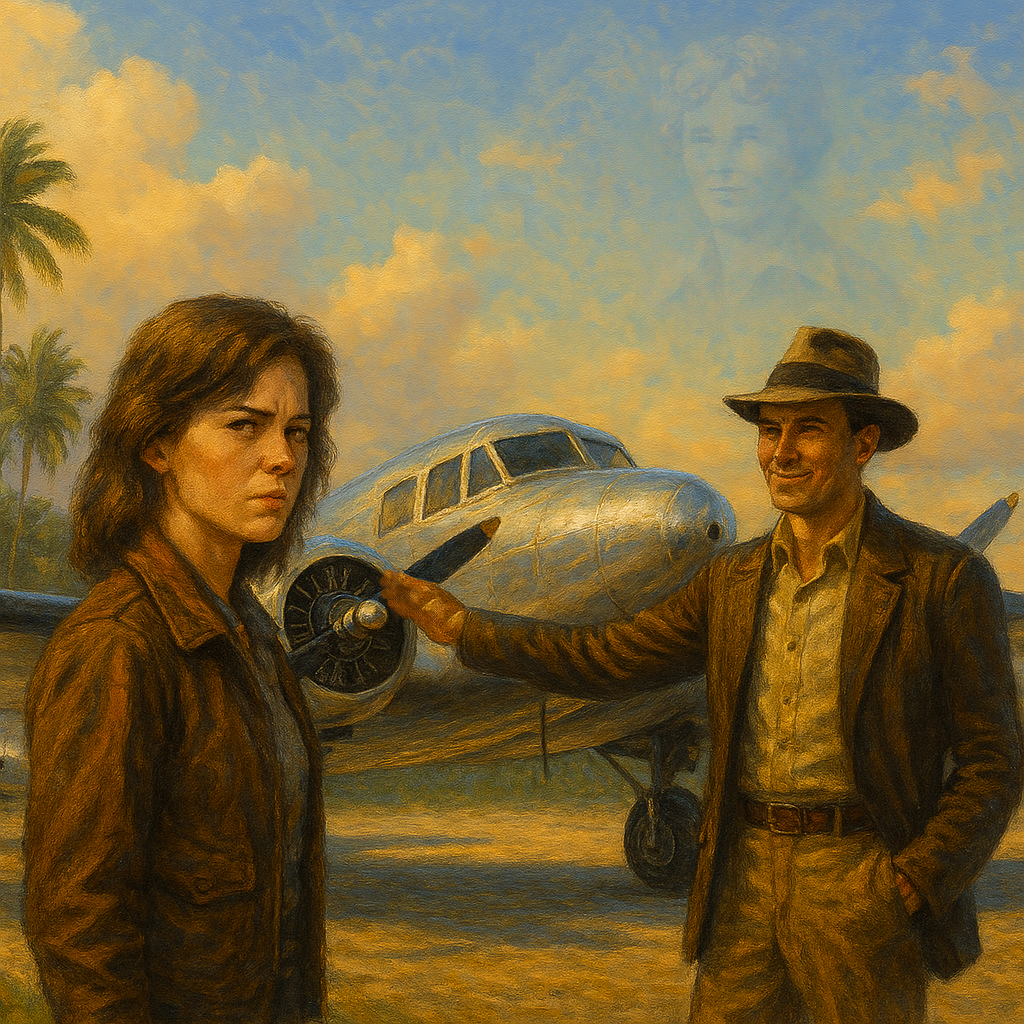
    A man and woman in conversation in front of a shiny Electra aircraft sitting on a runway on a tropical island. The ghostly specter of Amelia Earhart faintly appears in the clouds above.

    Amelia’s Legacy

    by CS Norwood

    © 1992, 2026 CS Norwood. All rights Reserved

    The sun had long ago reached its apex and was beginning a slow descent behind a line of billowing silver-tipped clouds. There it produced a fiery mix of evening orange and deep purple that mellowed to grey where it blended into the far line of the oceanic horizon. Possibly it was the changing light that finally woke her. She did not move immediately, however. Not only was she exhausted, sore and disheveled, but she thought she was probably suffering from a bad case of sunburn as well.

    She lay still for several minutes until she could no longer tolerate her awkward position. Slowly, in spite of the pain, she sat up. Pulling her leather jacket from the sand near her feet, she used it as a cushion to rest her sore back on the trunk of a palm. Though extremely weary and still a little dazed, she began to assess her situation. Looking behind her, she took in the island upon whose shores she rested. From what she could see, which wasn’t a great deal, it consisted of a dense tangle of vines, coconut palms, and mangos, all of which starkly contrasted with the shimmering blueness that encircled it.

    Georgiana was still reeling from the crash. For someone usually as verbal as herself, “endless” was the only word she could come up with to describe her Pacific view. “Lush” was the only word she could use to describe the jungle behind her. Ironically, that was also the only word she could come up with to describe the man who was responsible for her being here, utterly alone, for all she knew. Matthew Youngblood. What if he really was killed in the crash? The plane went down, where? Out there, in the gentle surf? It was so beautiful. What right had they to crash headlong into such beauty? She wrapped her arms across her chests the temperature had begun to drop fast with the setting sun, and her teeth began to chatter. She put the jacket on and would have left the beach, the jungle might be warmer, but she needed time to think and, out here, things might be a little clearer, less tangled.

    Matt had enticed her on this journey, this odyssey, this catastrophe, she thought, her anger rising. Why had she let him talk her into this?

    She let her mind wander back to a few days ago. She had been comfortable, resting in the hotel on Papua after the long shoot. It seemed the older she got, the quicker she tired of the 12 and 14-hour days on location, and she had decided to stay over for an extra weekend after the rest of the crew had flown back to L.A. She had not realized that Matt Youngblood, a freelance photographer, had been staying in the same hotel until she ran into him in the Melbourne Room bar.

    “Georgiana Hyatt…!”

    She lifted her eyes in the dim, smoke-filled room and saw him making hi way through the packed bar toward her. She did not know how she had missed seeing him the moment she walked in. Matt was, as always, breathtakingly handsome. Tall, rakish, yet with boyish charm, he had an adventurer’s look about him. He wore his brown fedora “Indiana Jones” style, although he was a little taller and darker than the movie hero. Each time she saw him again, and the absences usually spanned several years, she wondered anew why they had never slept together. He was as close to an Adonis as anyone she had ever seen. Maybe that was it. Maybe he was a little too perfect, too magnificent.

    “…Georgie!” He swept her into his arms as they came together, their lips met and she felt the fire of his intense passion as he kissed her long and hard. Suddenly, time and place no longer mattered, and any resistance she may had felt left her. She submitted to his will. Matt was the center of the universe, all she had ever longed for. Then, suddenly, he released his iron grip on her limp body, the moment passing. Awkwardly she returned to reality.

    “Where’s the hubby?” he said, still holding her, smiling mischievously.

    “Ah…Matt…it is so good to see you again. I’m not married,” she mumbled, still locked in his spell.  She wondered, idiotically, if she should perhaps shake his hand now. Instead she stood, catching her breath, studying those boyish features, drowning his deep, dark eyes.

    “In that case, may I join you?” he already held a Scotch whiskey in his hand. She hadn’t noticed it when he crossed the room. Before she could reply, he pulled out her chair and another for himself.

    “What’er you doing on Papua, Georgie?” He listened intently as she told him of the new line of South Pacific swimwear Intaglio Design was promoting, and how she was now their top model. He downed his Scotch, ordered another for himself and a vodka Collins for her. By the time the waiter brought their drinks, he had explained that he had just finished a World Environs assignment on New Guinea and just flown over to Papua for some change of scenery.

    “I discovered this great old twin-engine Lockheed Electra. Bought it on the spot. Completely restored. I’ve been flying myself all over the islands, paying my way by shipping off photos at each stop. It’s been terrific, Georgie. I wish you could take some more time off and come with me. I’m flying off to the Marshal’s tomorrow. I need to stop on Guam…”

    Similar backgrounds and mutual acquaintances allowed the conversation to flow easily between the supermodel, just passing her prime, and the world-class photographer. The two sat together long into the evening, sipping their drinks, talking of the people they knew and the places they had been, the near misses, and the times they had connected. Later, walking the beach barefoot, both speaking of other things, but telling of the thousand reasons they were each still alone, he held her again, and he whispered again, softly, so enticing, “…come with me Georgie.”

    That night, perhaps because of the magic of the South Pacific, perhaps because of their long unrequited desire, they did not remain apart. Their lovemaking was as Georgie had always imagined, made so much more by passionate by the longing, the sea air, and the faraway island that held them close.
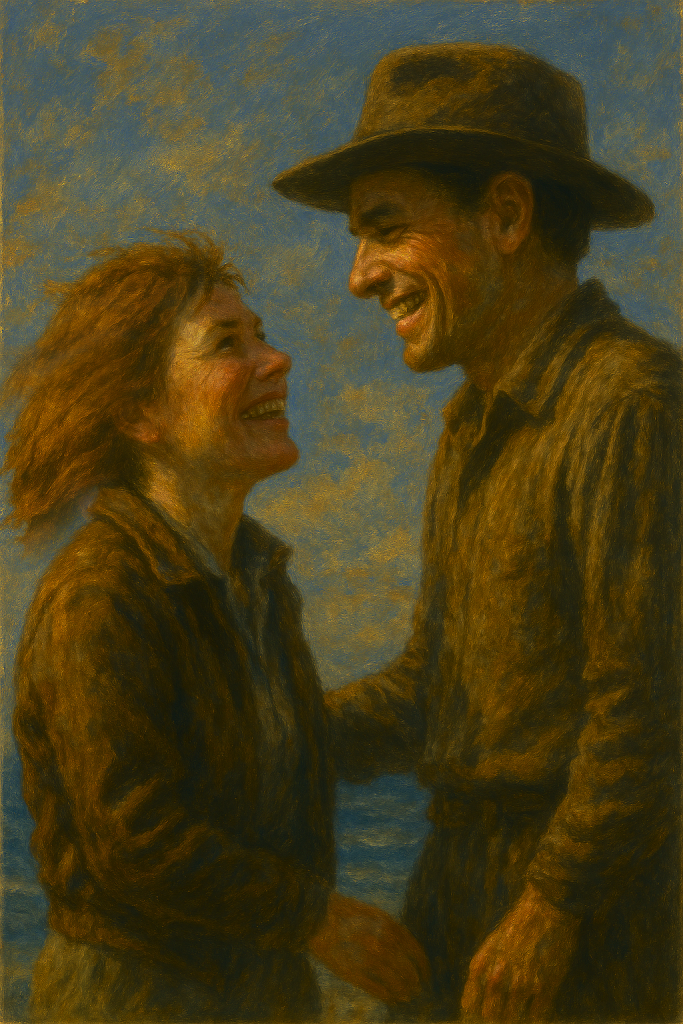
    In the morning, Matt took her to see the Electra. It was beautiful, sleek and shining, a silver aluminum masterpiece. It belonged in the sky, she thought.

    “Come and fly with me, Georgie. It’ll great up there together, you’ll see! Fly with me.” Matt would not be denied.

    “It’s so old…is it safe to fly?”

    “Perfectly. It’s been completely and meticulously restored,” he said, patting the fuselage. “I updated the radio and added a few bells and whistles, of course. But this beauty will take us anywhere we want to go in these islands.”

    Standing back, Georgie frowned, her hands shoved deep in the pockets of her leather jacket. “Something … something seems so familiar about this plane,” she said.

    “Maybe you remember seeing photos of one just like it. It’s the same model Earhart and Noonan were flying when they disappeared out here.”

    “Oh, God!”

    “Hold on, Georgie! It’s not the same plane. It’s one like it. Anyway, they probably went down because of navigational problems, off course, out of gas, you know. There weren’t any malfunctions of the aircraft.”

    “How do you know?” she demanded.

    A man and woman in conversation in front of a shiny Electra aircraft sitting on a runway on a tropical island. The ghostly specter of Amelia Earhart faintly appears in the clouds above.

    “Relax, Georgie. This baby’s sound as a 747,” he said reassuringly. Then her folded her in his powerful arms and kissed her long and deep, and she forgot everything else, even her apprehensions.

    “Okay, so where’re we going?” she asked as she fastened her seat belt.

    “Well, we’re headed for Howland. I’ve got to get some natural-habitat photos…”

    “Did you say Howland?” Georgie screamed above the roar of the engine as the aircraft lifted into flight.

    “Yeah! There’s a small strip there. Marine biologists use it all the time. Won’t be any problem landing there.”

    “Isn’t that the same damn field Earhart landed on just before she vanished?!” This was all a little beyond coincidental; Georgie began to worry.

    “You’re not superstitious, are you Georgie?”
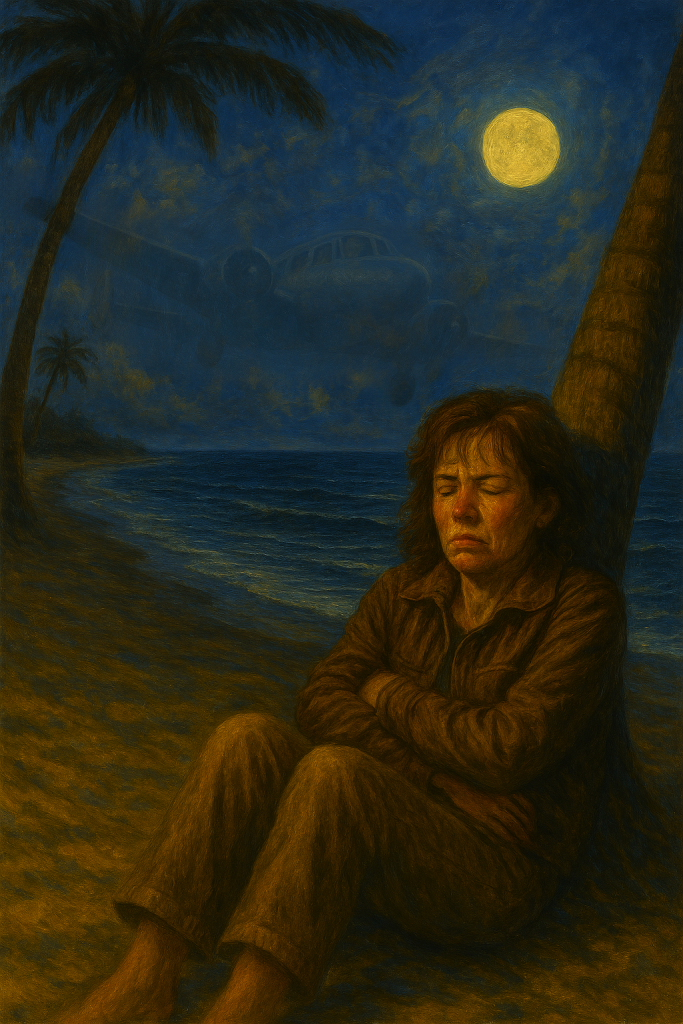
    Girl in kaki slacks and leather flight jacket huddles beneath a palm tree on a beach. The moon shines brightly and the spectral image of an Electra aircraft is in the sky above.

    Sitting here now, darkness closing in around her, she damn well wished she had been superstitious. She wished she had demanded that Matt turn the plane around that very instant and take her back. But that was yesterday.

    A full moon hung directly above now, playing its flickering yellow-white light across the waves in a phantom, iridescent glow. A canopy of stars, hanging just above her head, adorned the indigo sky. Waves washed onto the beach in a steady, low roar, moving ever closer with the rising tide. They licked at the sand near her feet, hissed softly, then receded into the smooth, wet sand. Georgie huddled beneath the palm, wrapped against the night breeze, lonelier than she had ever been in her life. She needed water and food. Tomorrow could not come soon enough.

    Thirst and hunger gnawed at her. The mindless bliss of sleep eluded her. The sandwiches and thermos of strong coffee they had shared to clear their heads from the liquor of the previous night had long since disappeared…drinks together a few nights ago…an age ago, she thought. The rest of the food on board certainly went down with the Electra. Her head dropped to her hands, her elbows on her bent knees.

    She couldn’t remember much about the actual plane crash, she realized. Did they land in the ocean or on this island? She couldn’t see any debris around her. She did remember that they somehow got off course and were running low on fuel. Of course, the radio had gone out and the radar wasn’t working right either. It was like something straight out of a very bad movie. She laughed out loud at the irony of it all, while steady streams of silent tears coursed the smudges on her face.

    Suddenly she remembered watching in horror as Matt fought for control of the airplane. Her last words came back to her now. “We’re dead, aren’t we, Matt!” She couldn’t remember his reply or even if he did reply. Overwhelmed, Georgie abandoned herself to her tears and the lonely, starry night.

    Finally, she slept, although fitfully tossing from side to side. She was never able to find a comfortable position, and she was not used to the incessant roar of the ocean. By morning, she was famished, and her tongue was swollen from thirst. She was cramped so badly that she was not certain she would be able to walk, but she knew she had to try; she had to pee. Every movement seemed a monumental effort, hardly worth it. First her swollen tongue, then her stiff neck, arms, back, and finally, she stretched her cramped legs, groaning with every new effort. All systems go! If nothing else worked, she would bully her body into compliance. With all the strength she could muster, she pushed to her feet and walked into the dense underbrush to relieve herself. Modesty first.

    “I don’t know why I’m being so damned modest,” she said aloud, astonished at the loudness of her own voice.

    “Well, you damned well ought to be in a tropical paradise like this; you never know who the hell’s going to be combing these beaches,” a masculine voice replied to her own.

    Georgie’s heart skipped several beats. When she came out of the cover of the vines, her heart was still pounding crazily from her sudden fright.

    She struggled with the thought of killing him on the spot — if she wasn’t certain she wasn’t already dead, she might consider it — an instantaneous thought. Instead, she rushed into his arms in gratitude for being alive, here with her. She wasn’t alone after all.

    “Matthew” My God, what happened to you? Where in hell were you? I looked all up and down this beach for you yesterday. I didn’t see a trace.…”

    He drew her reluctant body to him and held her close to his chest. “When the plane hit the water, it flipped. You must have been thrown clear almost instantly. I stayed with it as long as I could … get out as much gear as I could. I got a few supplies before she went down, flashlight, batteries, some of our food and some drinking water, not much really. The tide carried you in before I could get to you. The plane rested on the edge of the reef for a while, and I had to keep diving as long as I could. When the tide changed. It pulled the plane off the ledge, and it went down into deep water.”

    “Did you get a chance…”

    “No,” he said softly. “the plane was too old. It didn’t have a transponder. There was no way to send an emergency signal. Com’on, come with me. I hauled everything around to the north side of the island. I got a chance to spot a little lagoon surrounded by some cliffs. We can probably find some shelter there, and you need some water and something to eat. I’ve already laid in a supply of really fresh coconuts this morning,” he said with his old characteristic smile.

    Georgie looked into his sunburned face, already polished to a shine by the Pacific wind. A stubble of beard adorned his angular jaw.

    “This isn’t a joke, Matt. It’s not a game or some…some wild adventure photo shoot of yours! We are lost out here, and no one knows where we are!”

    “Com’on Georgie! It doesn’t help a damned thing for you to get hysterical over this! We’re here now and, by God, we’re gonna make the best of it! Now com’on.” He grabbed her arm and pulled. She winced, jerked her arm free, glared at him, and then followed stiffly when he turned his back and walked off. She looked back up her beach one last time. Perhaps she might need to come back — retrace her steps for some reason — but the tide had already washed their tracks away.

    He led her in a short cut through the scraggly palms that adorned the eastern tip of the island. Presently, they emerged on the northern shore. It was as if they had entered a completely different world. The beach she had just left had been clean and white, but what little beach she could see here was littered with sharp lava, volcanic rock, and odd flotsam.
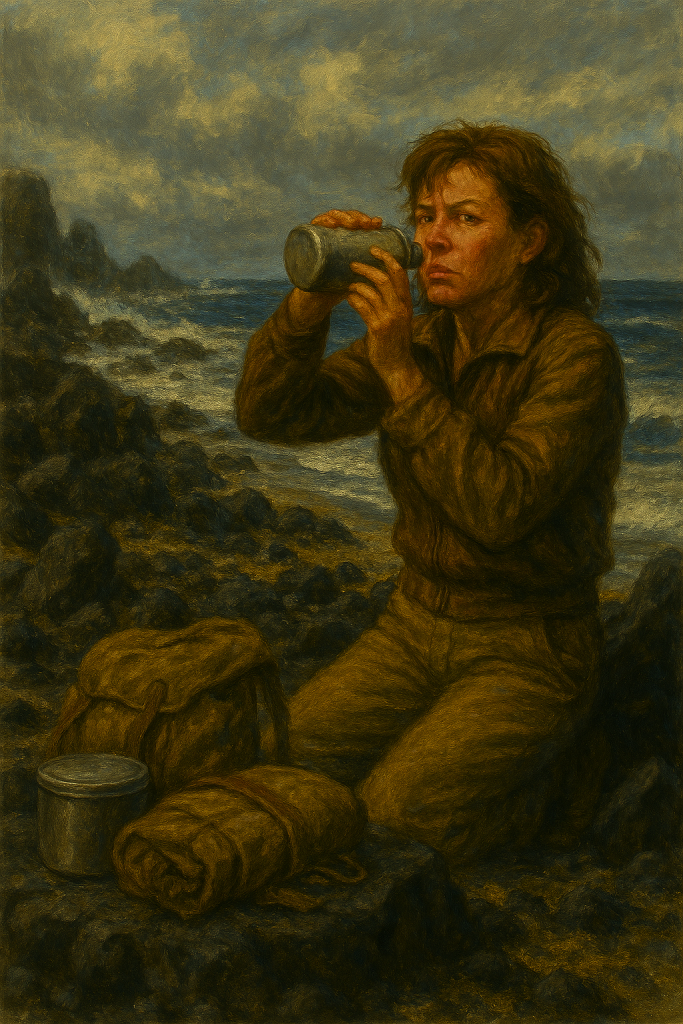
    A woman dressed in flight jacked and khaki slacks drinks from a thermos. She's seated on a rock-strewn beach.

    “I’ve just about got everything over here already,” he said, satisfied with his own efforts. He handed her a canteen of water and opened a watertight container that held the last of their sandwiches. “Easy on the water until we can locate some here,” he said. “Coconut water can keep us alive, but it’ll give ya the runs, too.”

    She looked at him now with a growing realization of the real gravity of their plight.

    “If worse comes to worse,” he held up a fistful of crumpled plastic wrap, “I can rig a little contraption to catch condensation.”

    She knew he was doing his best to reassure her.

    “Why did you wait so long to find me. You should have come looking for me right away, Matt,” she said, accusation rising in her voice. She was mad at herself the instant she said it. She needed Matt on her side more than ever now. It served little purpose to make him an enemy now. Still, she was finding it hard not to blame him for their situation.

    “I did,” he said, unruffled by her accusing tone. “I found you last night. You were asleep. I didn’t want to wake you, so I just kept working till daylight. I kept an eye on you. You’re not saying you wanted to help me move everything last night, are you?”

    “No…”

    “Com’on. See that lagoon over there?” He pointed to a small horseshoe curve in the shoreline about a quarter of a mile away. “I waited for you to check it out.”
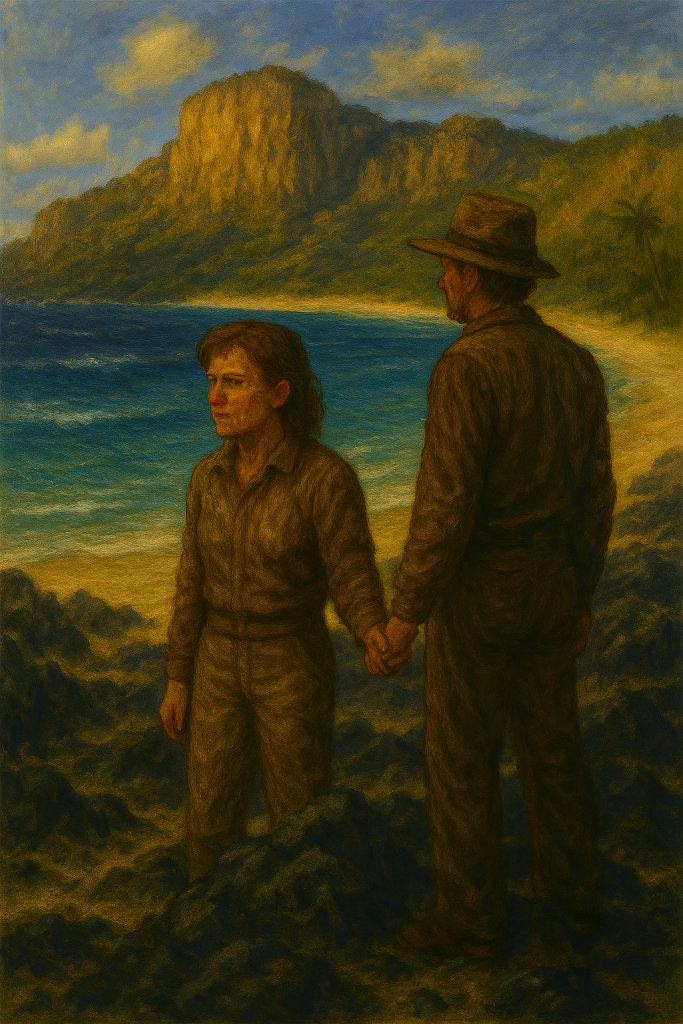
    She followed him along the rocky shoreline and onto the little beach that surrounded the calm, crystal clear lagoon on three sides. The white sand stretched from the water’s edge about thirty yards back up the island where it suddenly rose sharply into a rocky cliff. He led her away from the water’s edge, back along the rock-strewn base of the cliff. The going was tricky and she was becoming tired, her thoughts wandering to what she would be doing today if she were back in L.A., working as usual, when suddenly, they were back on the sandy floor of a beach facing a hollow in the cliff’s wall.

    “A cave!”

    “You wait here…”

    “Not on your life,” she said. “I’m not going to stay here while you wander in there and get lost forever!”

    He studied her face for a moment, “You’re right. That was foolish. We should stick together now. Let’s go back and get the flashlight and the rope.”

    He was headed back up the beach before she could protest.

    “Alright, we’re tied off,” he said as he finished wedging the piece of driftwood between two rocks at the cave’s entrance. He tested it with a couple of full-body tugs, nodded to himself and stepped into the dark, gaping hole. Georgie followed; actually, she had little choice as they were tied together, “Just in case,” Matt had said.

    “Do you think there are bats in here?”

    “No. There are no bats on these islands. You’re safe, Georgie,” he said. “You’re only imagining bats because it’s a cave.

    Georgie swallowed her rising fear. She had always been slightly claustrophobic, and her imagined bats certainly were not going to help this situation. She would still rather be with Matt, though, than outside, waiting and wondering, she rationalized.

    They followed the opening about twenty more feet before the light beam revealed a narrow passage, turning sharply to the left. “Let’s go,” Matt said. So far, they had crouched through the cave, but as soon as they stepped through the passageway, they found themselves in a large, high-ceilinged chamber, they could stand upright now. Remarkably, the chamber was not completely black. Light filtered through a slice in the rocks on the sloping wall to their right, and in the stillness, they could hear the steady, echoing drip of water from a seep in the rocks onto the chamber floor.

    Matt quickly located the water source beneath the chamber’s window. The water tasted slightly of minerals, but it was fresh. He set his canteen beneath the drip to collect the precious liquid.

    “This solves our drinking-water problem,” he said.

    Georgie rested beside the seep as Matt, freed from his tether, began to explore. She closed her eyes in the dim light, moved her hand back to brace her still-sore back and gave a startled cry. Matt rushed back toward her.

    “What is it?”

    “Something … there!” She pointed down.

    He played the light on the ground surrounding them. There, just to the right of the seep, lay an old leather flight jacket, similar to the ones they now wore, only much, much older. Matt was reaching for the jacket when his light caught something else. About ten feet away were the remnants of an old fire pit, barely discernable in the layer of dust and debris that covered it.

    “Someone’s been living here, Georgie,” he said.

    He played the light beam around the perimeter of the little nook of the chamber at the water seep.

    “Look!”

    Both of them cautiously walked closer to the chalky gray mass.

    “My God. It’s a human skeleton,” Georgie said in horror.

    “Must be the owner of this jacket. By the looks of what’s left, whoever it was, was broken up pretty badly. Look,” Matt said, “the ribcage is busted all to pieces. The left leg is fractured, and the right arm is broken up pretty good, too.”

    Matt stepped closer for a better look and kicked something loose with his foot.

    “What is that?”

    “Well,” he retrieved a round leather tube from beneath his foot. “It looks like some kind of document carrier. He took the handkerchief from his back pocket and wiped off a layer of dust.

    “Here, hold the flashlight. Look, there are some initials embossed on it, an F and, I believe that’s an N.” He paused thoughtfully before repeating the initials. “F.N.”

    “You don’t suppose…” Georgie said.

    “Suppose what?”

    “That that’s Fred Noonan’s case…that that’s Fred Noonan!” She pointed to the skeletal remains that leaned on the side of the chamber.

    “What…no! You’re letting your imagination run wild now,” Matt said, yet there was a hint of uncertainty in his rebuke.

    “What’s in there?”

    He opened the case. “Nothing, it’s empty.”

    “Damn!”

    “What did you think? You’d solved the puzzle of Amelia Earhart?” He laughed. “You’re being sort of romantic, aren’t you?”

    “Maybe. It would be exciting, though, wouldn’t it? To finally solve the mystery. Besides, there’s nothing that says that isn’t the body of Fred Noonan, is there? After all, isn’t this real close to where they were last heard from?”

    “Well, I guess…” He shrugged his broad shoulders and grinned his boyish grin.

    Suddenly he stopped short, frozen in place.

    “What!?” Her eyes followed his to the gapping fissure, the window in the chamber wall. There was nothing.

    “Nothing!” He appeared shaken, but regrouped quickly, drawing her attention back to himself. “Nothing … You were saying…?”

    She eyed him suspiciously but continued, “I was saying that those are Fred Noonan’s remains, and Amelia Earhart’s remains must be somewhere close by, right on this very island!” She spoke almost triumphantly.

    “Well let’s just go get our shovels and get busy and we can probably dig ‘em up real quick-like!” Matt was sarcastically mocking her now. His impatience was evident with his rising voice. The two faced off in the dim light.

    “Let’s get out of here.” Matt broke the ice that had suddenly developed between them. “We shouldn’t use up all the juice in these flashlight batteries.”

    As soon as they emerged into the strong light and fresh air of the lagoon, Georgie stopped him.

    “What is wrong with you? Just because I think those are Fred Noonan’s remains, you’re angry with me? What gives here, Matt?”

    “Not a damned thing gives here, Georgie!” He tore himself from her grasp and headed off down the beach toward their meager salvaged possessions.

    He was becoming extremely short with her now, and she didn’t like it…not one bit. She ran after him.

    “Look, Matt! Just because I’m a romantic, and it would be sort of neat to maybe be the ones to solve a real mystery that’s over fifty years old…”

    “Alright! You solved it! Okay!?”

    His words sent her reeling. “What?” she said to his once-again retreating form. And once again, she had to run to stop him.

    “Where are you going in such a hurry. What do you mean, ‘I solved it?’ Stop!

    “No. I’ve got to check on our stuff, now.”

    “Why the rush. We’re alone here, aren’t we?” She held him now by his jacket lapels. “What did you mean when you said I solved the mystery of Amelia Earhart? What’s going…”

    She felt his body suddenly tense as he gasped, holding his breath. She turned and followed his gaze, transfixed on something behind her at the top of the cliff.

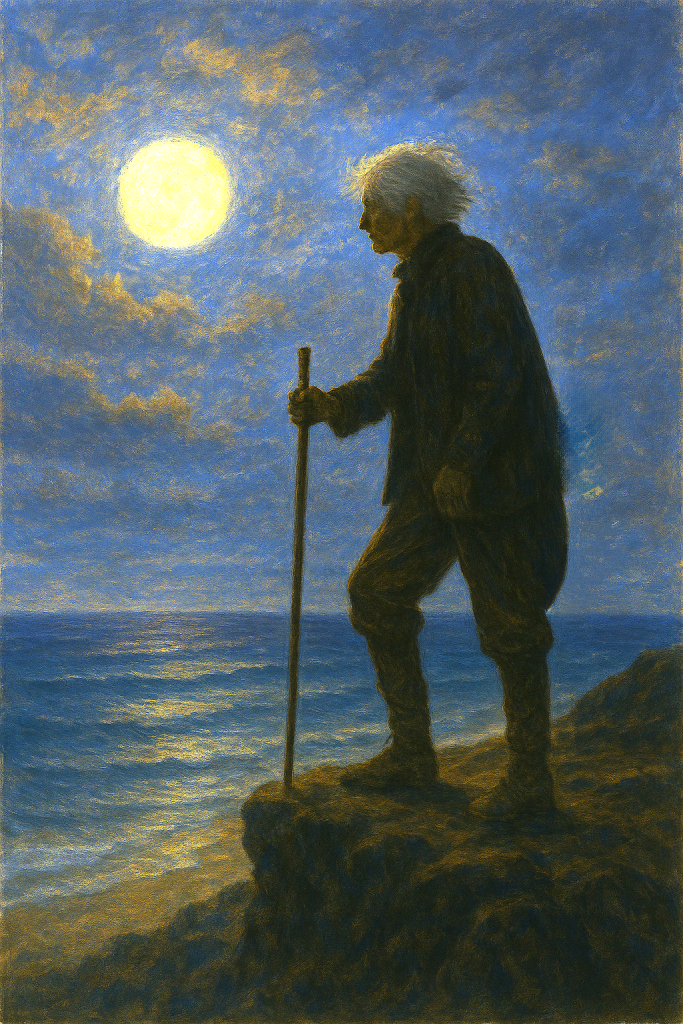
    There, silhouetted along the top of the rocky ledge, stood a frightfully thin figure, leaning on a long staff. Although bent and aged, it was obvious, even from this distance, that the old woman had once been tall, lithe, even aristocratic. As Georgie stared in awe, the woman’s wispy short grey hair feathered in the trade winds from the sea.

    “A…Amelia…” Georgie suddenly lunged in the direction of the lone figure. Matt grabbed her and held her.

    “It’s her. I saw her looking at us through the rock crevice in the cavern. It is her, Georgie. She’s old, but it’d be hard to mistake those features.”

    “Matt! We’ve found her! We’ve rescued Amelia Earhart! We’ve…”

    “Stop it, Georgie!” He held her hard and shook her. Tears of joy and confusion streaked her beautiful face. “Stop!” His voice had softened now. “Think about this, Georgie. That’s Amelia Earhart up there! She’s been stranded on this island for over fifty years, Georgie!”

    “What? What are you saying, Matt? We’ve found…”

    “Georgie,” he stroked the soft tangle of her long hair, looked deeply into her tear-filled eyes, then drew her to him. He held her close, rocking her gently in his embrace.

    “I suppose her final flight — her legend, this island, were her legacy, my darling … and now it’s ours. Fifty years,” he whispered, “and no one ever came to her rescue, Georgie…what makes you think anyone is coming to ours?”
  • AWI Old Brands – Motherlode

    Motherlode

    by CS Norwood

    ©1992, 2026 CS Norwood. All rights reserved.

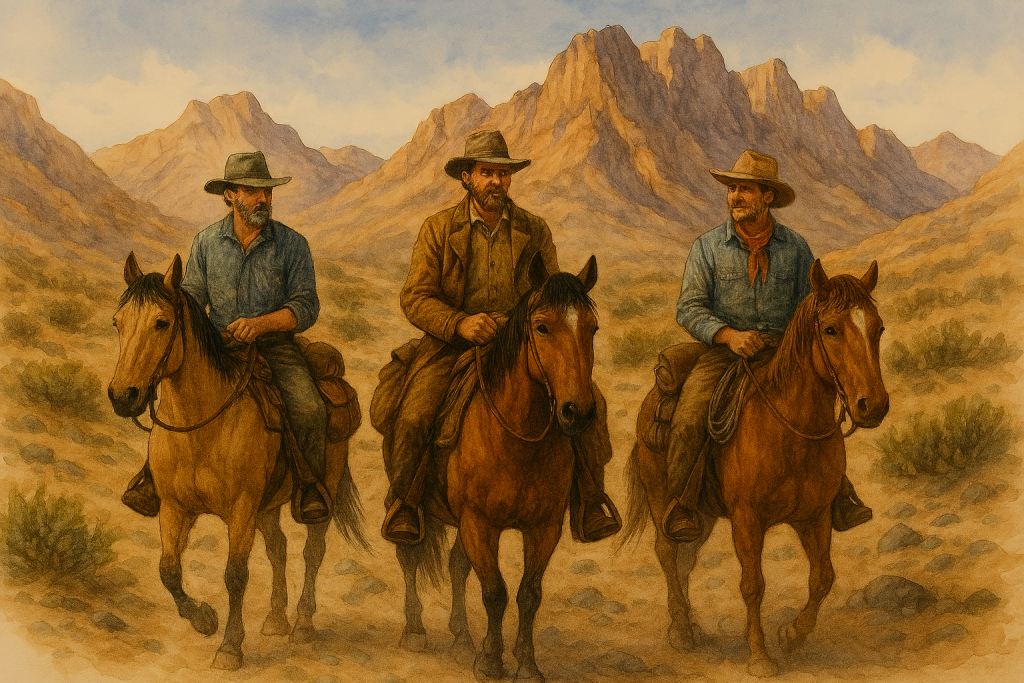
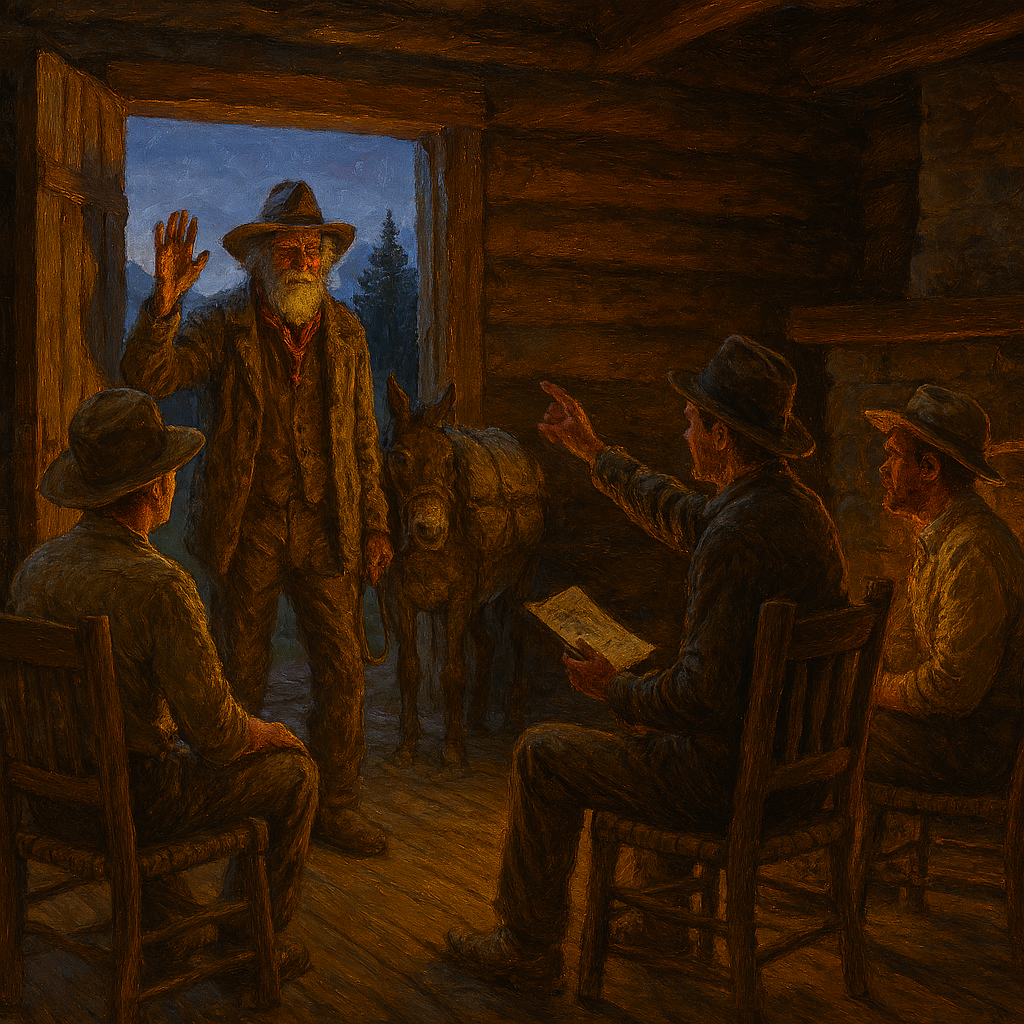
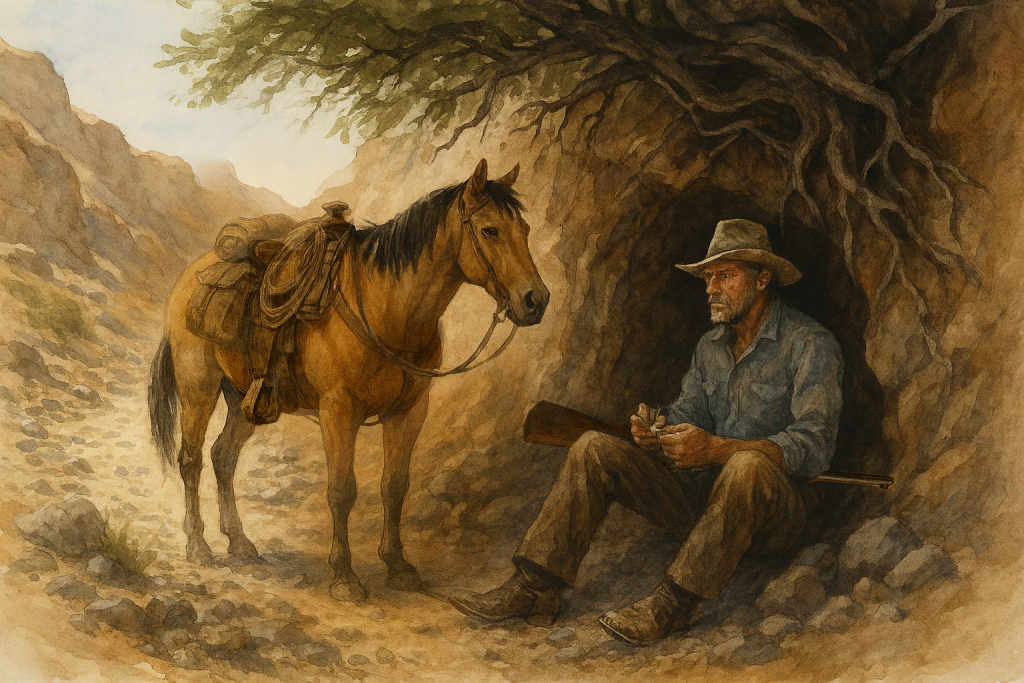
    Travis Danner gave the big line-backed dun a free rein and allowed the horse to pick his way across the loose basalt and patches of gravel and scree that littered the dry wash. Just before the arroyo bent in a blind curve to the left, he reined Dunny into a pocket along the wall. Near the end of the winter months, during the season that some natives called the Corn Planting Moon, relentless rains buffeting the not-too-distant mountains sent torrents of water racing down the slopes and into the gullies and arroyos that zigzagged their way across the desert floor. Carved into the wall of the arroyo by the last flash-flood waters, the pocket Travis rode into provided a welcome resting place for the man and his horse. Canopied by the exposed gnarled roots of a lone mesquite above, it was a place of shadowed coolness. As the season of corn planting was past, he had no fear of floodwater today. Now he could rest and wait for his two brothers in the shadows, out of sight of any roaming Apache bands, although that was unlikely. Not many had been seen in the area for several months now, he’d heard in town. Rumer was they were moving south, heading for strongholds. Still, a man never left caution to rumor out here. Those who did usually met their end unceremoniously and rather quickly. He was a rough man, but a cautious man and he was still here. Though, at forty-one, Travis was beginning to feel his age, mostly while on the ground, but sometimes while still in the saddle. Dunny shifted under him.

    “Yer feelin’ it now, ain’t ya old boy?” Man and horse had been partnered for seven years now and been through some tough scrapes together, yet they wore their scars only on the surface. A fairly deep stab wound in Dunny’s neck from a mad cow, and a nick or two from a stray bullet in Travis’ side and on his dally hand were the most visible scars if anyone cared to look hard enough. Travis laid his fingers in the dimple left behind in Dunny’s neck as memories of those wild days rounding up feral cattle in Texas brushland threatened to flood back in. Days of blazing sunrises, sweat, and danger capped off with peaceful moments of beans and flatbread cooked over wilderness campfires. There were cherished memories of Carmen in the border-town cantina, as well.

    No time for that now, though. No regrets. Just sore bones for an aging cowboy who knew nothing but the brutally tough and dangerous life of a cowhand who owned nothing but the saddle horse he rode in on. “I still have my bedroll,” he smiled sardonically as he checked his pocket watch—an hour before noon—then pulled out his cigarette makings although he would not smoke out here. The smell of burning tobacco was an obvious tell. He was idle, but his mind wandered on. The future was just that, the rest of the day; tomorrow was always a long way off, and there was nothing more to look forward to than a peaceful night under a starry sky. His thoughts and memories were clouding in on him again. His sigh was audible, and something he rarely did—make sounds in dangerous territory. He needed to think differently or he could bring trouble raining down from where, he didn’t know, but he knew it was never very far away.

    He had about half an hour before the telegram said his brothers would meet him at the small seep known as Carson Spring. It was only a mile or so east of where he sat now, and he could cover that distance easily in less than a quarter of an hour. He shifted his seat once again as Dunny shifted his feet, and his thoughts shifted to the man they were coming together to meet.

    He had become sort of a legend in these parts. Over in the nearest settlement—despite its small population it carried the rather large moniker of Lyman City—they called him “Hazelnut.” Their uncle, Hazel Daughtry never seemed to mind what folks called him. Travis exhaled slowly, wondering why, after all these years, his brothers had telegraphed him in Carson City to meet them here. The reunion would certainly be nice—but why had Uncle Hazel telegraphed Joel and Reedy, telling them they needed to locate Travis wherever he was and be at Carson Spring at noon on the twenty-fifth of July. Suddenly the gelding’s head shot up and his nostrils flared. Travis had long ago learned to trust his mount’s keen sight and sense of smell. He guessed by Dunny’s ears pricked forward and tense alertness, even before he saw or heard anything, that at least one rider was approaching.

    A single stroke along Dunny’s neck signaled stillness and readiness for the trail wise animal as Travis eased his Sharps carbine from its boot. Then the motionless horse and rider waited; whoever was coming up the arroyo was still on the other side of the bend, out of sight. Now Travis heard them, more than one rider was coming. They were moving as quietly as they could, but he could tell by the sound of the horses hooves on the stones, that there were at least two riders, maybe three, but he doubted that, and that they were shod horses; that meant that he wasn’t going to have to face a warrior band in the next few seconds.

    Reedy Danner, his youngest brother, rounded the bend first, with Joel riding a dusty bay beside him. Travis made no move but let his two younger brothers ride almost beside him before he spurred the dun’s flanks and exploded him out of the pocket.

    Reedy and Joel Danner drew their revolvers simultaneously, almost before a man could blink.

    “They still hang a man in these parts, even if it is for shootin’ his own brother, don’t they?” Travis grinned.

    Reedy was the first to react. He spurred his horse forward to cover the few short yards to meet his brother.

    “Travis! Hang it all, big brother, you sure did give us a start!” He reached across the gap and, grabbing Travis, pulled them both from their horses. The two men landed in a cloud of dust, hugging and laughing.

    Joel steadied his own rearing mount as he re-holstered his revolver, then dismounted and crossed to his brothers.

    “Darn, Travis! You always did know how to make an entrance,” Joel said as he reached a gauntleted hand to first Travis and then Reedy. “Git up outta that dust, and let’s have a look at yer sorry self.” He extended a hand to Travis who moved just a little slower now than the younger man.

    “I been hearin’ all these stories about you, riding the long trails, fightin’ outlaws and leavin’ yer mark ever’where you go, brother!”

    Joel and Travis embraced. It had been almost ten years since the three Danner brothers had been together in one place. The last time was at their mother’s funeral.

    “Well, Joel, the tall tales about you are runnin’ pretty rampant, too, I’d say. What’s this about you foilin’ that holdup the Wallace’s tried on the Abilene train?” Travis’ broad smile cut his chiseled features—weathered from a hard life in sun and wind.

    “T’wern’t nothin’. I was just a little handier than that sorry lot’s all.”

    “Nothin’ my eye,” exclaimed Reedy as he slapped another cloud of dust from Travis’ back. “He made the Eastern papers! He’s a hero, Travis! I got some catching up to do to make the same mark’s my brothers’er makin’,” he laughed without rancor.

    “Rightly so…about the hero and the catchin’ up, I reckon!” Travis laughed, and the three brothers faced each other quietly, smiling, each trying in his own silence to account for the long years since they had last met.

    Travis broke the silence. “Reedy, yer the youngest and still able to move; get those danged horses, will ya?” he commanded as he retrieved his fallen Stetson and slapped it across his chap to loosen the dust.

    “Yes, sir, big brother,” Reedy grinned and hurried off.

    The three men rode out of the arroyo together, headed east for Carson Spring. All three brothers were strong, lean men, almost equally tall, but Travis was the tallest at two inches over six feet. Reedy was the shortest but not by much. Travis and Joel were dark of hair and skin like their mother, who was Cherokee. The two older brothers favored her in mannerisms as well as looks. They were apt to be taciturn men, their actions often speaking louder than their words. John Danner, their father, a burly man of Scotch-Irish descent, was fairer, but not pale. Reedy inherited his father’s sandy hair and steely-blue eyes, his quick grin, and love of conversation.

    “It’s been a lotta years since I laid eyes on Uncle Hazel.”

    “Us, too!” Reedy the more talkative of the three said. “Why, Joel and I were sayin’, before you ambushed us, that is, that it’s been nigh onta fifteen years! You heard they’s a rumor he struck it rich last year, didn’t ya, Travis?” Reedy continued without waiting for an answer. “Still won’t come outta them mountains, though. Holed up there too many years now, I reckon, “ Reedy grinned broadly, showing his even white teeth as he motioned to the stark specter of ragged peaks in the near distance. The look of them was almost intimidating. They seemed to have pierced the desert’s tough hide, from its belly out, as if the gut of the earth could no longer contain them. The sight brought silence as do most grandly contrasting visions—the flat desert floor and the stark mountain peaks.

    They rode in silence now, as horses stepped softly into the desert sand. A bit clanked occasionally, and Dunny blew dust from his nostrils in their lazy walk. The sounds these quiet men and their horses made were enough to fill the void of the lonely land ahead.

    Carson Spring, the place Uncle Hazel was to meet them, lay at the foot of those ragged peaks, nestled in a cottonwood draw. “Let’s step it up brothers,” Joel said, “or we’ll late for our meetin’.” With that, the brothers eased their mounts into a slow gallop.

    Apache people called the mountains “ghost “ mountains. They had roamed this land for centuries but usually skirted these particular mountains. They had never been happy about Hazel Daughtry prospecting there, but they had never been able to rout him, either. He was as elusive and ghost-like as one of their ancestors, possessing the ability to fade into the granite that surrounded him. As the years passed and Hazel remained, he became as much a part of the ghost mountains as the rocks themselves. In Lyman City as the cavalry began to chase out the remaining Apache people, leaving only the tough desert marauders to fight for their homes, people began to drop the Ghost Mountain moniker and just call them the “Hazelnuts.”

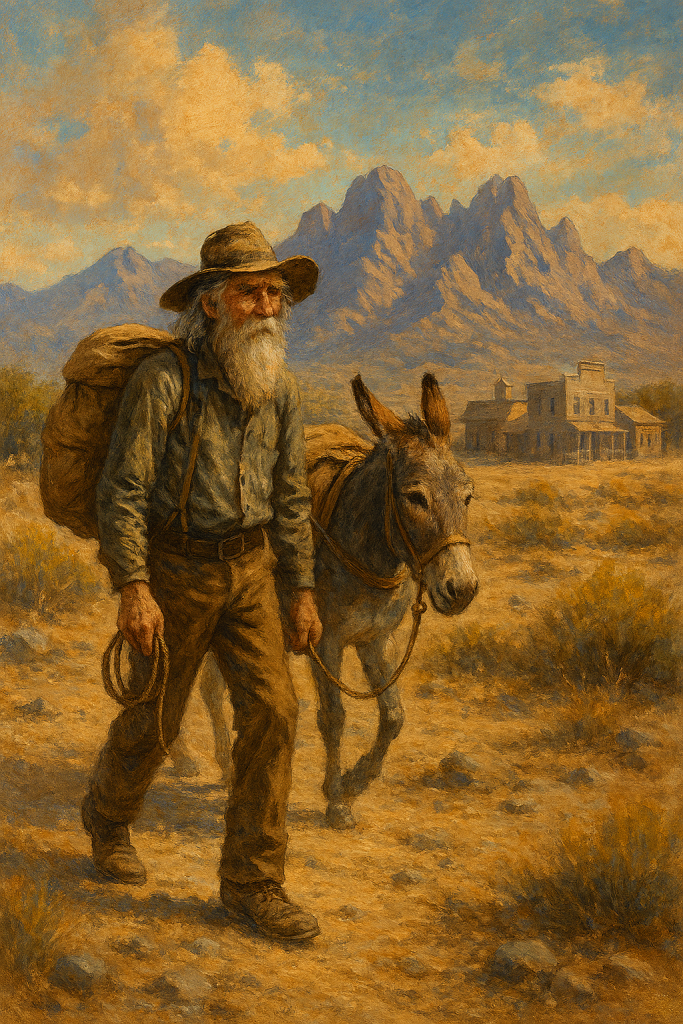
    Hazel paid little attention to what people called them. He cared little for the ways of city folk yet always drew attention when he wandered in with his faithful burro, Biscuit, in tow. His last trip was a little earlier than town’s folk expected. Usually, Hazel’s sparse supplies lasted for months at a time, but this was his second trip in a month.

    He was always a curious sight with his battered hat and dusty clothes from the long walk down the mountains and across the miles of desert. His long hair and beard had long ago turned silver-gray, and his face was a deep bronze. His hands were calloused and almost as tough as the rocks he dug. Yet if all this were not the quintessential picture of a grizzled desert prospector, his most striking feature was his eyes. As blue as a crystal mountain lake, they seemed to focus always on something just ahead, even when the merchants in town addressed him directly, he looked at them but focused on something beyond their faces. People started saying that he was always looking at that “sack of gold.” Like his two oldest nephews, sons of his half-sister, he spoke little, procured his rations with gold dust, leaving rumors abounding in his wake.

    The last time he came down to Lyman City, however, looking the same as usual in a town that was constantly changing, he did something he had never done before. He went directly to the town telegrapher and sent a message to his youngest nephew at the last place anyone in Lyman City had heard from him, Yuma, Arizona. Hazel penciled the message in hard-pressed scribble and Bartum Bixby sent it clicking off over the wire. As soon as it was gone, Hazel left the office, walked to the hitching rail, tightened the ties on Biscuit’s load and trudged back along the same street he’d walked in on. The entire event caused a stir and Bartum did not hesitate to spread the word that the Danner brothers were coming home. Uncle Hazel needed their help desperately, he had said in the wire.

    Old prospector, Uncle Hazel and his burro named Biscuit walk into town from the rocky desert landscape.

    Immediately, and almost out of thin air, rumor had it that crazy Hazelnut Daughtry had found the motherlode. But this fairytale was just the nugget these seedy characters were waiting for. Crow and Wiley resolved to attend the Danner family reunion. After all, four men travelling together could not simply vanish into thin air like that one crazy old prospector could. They would easily leave a trail large enough for anyone to follow, even a pair of born losers like Crow and Wiley. They rode out of town at sunrise, trailing the Danner brothers who had ridden in the day before and left at first light the next morning—the twenty-fifth of July.


    Carson Spring, a small trickle of water this time of year, created a little pool and then ran a hundred yards out into the desert, finally disappearing beneath the scorched sand. The three brothers dismounted and let their horses drink.

    “Hotter ‘n hell out here,” Joel dipped his neckerchief in the cool water and wiped his brow. Travis turned his gaze to the surrounding mountain face. At first glance, it appeared impenetrable. His eyes narrowed as he studied the terrain; he could pick out at least two avenues of ascent. One was straight ahead, while the other appeared to be a small deer track farther back up the wash. It wound through some low cottonwoods, disappeared around a rock outcropping, and then reappeared about two hundred feet above before it left the ledge and disappeared altogether. It was the steeper of the two, and the one more exposed to snipers. Travis guessed that Uncle Hazel would come down the closer trail. Flanked by large boulders, it rounded a steep slope and disappeared almost immediately. Certainly, there was always the possibility there were other trails known only to local tribes or Uncle Hazel. These two were only the most obvious from his vantage point.

    Some minutes passed without a sound when suddenly, Hazel Doughtry was standing there with them. He seemed to materialize from the rocks behind the spring head. It was so unexpected that even the unscrupulous pair lying in wait to dry gulch them were taken off guard.

    “Oh, Lord have mercy! “ Reedy exclaimed as he jumped when he caught sight of the grizzly apparition that was his only uncle. “Where ‘n hell’d you come from?”

    “That’s not where I cum from, boy—that might be where I’m headin’, though!”The old man said matter-of-factly, and then chuckled, as if, after ruminating on the idea a moment, he had stumbled on some sort of truth.

    “Which one ’er you? I cain’t ‘member.”

    “I’m Reedy, Uncle Hazel,” the youngest brother recovered from his fright and extended a damp hand. Travis looked on as the sinewy little prospector shook it in a grasp not unlike the slow closure of a steel vise. He could see Reedy wince. Old Uncle Hazel might be as wiry as a catamount, but he was as strong as a grizzly, Travis thought.

    “You look so much like yer Pa … fair like him ’n me. We just let the sun cook us dark, is all. I sure do miss that crazy Irishman,” he said with a hint of sadness in his voice.

    “And yer Travis,” he pointed correctly without waiting to be introduced. “Ya got yer Maw’s looks—just like a Cherokee,” he said without rancor, a note of respect in his voice. “You too…”

    “Joel…”

    “That’s it! Joel! … only not quite’s much like her as yer brother here,” he said.

    The re-introductions to his nephews complete, the three brothers stood silently as their uncle looked from one to the other. It was not an uncomfortable silence, however, for these men were, each in his own way, used to the solitary life, a life where a man is most comfortable when the air is still and silent, so he can pick out the voices of the wind and trees, the birds, and animals that surround him, especially the deadliest of all: the two legged variety who wear side arms and carry death in their hearts. Travis, Joel, and Reedy were drifters, working cattle when those jobs were to be had, the odd job of riding shotgun guard on the Butterfield Stage, marshalling for a boom town—the toughest job a man could ask for—or just mending fence for some rancher over in Texas. On a smaller scale, Uncle Hazel was a drifter too.

    The old prospector had spent the last twenty years of his life wandering through his Ghost Mountains, always searching up a little higher, or around the next outcropping for his elusive motherlode, always looking somewhere up ahead to fill his sack with gold nuggets.

    When Travis finally broke the silence, his voice was just above a whisper, “I think there are two of ’em. Do you know ’em, Uncle?” No one moved but remained as if they were still in conversation.

     “I’d lay odds it’s that pair from over Lyman City way. I kinda expected they’d show up at this here at our reunion,” Hazel replied. “They’re out there about fifty yards, crawling along that gully. Can you boys take ‘em?”

    “What’s say we just send ’em packin’ before we get down to business?” Joel asked. “When I drop my hat…”

    Travis nodded.

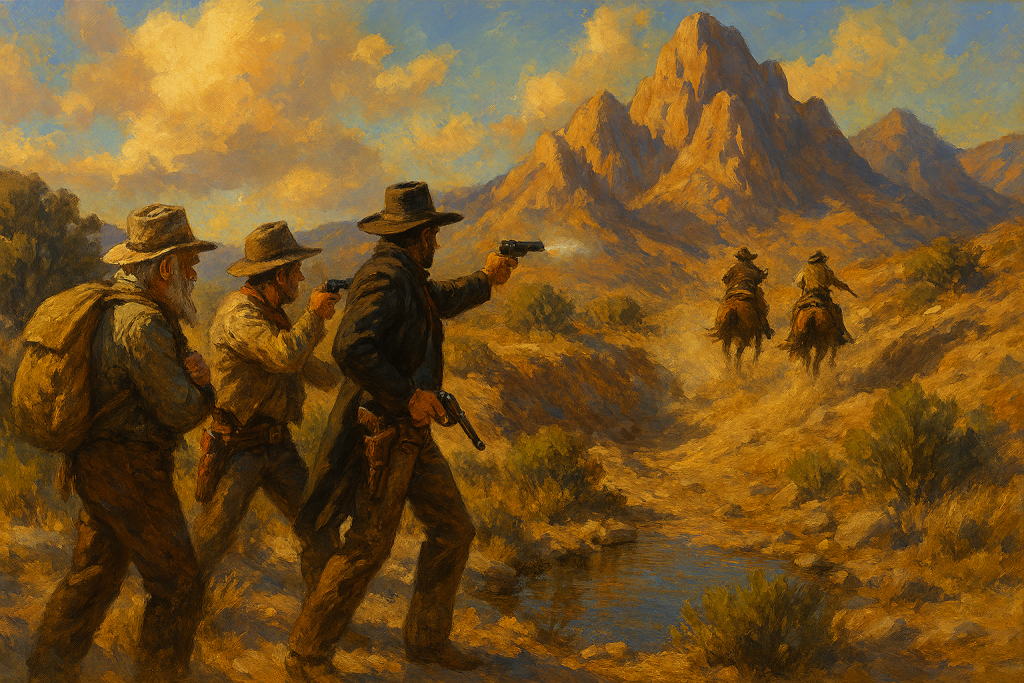
    By the time Joel’s hat touched the ground, the three brothers had drawn their pistols and wheeled in unison toward their targets. After their lightning draw, the thunder of exploding guns came as bullets split the desert air and bit into the rim of the gully, sending pieces of gravel showering atop the crouching figures of Crow and Wiley. The two ne’r-do-wells ducked and scurried back along the ever deepening channel as they dodged the rain of bullets that followed their course. The scoundrels reached their already frantic horses, mounted, and whipped them out of the gully into a hasty retreat. The four men by the spring laughed at the retreating figures.

    Western gunfight along a desert draw. Guns are blazing from three men near a spring, and two claim-jumpers are riding their horses away as quickly as possible.

    “Fine work boys. Ya sent ’em packin’ pronto without nary a drop a blood spilt here taday.” Uncle Hazel laughed and practically danced in his glee.

    “Now that we’ve taken care of those hombres, Uncle, just what is this reunion all about?” Travis asked the old man as he reloaded, then holstered the Colt.


    The prospector looked at the face of each nephew in turn, eyeing them closely. He studied the men before him until Travis noticed a change in his uncle’s eyes. One moment he had been carefully gaging each one, and the next it was as if he was looking right through them to something a little beyond the point where they stood.

    “Common, boys!” Hazel broke the spell and suddenly erupted into motion. He waved them to follow, and almost before they could move, disappeared among the same rocks he had sprung from earlier. As the brothers looked on in amazement, Uncle Hazel re-emerged from behind the rocks climbing up the near trail that Travis had spotted.

    “We best hurry before he disappears again!” Joel said.

    They collected their horses’ reins quickly and led off single file up the narrow trail, first Joel, then Reedy. Travis brought up the rear, his eyes constantly surveying the trail behind until he was certain they were not followed by anyone.

    For the next hour they climbed a narrow path, switching back on itself through intricate turns and loops around boulders, precipitously clinging jack pines and tough manzanita thickets. Travis studied the trail behind him at each turn, marking his route, but it would not be an easy backtrail; it was traveled little and not well defined. A man could become hopelessly lost up here with what appeared to be only one way out. False trails lead to shear ledges that dropped off into thin air, the desert floor hundreds of feet below. This was a dangerous place to get lost in, he realized.

    They had entered a strangely different world here, where the wind blew down through hidden copes of trees, whispering in a rustling sough as it passed. The air became cooler and seemed fresher as they climbed.

    Desert floor sage, tumbleweed, and prickly pear, were replaced by yucca and juniper and then by the red tangle of manzanita thickets. While tenacious jack pines clung to the rocky ledges, taller cottonwoods mingled with longleaf pines in ever thickening forests. The foursome eventually left the mountain’s face and followed the trail that entered into the heart of these ghostly mountains. Now they began a gradual descent. Trees, protected from the harsh environs of the mountain face, grew taller here. Presently, they entered the forest, remounted, and after another hour of riding along a more or less horizontal path, suddenly rode out onto a clearing beside a small lake. The change took everyone by surprise, except, of course, Uncle Hazel, who continued his headlong journey. Not once had he spoken, nor, for that matter, stopped to rest, since they left the desert floor.

    Travis, Joel, and Reedy pulled their horses to a halt for a quick breather. Each leaned forward on his saddle horn while taking in the panorama.

    The water was crystal clear and reflected the color of the intensely blue sky. Above, the cry of a hunting eagle caught their attention as it soared, talons first, to the lake’s surface lifting off with his evening meal, a mountain trout.

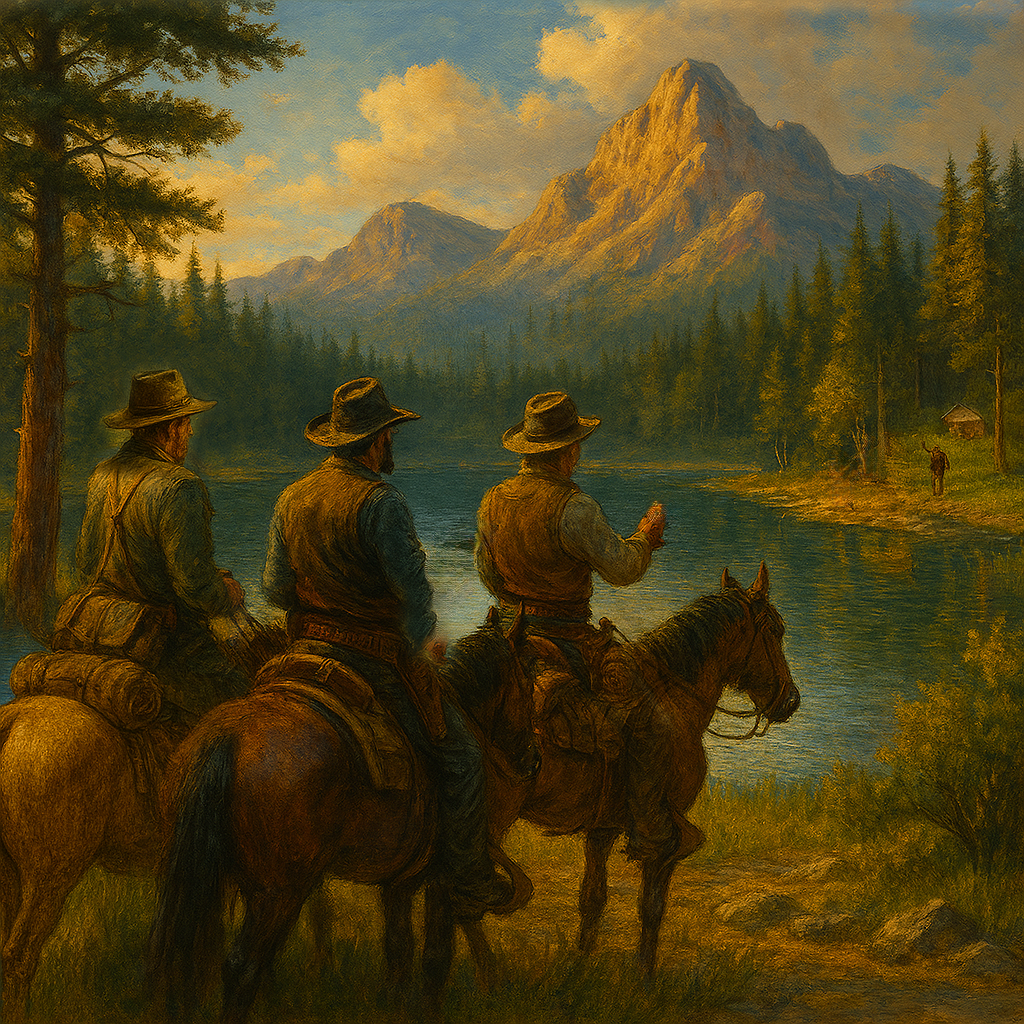
    The lake was about a quarter of a mile long and twice that at its widest point, Travis speculated. He inhaled deeply of the sweet pine and faint pungent odor of fish. It was one of the most beautiful sights he had ever seen. Surrounded first by a border of tall reeds and lush grasses, then by towering pines and white oaks, the entire view was capped off by a backdrop of rocky mountain peaks. This is what paradise looks like, he thought. A man could rest his weary bones in peace in a place like this.

    “Where’d he go?” Reedy broke the spell the tired trio had slipped into.

    “Dang it all!” Joel cursed lifting the reins as his horse stepped forward. “Whoa, now! I’ll be hanged if that uncle of ours ain’t the real ghost in these here mountains!”

    “Beats anything I ever saw,” added Travis as he picked up his own reins.

    “Common, boys!” The shout skipped across the lake. It was Uncle Hazel. He was waving and calling them from the far side.


    “Well, this is it! My home, boys! Pull up a chair. I suppose yer wonderin’ why l sent you that there telegram, ain’t ya?” They had entered a stout roomy log cabin, well hidden among the trees, about a hundred yards from the lake’s shore.

    There were plenty of split oak chairs around the fireplace for a man who lived alone. Reedy remarked on this.

    “Got nothin’ ta do in my spare time, boy. I’m gettin’ old. Give up minin’ last F’brary. Got blasted cold up here! I figured no Injuns—nobody gonna come after me all the way up here. So, I settled in, thought about you boys, and built ya some chairs for when ya comed visitin’.”

    Uncle Hazel finished with a self-satisfied smile for each of his nephews.

    “What, exactly, did you get us all the way up here visitin’ for Uncle Hazel?” Travis straddled a chair, leaning forward to cross his arms over the back. He was bone weary. It had been a long day’s ride, not to mention the long mountain climb afoot, and he was in the mood for some answers. “And who were those two we had to run off back yonder at the spring?”

    “Oh!” He waved Travis’ questions off in characteristic style. “Them’s just that pesky old Jim Crow and Jeb Wiley. They’re the sorry pair a varmints been tryin’ ta trail me ta my digs over two year now. I expected they’d get wind of my telegram pretty quick and follow you boys ta the spring. Ya handled ’em just like I knew ya would. Just like I ’member yer Ma taught ya! ‘Ain’t no need ta kill ’em when you can scare ’em ta death!’ she’d say.” Remembering his half-sister’s words seemed to tickle Uncle Hazel.

    “What’s this deal?” Joel’s voice held its own edge of weariness and impatience. “You didn’t get us all the way up here to just stop some two-bit claim jumpers. Gotta be somethin’ more to this, Uncle Hazel.”

    Hazel got up, took a can of coffee from a shelf, and carefully poured a measure into the coffeepot. He ladled in some water, moved to the crane on the fireplace and swung the pot over the fire he had poked back into life when he first entered his cabin. Having done all this in silence, he tuned to face his kin.

    “I found it.”

    “Found what?”

    “The motherlode.”

    The brothers straighten their tired backs, all attention now.

    “You mean…” Reedy began.

    “I mean, boys. I’m a tired old man. I been up here, alone, nigh onta twenty year now, and I’ve hammered and picked and dug on about ever’ square inch a these consarned mountains. I’ve fought off claim jumpers, and Apache braves fer the right ta stay here. I’ve learned how ta pretty-near be a phantom ta survive. I staked a legal claim on ever’ inch of it, and me and the Apache bands, and the U.S. government have kept everyone else off’n my claim up until now. And it’s just been this past F’brary that I discovered it. After all these years … ” He stopped. His voice choking, he wiped a tear from his eye as his three nephews sat in respectful silence.

    “After all these years a diggin’ an scratching in this heat n cold, I have finally found my motherlode, and I want you boys—my onliest kin—ta inherit it…”

     “Gold!” Reedy exclaimed. “Brothers! We’re gonna be rich!”

    “Yer gonna be rich, all right. “Uncle Hazel continued. “But it ain’t gold I’m talkin’ about…”

    “What? What are you talkin’ about?” chorused the three.

    “But you said you found the motherlode, Uncle Hazel? Ain’t there no gold up here?” Reedy asked, puzzled.

    “Ah, sure,” Uncle Hazel waved, “they’s plenty a gold—gold dust, an little veins a gold all over these here mountains. There may even be a motherlode vein running beneath that lake out yonder…but it’d cost ya a king’s ransom ta dig ’er up! No, boy, the motherlode I’m leavin’ with ya is worth more’n any a my puny little digs a gold.”

    “Here,” Uncle Hazel walked to the fireplace and carefully removed one of the stones along its base. He reached into a hollow space in the stones and pulled out a sheaf of papers.

    This, boys…this is my motherlode.” He held the sheaf up high to emphasize his point. “It’s the reason I been up here fer all these years, and I didn’t even figure it all out till F’brary this year!”

    He handed the papers to Travis first.

    “Why, these are deeds, Uncle Hazel.” Travis appearing a bit confused, looked the papers over quickly then handed them to Joel.

    “Don’t ya see it? Ever time I cum across a new little vein a gold, er panned enough dust outta that stream up yonder behind the cabin, the one that feeds the lake, I’d pack up old Biscuit ’n go down ta Lyman City an buy me a legal deed ta some more a these here mountains. Nobody down there wanted the land. They just wanted the gold they thought’s in it. But nobody’d risk comin’ up here cause a the Apache raiders, and ghost superstitions, n danger n lonesomeness ’er what not.”

    “You’re saying you own a deed to these mountains?” Travis wanted this thing clarified. It was beginning to slowly dawn on him exactly what his uncle was offering them.

    “Yep,” Uncle Hazel replied proudly, “ever blasted wonderful inch. Don’t ya see how ironical it is? It took me twenty consarned years bustin’ my back a lookin’ under rocks to see what was all surroundin’ me all the time, boys…These mountains are my motherlode! These mountains are why I stayed, t’wern’t the gold at’ll! I could’a picked up stakes n gone somewhere’s else to find a better claim, but I never could leave here, and I wasn’t figuring out why when my pannin’ and diggin’ was only providin’ me deeds n grub. Then one day it come to me all of a sudden like. I was sittin’ where you boys parked yer horses earlier, and I saw it…and it was purest gold…and it was paradise, boys…” His voice trailed off.

    “And it’s all yours from today on. There’s enough gold up here ta give ya a grubstake, but if it’s a place to call yer own ya been lookin’ for, well don’t look nowhere’s else. Build ya a couple more cabins, find ya each a good wife, raise ya some young’uns n live out yer lives in peace, but don’t go chasin’ no pots o’ gold. Nothin’ll make ya any richer or make ya any happier than what I’m givin’ ya right here, right now if ya’ll have it.”

    The boys sat in silence, but Travis knew there was nothing except these mountains left for him. This was what he was looking for—what he had longed for. He would ride for his own brand now and perhaps ride down to see if Carmen was still at the cantina.

    “But now,” Uncle Hazel slapped his hands on the table then continued as he began hefting packs loaded with flour, salted venison, and coffee. “…now I’m too old to protect it anymore, it’s bigger’n and tougher’n me. So, that’s why I’m leavin’ the whole shebang ta you boys—my only livin’ kin. That last paper there,” he pointed to a large, clean legal document in Joel’s hand, “that’s my last will an testament there. Leave’s the whole shebang to you and Joel and Travis ta divey up how-some-ever you see fit,” he addressed Travis.

    “Guard ’er well nephews! Remember, they’ll always be somebody’ll think they can just waltz right up here an take ’er away from ya. I tested you boys today… set ’er up so’s that pair could follow ya easy, wanted ta see how ya’d handle yerselves anybody comes claim jumpin’ after yer gold dust…well, my guess is they’ll be fryin’ in hell’s fryin’ pan afore they know what hit ’em!” He laughed as he raised the wooden latch on his door. “And I want my only livin’ relations to have it all! By the way, that trail out’s a might tricky. I wouldn’t try ’er tonight…if ya get my drift.”

    As he opened the door, the cool night air rushed in to stir the flames in the fireplace. An owl hooted in the trees close by and somewhere off in the distance a lone wolf called for his mate.

    “Wait a minute! Where’re you headed for Uncle Hazel?” Travis called after his uncle as the old man stepped through the doorway.

    “Oh,” Uncle Hazel waved again, “Me ’n ole Biscuit, we’re just headin’ out to check on the motherlode.”

    And with that, the old prospector gathered the lead of his little burro, turned away, and disappeared into the shadows one last time … or so goes the legend of the motherlode.


    THE END

  • AWI Old Brands – A Texas Story

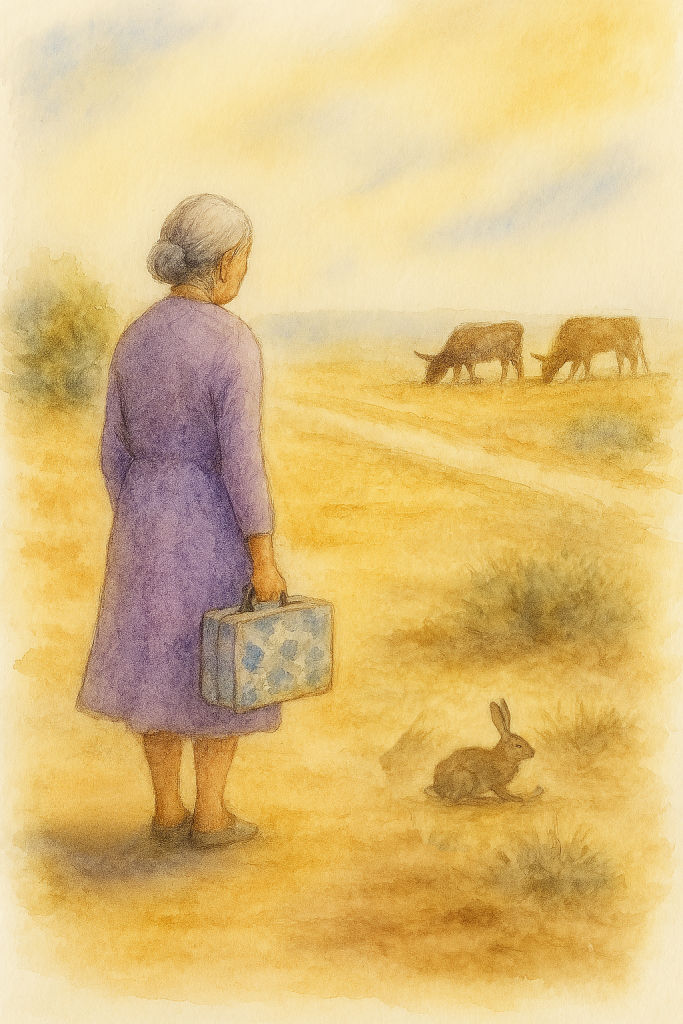
    Old lady in lavender dress with flower valise stands beside a dry Texas road with a jackrabbit nearby and longhorn cattle grazing in a field on the other side of the road. She stands alone.

    A Texas Story

    by CS Norwood

    ©1992, 2026 CS Norwood. All rights reserved.

    The flat light of midafternoon washed the solitary lavender-clad figure almost as pale as the bleached brown dust she stood in. A lone crow cawed from his perch in the mesquite thicket at the end of the draw as two red and white speckled longhorns across the roadway stepped forward in unison, heads bowed as they cropped the sparse, dry blades of grass. None of them, however, seemed mindful of the old woman who endured the silence and tolerated the air of indifference in her usual manner. She stood with her head held unnaturally high, looking neither right nor left, but with eyes focused straight ahead on what may have been some far-off thought. Even the powerful Texas-sized jackrabbit that hopped in slow motion, kangaroo style, not ten feet from her side paid her any notion. In a world of butterflies, lazy buzzing bees, jackrabbits and longhorn cattle, Violet Sheldon stood alone and virtually colorless.

    “It’s about damn time,” she mumbled flatly, as first the drone of the powerful engine and then the silver dome of the Greyhound topped the rise. She bent her knees and retrieved the blue flower-covered valise at her side as the bus slid to a stop in front of her, stirring a cloud of dust to accompany the noisy hiss and metallic squeak of air brakes and automatic doors.

    As Violet gave herself up to the sleek beast, not even the jackrabbit poised motionless in the dry thistle took notice.

    “Pardon me, is this seat taken?”

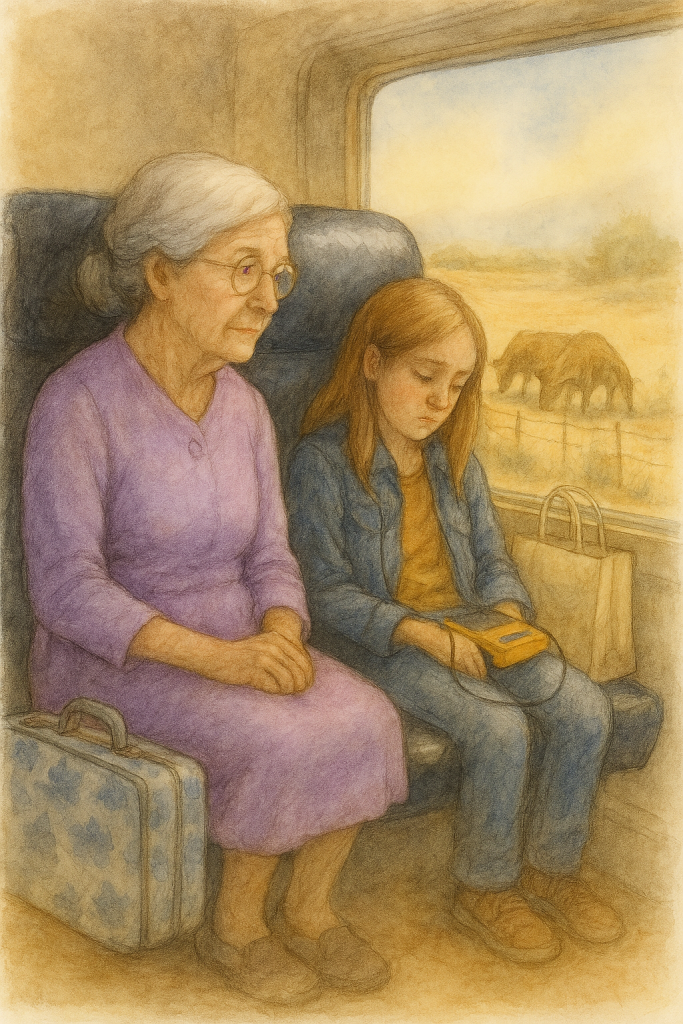
    A slight blonde teenager in blue jeans and jacket, appearing to be wired directly into a yellow Walkman radio, lifted her eyes rather blankly at Violet’s question, then cast scornfully about at the dozen or so empty seats surrounding them. She shrugged her angular shoulders, focused straight through Violet’s eye sockets, and pinpointed somewhere on the other side of her skull.

    “Be my guest, lady,” she clipped, and turned her head to stare at the blur of the roadside. At once the girl resumed her head bobbing and chin jutting that Violet assumed coincided with the musical rhythm emanating from the Walkman.

    Violet Sheldon seated herself beside the silent, undulating girl and was, again, alone in the world.

    Old lady in lavender dress seated beside a teenage girl on a bus. Outside the window is the passing Texas scenery.
    Violet and Laurie travel and talk…

    “Dammit!”

    The sudden expletive jarred Violet’s sweaty half-sleep. She moved her sore neck slowly and wiped the drool from the corner of her mouth. The highway sped by as she collected herself.

    “Damn…lady, ya got any triple A’s in that purse a yers?” The teen drawled as she mashed buttons and snapped tiny compartments on the radio.

    “I’m not accustomed to carrying ‘triple A’s’ with me.” Violet retorted as she  smoothed some invisible creases on her dress.

    “Well, that cuts it!” Teen snapped as she yanked the headset from her ears. Violet wondered how long this young girl would survive disconnected from what seemed to be her life support system. “What’m I gonna do for the rest of this bor-ing trip!?” The girl flung her head back onto the black vinyl of the seat in a gesture of total dejection.

    “Well, we could talk…” Violet offered.

    The round-faced teenager stared at her as if she had just dropped in form another planet. “Talk? About what?”

    “Well…my name is Violet Sheldon. I’m from this side of Bronte. My house is just down that lane where I got on the bus. About a quarter of a mile…” She hesitated. When there was no response, she continued, “I’m on my way to see my sister in Dallas; it’s my birthday tomorrow. And Lydia—Daddy and I just called her Sissy, you know—Sissy always invites me to spend the day with her on my birthday. Sort of a little tradition, you know.”

    Her words drifted off into silence, but when the silence continued and Violet was certain the girl’s life must be ebbing away, she prompted, “…and you are?”

    “Oh, ‘scuse me. I’m Laurie Fallman. From San Angelo. At least that’s where my dad lives now. I live there too, with him. My mom lives in Fort Worth. I’m going up there to see her. I guess it’s kind of a coincidence. It’s my mom’s birthday tomorrow, too.” Laurie indicated a designer shopping bag wedged between the side of the bus and her feet. “I didn’t get her much. Not that it’s any big deal or anything…”

    Laurie’s voice trailed off as she turned to stare at the receding landscape. Baked brown hills covered with wiry, tenacious honey mesquite and interspersed with prickly pear, yucca and dusty clumps of broom grass monopolized the view. Occasionally, behind the ever-present barriers of cattle fence and barbed wire could be seen deer grazing with the lean Brahmas or fat Herefords Texas cattlemen doted on.

    “God, there’s nothin’ out here. What’s it like livin’ so far from anything? I’d be bored outta my skull!” Laurie emphasized the last three words but never looked at Violet’s face for her reply.

    “Oh, it’s not so bad as you might think, my dear.”

    “But there aren’t even any boys out here,” she whined.

    “Maybe not so many now, but things were a little different here when I was a girl your age,” Violet said. “We’re almost to Abilene. Lots of cowboys in Abilene when I was a girl. Over in Sweetwater, too.

    “Yeah?” Laurie was listening now, intently studying Violet’s face for the first time.

    Oh, the wrinkles, Violet thought. She restrained the hand that threatened to call attention to the lines and valleys that marked her years. That’s all anyone ever sees anymore. If only this shallow little girl could have seen me when I was young. When I was the most beautiful girl this side of Dallas! And everyone knew it!

    “My daddy named me for my violet eyes, you know.”

    “Really?” The girl looked closer, peering into Violet’s eyes. “Hey, they really are violet, aren’t they!”

    Violet, ignoring the girl—she surmised that Laurie was probably not very bright, and probably totally self-absorbed anyway—continued her soliloquy.

    “I was the apple of my daddy’s eyes. He was rich too, you know!”

    “Really?”

    Violet paused again, lifted her chin, and looked through her bifocals at this monosyllabic adolescent. “Yes, my dear, really.” She was hoping her abruptness would serve to curb Laurie’s interruptions.

    “He liked me much better than Sissy, or even Mamma for that matter! He was a wealthy man…owned acres and acres of land. Why, we had the largest ranch in Bronte, back then. Of course, when the war started, he had to leave. Well, when he was killed ‘somewhere in the Pacific,’ you know, well—I did believe my heart was going to bust wide open, and everything inside me would spill out on the ground!”

    Her slight fist tapped her chest and then she flung her arms wide. Tears welled in her eyes as she spoke, and hard little lines tightened downward at the corners of her mouth. Almost immediately, however, she recovered with a sigh and a smile.

    “When I was nineteen, Daddy bought a brand-new Packard automobile. It was the most beautiful automobile I’d ever seen. All black and shiny. Hum,” she laughed. “Why, I can still see my reflection in that car!” She rested her head on the back of the seat and closed her eyes to drink in the memory. “Those seats were the finest, plushest velour, too. Not this old vinyl stuff they started usin’ after the war!” Violet grimaced and slapped the seat covering in disdain.

    “Did he let you drive the car much?”

    Violet remembered the girl and shot her a withering look.

    “Why, of course! Curtis Mahan lived down the road a few miles from us. Down in Tennyson, maybe you remember passin’ it before my stop?”

    Laurie shook her head and returned a blank stare and half smile.

    “Anyway,” Violet waved her off, “as soon’s my Daddy brought that car home, I grabbed Sissy, who really was a sissy, you know, couldn’t even drive a stick shift automobile, even though she was a year older than me, and we drove straight down to see Curtis.

    “His daddy owned a very large ranch in Tennyson. The biggest spread there. Over 3,000 acres. Not quite as large as my Daddy’s though, you know. Well, Curtis Mahan was without a doubt the handsomest boy outside of Abilene and, mind you, there were some handsome fellas in Abilene. He was tall, dark as an Indian, and Oh! He was strong. I was so in love with Curtis,” she sighed. “Everyone said that we were the perfect couple. We were going to get married that very summer. I thought then that I was the luckiest girl in the whole wide world. I had my Daddy, and I would soon be Mrs. Curtis Mahan!”

    Ecstasy of past memories lit her face and then suddenly vanished. After a moment, she continued, “I didn’t know it then, the day Sissy and I first drove that Packard down to see Curtis, but I found out later—Sissy was in love with Curtis, too. She turned his head. That little tramp…” Violet’s jaw tightened, her face became hard, her eyes narrowed, full of hatred. Her fists clenched until the thin, translucent skin of her knuckles seemed to disappear across the white bone beneath. Then, suddenly, she seemed to remember where she was, and that time had far removed her from the day she discovered the treachery of the man she loved and her own sister.

    “Look, we’re in Abilene, the bus is pulling in.” Laurie, appearing grateful for the opportunity, interrupted Violet. “I have to use the john. You better go too, Mrs. Sheldon; it’s gonna be a long ride from here to Fort Worth.”

    “It’s Miss Sheldon, my dear. I never married.”

    “Oh…well. You might need a Coke or something.”

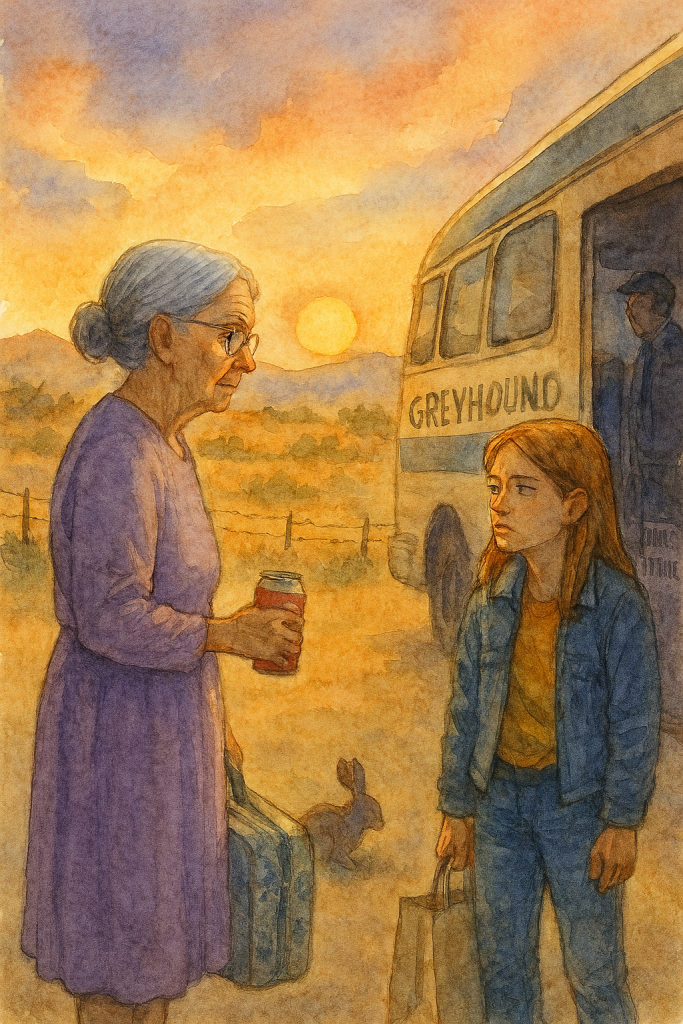
    Violet emerged into the late evening glow of the once bustling cattle town. The vermillion orb of the setting sunbathed the streets and buildings in its peculiar light. The intensity of the summer heat softened with the setting sun and the bent, stoop-shouldered little woman pulled on her sweater.

    The bus driver called a ten-minute stop. As Laurie ran first for new batteries and then for the lady’s room, Violet dug for a few quarters and deposited them in the Coke machine. It rattled and clanked, then delivered the dewy red and silver can with a vengeance. Never having trusted these things, she was certain that by the time the can had made its furious descent, the liquid was so shaken and jostled that its contents would explode. She held the can at arm’s length before she snapped the top open.

    Violet stood in the fading light, sipping delicately, as a soft breeze ruffled the hem of her chiffon. The breeze carried with it the soft scent of sage and dry desert. Her eyes looked beyond the station, beyond the town, out across the barrens of the surrounding hills. These were the same hills she and Curtis had roamed wild and free that summer before the war. The wind rose and she could almost hear Curtis’s voice carrying on it.

    Laurie returned presently, batteries in hand, examining the zipper fly of her jeans.

    “That’s where it happened, you know.” Violet indicated with a nod toward the east. To Laurie’s puzzled look, she continued, “Up on that ridge. That’s where they found Curtis’ body. It was after the war…still in ’45. Curtis finished serving his country. He didn’t seem to be scared by the fighting like some of the other boys around here. It’s ironic, isn’t it? To come through an entire world war without so much as a scratch—They said his horse must have been spooked by a rattlesnake or badger or something. Plenty of both up there.”

    The old woman and young girl stood silently together, gazing back across time, one caught in her past, the other not yet old enough or wise enough to understand that each heartbeat gone by was her past.

    “Time to go, ladies,” the driver called.

    Old lady in lavender dress and teenage girl talk outside the bus at a evening stop in Texas hill country.
    Violet and Laurie continue the story…

    Laurie spent the next few hours plugged in to her life support system. Violet dozed.

    “Looks like we’re almost to Fort Worth,” Laurie remarked.

    Outside their window, the night scenery had changed from occasional sights emanating from the low, squat ranch houses to spotlights on the facades of towering, overdone mansions sporting Greco-Roman columns and ghostly floor-to-ceiling windows. Soon the east-bound highway lanes increased from two to three, then four, and restless buildings began to crowd in upon one another in a hodgepodge of old and new, large and small, business and domicile.

    “I’m sure your mother will be very happy to see you.” Violet spoke softly in the dimness of the bus.

    “Yeah, like I said, I didn’t get her much. Just a paisley scarf.” She indicated the package again. “I hope she likes it. She was a 60s flowerchild, and I thought she might like paisley…sort of for remembering when she was my age, you know. So maybe she’s gonna like it.”

    “I’m certain she will like it very much,” Violet said.

    “I was thinking, while you were asleep and all, about what you told me. That’s really sad. I mean, about losing your dad and then Curtis like that,” Laurie said.

    Violet bent her head and smoothed her dress.

    “You said you didn’t know that Sissy and Curtis were in love that day, the day you drove the car over, that day before the war. When did you find out?” she asked.

    Violet’s gaze focused again on nothing in particular, but turned inward, on the past.

    “I didn’t find out for certain until after the war. It was the day he came home.” Her voice could not hide the bitterness she felt. “Oh! How I remember that day!

    “By the time Curtis was discharged,” she continued, “Daddy had been dead for almost a year.

    What with him gone, and Mamma not a very good manager and everything, we were already starting to sell off our grazing land. I was near total despair. Mamma’s heart was broken. She was almost as devastated as I was, but I still had Curtis, you see. And when Curtis got off that train in Abilene, I fairly flew into his arms. I could feel his arms around me, but Sissy had come with me to meet him, too, and even in Curtis’s arms again after what seemed to be an eternity apart…well, I was such a sensitive girl—I felt—I knew, that something was not right. Something had changed. Maybe it was that he just didn’t hold me as tight as before…something…I knew! I pushed him off at arms’ length so I could study his face, and then I saw it. He wasn’t even looking at me! There was nothing for me, nothing but pure longing in his eyes looking right past me at Sissy. They were actually holding each other with their eyes…

    “‘Curtis! My darling! No!’ I looked from one of them to the other, and I can remember shoutin’ and blubberin’ like a little baby. I could hear the questioning and the fear in my own voice. I can still hear it. I wanted to shake him to pieces; I know I tried. My whole world had just ripped apart! I was literally pleading for him to pay attention to me, but it was no use. They were infatuated with each other, irreversibly drawn together. Sissy tried her best to explain it to me later, to say how so very sorry she was…they couldn’t deny their true love for each other. What could I do…”

    She looked down at the shadows of the large blue veins that ran like highway routes across the maps that were her hands. Why do they look so much more ancient at night, she wondered and sighed.

    The driver maneuvered the bus expertly into the Fort Worth terminal, and the doors swung open.

    Laurie searched the platform. “There’s my mom! I’ve got to get my bag. Come with me to meet her.”

    The three stood on the platform of the bus terminal exchanging pleasantries until the driver again called for Violet to board the bus. She had spoken kindly and glowingly to Laurie’s mother in praise of the girl’s company. She was polite enough not to mention her thoughts that the mother’s daughter was rather shallow and might benefit from at least a trial separation from her Walkman.

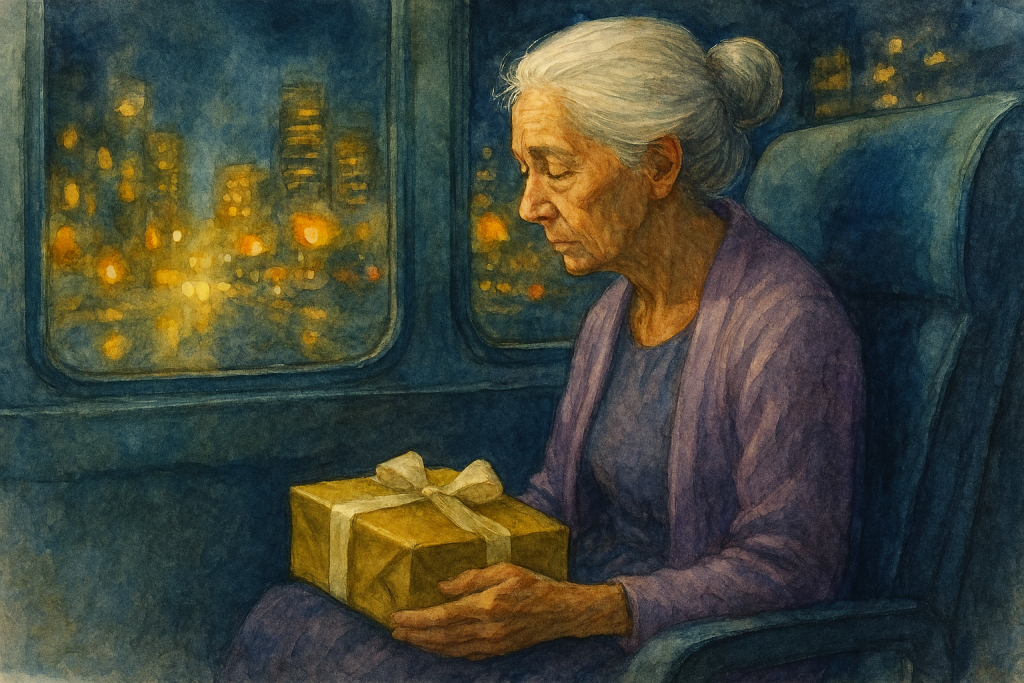
    In the absence of her young friend, Violet moved to the window seat. The bus moved steadily through the empty streets, and she was settling into the rhythm of flashing streetlights and the glare of headlights from passing cars when something brushed her leg. With a start she realized that it was Laurie’s package—her birthday present for her mother. She slipped the gold foil-wrapped gift from its designer shopping bag. The flawlessly wrapped box was tied together with ivory ribbon looped in the center into a perfect bow. Obviously, Laurie had had the gift shop-warped, Violet thought. The job was too perfect for something the girl would have done herself.

    “Well, it will do no good to try to find your owner,” she said as she ran her fingers over the perfect package. “I wouldn’t have a clue where to start to find Laurie.”

    Violet held the package on her lap and stared out into the passing night. She dozed.


    “We’re here, Ma’am.” She felt the driver’s hand gently touch her shoulder.

    Old lady in lavender dress seated on bus with gold-wrapped package on her lap and Texas city lights outside the window.
    Almost there…

    “Oh! Yes. We are in Dallas, aren’t we?”

    She collected her things, her sweater, purse, blue flower-covered valise, and the designer shopping bag containing the perfectly wrapped paisley scarf, then stepped into the damp coolness of the Dallas night.

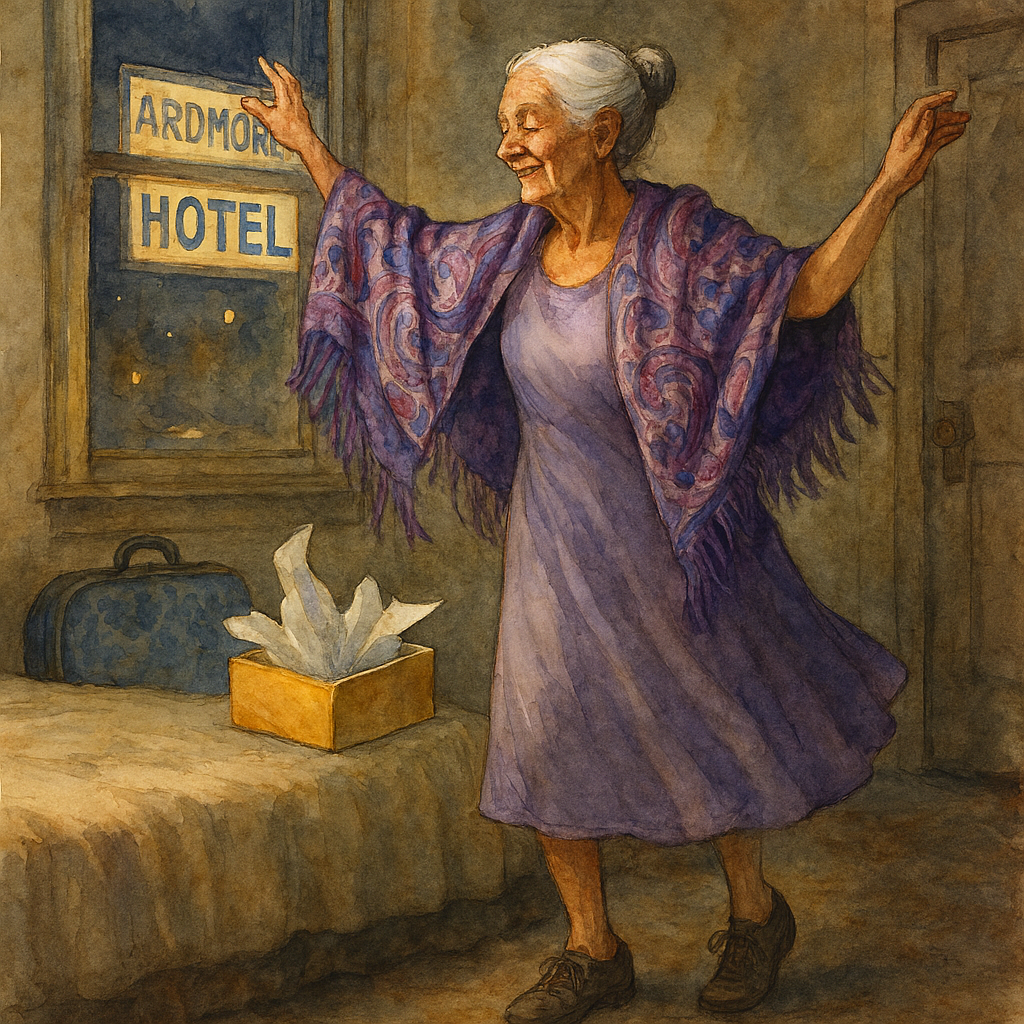
    Violet left the terminal and walked the block-and-a-half to the Ardmore Hotel. There she roused the disgruntled desk clerk and registered for two nights. The dim, shabby elevator lifted her and all her belongings to the second floor and Room 210.

    The room was stale and stuffy and smelled slightly of cigarettes and old wine, but Violet had become accustomed to it over the years.

    She sat on the edge of the broken-down mattress with its stained bedspread rumpled beneath her and rested a moment.

    “I need a bath,” she mumbled. Wearily and with an effort, she forced herself into the bathroom.

    After she had adjusted the water to a steamy temperature, she returned to the bed and removed her lavender chiffon. She left her slip on as she laid the dress across the foot of the bed. Suddenly, her attention was again drawn to the designer shopping bag. She removed Laurie’s mother’s birthday present and lay it in the center of the dingy mattress. It looked so out of place — almost glowing in the shadowy room. Violet stood staring at the package for a few moments, then padded on stockinged feet into the bathroom and turned the water off.

    She returned to sit on the edge of the bed and placed the present on her lap.

    “I am so tired of being alone,” she whispered and then, as if speaking to Laurie, she said:

    “You know, Sissy doesn’t really live in Dallas. Actually, I don’t know where Sissy lives. Hum, I don’t even know if she’s still alive. I think she is…I believe I would have felt it somehow…if she had died.

    “Every year on my birthday, I come back here, to this same shoddy, dump of a hotel. You’d think they’d remember me here, but they don’t.

    “Why do I come here?” Her fingers played across the satiny softness of the ribbon as she looked to her side, as if she were again seated beside Laurie.

    “Because…I suppose I have to keep up appearances…the neighbors, you know.”

    “You see, after Daddy was killed in the war, and after Curtis died up there on the ridge and Mamma died of her broken heart and Sissy ran off and vowed never to lay eyes on me again…well, I lost all the land. Everything except the house and garden. I was totally despondent, you see.

    “Everyone blamed me for killing Curtis, and…and I suppose I did…” Frown lines creased her brow, and the corners of her mouth turned downward as she stared at the ancient carpet.

    As if puzzled now, she continued, “You know, I remember wanting him dead. I remember that hunting trip up on the ridge. Sissy and Curtis were riding along the ridge together, and I…I stepped out on the rail in front of them. I slipped when I fired my rifle…I must have jumped out on some loose shale…everything was so fast. I was going to kill them both, you see. Curtis and Sissy. But the rifle fired into the air, and Curtis’s horse reared and he fell backwards, and his head smashed open and his brains poured out on the rocks. Sissy’s horse spooked and wheeled and ran back down the trail toward our campsite. I just stood there, holding my rifle and watching her on her horse and Curtis’s horse running off down the trail. Mr. Mahan, Curtis’s dad, pulled her off her horse when they stampeded into camp. He said she was in hysterics, and all he could understand was her screaming that Curtis was dead.

    “He died instantly. I dropped my rifle and ran to him as soon as Sissy was gone. I can still see him lying there, just staring up at the sky. I kissed him goodbye and closed his eyes, you know. He belonged to me, after all.

    “Sissy never told anyone what I had done, I suppose. She just left one day and never came back. I think Mr. Mahan guessed. He never spoke to me again and never looked at me again, either. People around town started pointing, and sometimes I heard them all whispering behind my back, but I didn’t pay them any mind at all, you know.

    “I got lonesome, though, after they were all gone, so I started coming here, to Dallas, every year on my birthday. Used to, I’d just come here and find some company for a few days, you know…a gentleman friend. Now I just come here. People back home think I come up to Dallas because Sissy invites me for my birthday every year.”

    With the faint sound of dripping water in the bath, she bowed her head, paused, and wiped a stray tear from her cheek, then carefully untied the ivory ribbon from the gold box. Gently she lifted the paisley scarf from the folds of tissue paper surrounding it.

    “Why! It’s got violet in it, and shades of lavender, too!” she exclaimed, holding the shimmering scarf out in the dim light. Then she jumped to her feet, laughing merrily as she wrapped the perfect paisley scarf around her thin, bare shoulders. “Sissy, darling! It’s exquisite! What a wonderful birthday present! It really is true! You definitely are the most wonderful sister in the whole wide world!”

    And in a world filled with streetlights, passing cars, honking horns, and wine-besotted derelicts, Violet Sheldon danced, danced, danced around the dingy room—alone again.

    The old lady in lavender dawns a lavender and blue paisley scarf and dances around a shoddy hotel room... alone again.
    Violet’s stolen moment of joy…

    THE END