Preface
Karen “Tanne” Dinesen, in Out of Africa, wrote in Danish, “I once had a farm in the Ngong Hills.” If the Alaskan Natives spoke of their cove at Chenik Lagoon in Kamishak, they might say, “There was once a village there.”
Lying beneath the spreading trees of Tanne’s farm just beyond Nairobi, I felt the depth of those words—not only in their meaning but in their essence. The air carried the scent of land long lived upon, and, in that moment, I knew it resonated with Alaska’s. At Chenik, the undulating salt-loving Elymus maritimus—beach rye that dances in the wind like the tide beside it—embodies the spirit of the land just as Africa’s grasses do. In both places, the interplay of scent, soil, and movement forms an identity, a heartbeat tethered to memory.
Opposites often share more than expected. In Alaska, I have felt the same profound connection as I did in Africa—that inexplicable sense of belonging to a land my heart recognizes as home. The stark differences fade, revealing something deeper: the emotional weight of place, the silent call of history beneath our feet.
The concept of opposites surrounds us—earth and sky, birth and death, samsara and nirvana, man and woman, sea and land. Even our own shadows reflect duality, ever-present yet never fully graspable. The Polynesians called the balance between past and future “ana pua-nana wale.” To stand firmly in one place, we must first reflect on where we have been and imagine what lies ahead.
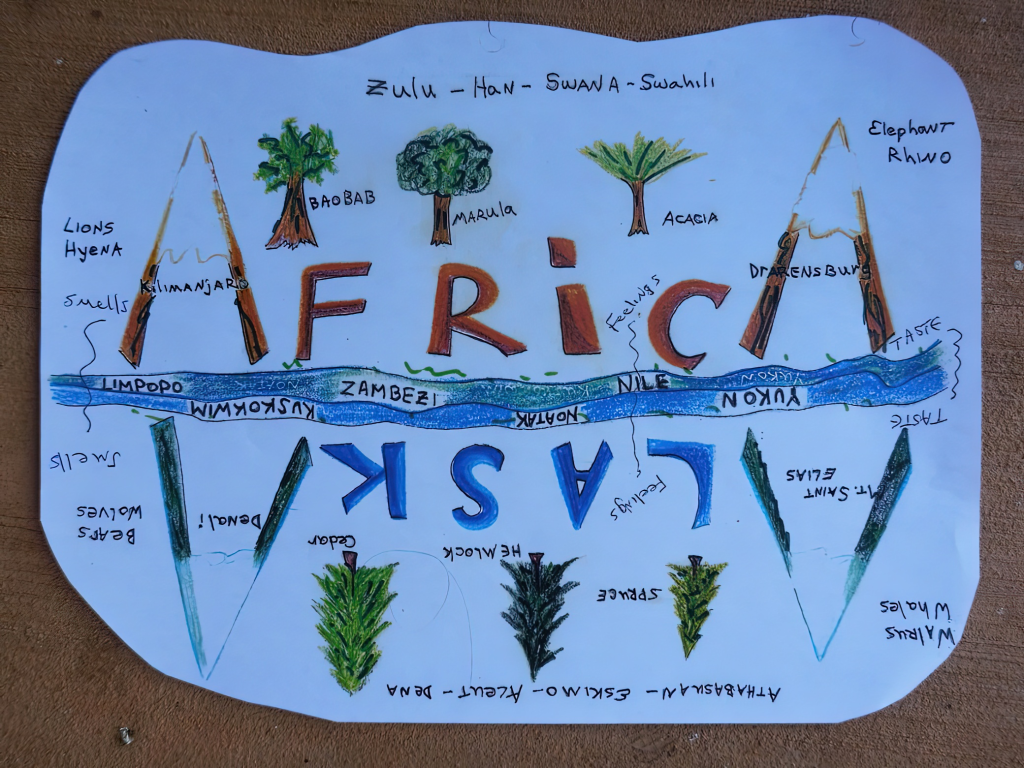
Alaska and Africa—geographic opposites—are best understood with a globe in hand. Yet beyond mere distance, they exert a pull, like a magnet drawing in curiosity, intellect, and imagination. These places stir something elemental, their contrast more kinship than separation.
My home in the north stands where a village once did, and the breath of those who lived upon this soil lingers in the spruce-scented air. Their presence is felt, not only in memory but in something intangible—a whisper from the land itself.
Chenik, an ancient village site, became a haven for nearly twenty-five years, shaping us just as it was shaped by those before us. Like the Phoenix, our camp rose from the ashes of past fires, only to become part of that cycle once more. What remains are echoes—the shadows of stories, real as breath yet elusive as mist. Though these narratives may seem like fables, they are as true as time itself.
Dedication
With these stories, I seek to honor Herodotus, the great Greek historian and storyteller who serves as my mentor. His narrative style—woven with cultural insights and historical accounts—guides my approach to storytelling.
Often called the “Father of History,” Herodotus was the first to apply a systematic method to the recording of historical events. Writing around 435 BC, he became a leading source of original historical knowledge, blending observation, inquiry, and vivid narration into a legacy.
Introduction to The Grand Antipodes
Opposites—whether in geography or within our own hearts—are often our greatest teachers, offering insight to those who look closely.
Were it not for a magnificent convergence of people and events, I would not be writing this. I owe a debt of gratitude to those giants who lifted me onto their shoulders, allowing me to see further down the path. To them,Idedicate this work, which is my earnest attempt to weave togetherstories that share the experiences and observations which shaped my journey.
This book is, at its core, a tribute to the insatiable wanderlust that carried me across oceans and continents, and to the countless individuals who inspired, guided, and challenged me along the way. From the Bering seacoast to the rugged Aleutian Islands, I ventured further and further westward until I reached the edge of the map the arbitrarily drawn international date line. Then, beyond that final boundary, I found myself standing in Chukotka, Siberia—without a passport yet warmly embraced by people I had been told were enemies.
This was but one of many moments that taught me to reconsider what I had been told and what I had assumed. It is opposites—be they distant lands, cultures, or ideas where the deepest connections often reside.
Where one finds the horizon, another may find their starting point. If I were to dig straight down, where might I emerge? Yes, into the antipodes, the other side of the world.
What I have set out to do is repay an overdue debt to honor the source that has given us a rich tapestry of experiences, woven together like the warm red and black stripes of a Hudson’s Bay blanket.
In the tradition of my Zulu friends, I wish to sing a praise song, a tribute to the land, the stories, and the connections that have shaped this journey. I want to sing it well, carefully enunciating each syllable, as ancient songs and stories were always repeated. I hope it brings both smiles and tears, stirring recognition in those who read it that they, too, have felt what I have felt. That there is camaraderie among all kindred spirits, a shared understanding that transcends borders.
Though the opening setting may be Alaska, the world at play here is far greater. A bountiful river of Africa runs through our Alaskan experiences, binding two lands that, though geographically opposite, share striking similarities.
Opposites, as it turns out, have more in common than we often realize. Just as our own shadows mirror us, so too do distant places reflect one another. This insight reminds us that the world is smaller than we imagined—that we are, in truth, one people.
The Alaska-Africa connection is a rich vein of treasure, first glimpsed as a glint in a mountain stream. We followed it upstream, and soon, it led us to the motherlode. We were given unspoken permission to mine it, and in return, we were gifted with something beyond measure—a veritable river of silver salmon, offering themselves to our nets, which in turn propelled us toward the other side of the earth.
It was a time when silver was gold silver salmon, that is.
These accounts serve as a tribute, a current flowing back to its source, honoring that which shaped, sustained, and allowed us to prosper.
In the Zulu court, there exists a role both sacred and deeply rooted in tradition—the m’bongi, meaning “thankfulness” or “gratitude”, is a singer of praise songs who was raised from birth to honor the Chief. These individuals are more than storytellers; they are the honored keepers of myths and legends, passing down histories through oral tradition from time immemorial. Their words do not simply recount—they uplift, integrating admiration, reverence and profound connection.
So too do I see my own role—weaving the ordinary into the sacred, binding experience with land and sea, air and animals. This is not new; it has been done across time and across cultures, from the first footsteps out of Africa to every corner of the world where stories are carried forward.
My praise song is sung for our ancestors, for the land that bore them, for the waters that sustained them, for the creatures that walked beside them, and for the diversity of people who continue to shape the world.
As the Zulu m’bongi honored their leaders, Robert Frost on the other side of the world in West Running Brook, honored the unseen forces that shape us—reminding us that a stream’s downward flow is its “tribute to its source”, just as we are tributes to what created us.
If Alaska is the final chapter of an ancient journey, then that journey began millions of years ago in Tanzania’s Olduvai Gorge, where Australopithecus—Lucy and her kin—first walked upright. Across the millennia, humans traveled ever further north, until at last, Alaska’s indigenous peoples arrived—crossing the Bering Land Bridge from the east. They would later encounter Europeans arriving from the west, converging in a land that feels, even now, like the farthest edge of the world.
Yet this story does not end where maps do. It carries us as far west as possible—even beyond passports and borders—continuing ever onward.
The beginning of my multi-cultural story has an Alaskan genesis, shaped by three distinct places—each bearing the weight of history far older than the Pyramids.
The Aleutians: Islands of the Four Mountains – A land of myth and mystery, where the ancient belief holds that “Chuginidak breathes through a woman.” This region remains one of the most remote and difficult places to access in the world, known only to the rare few who dare to tread its isolated terrain.
Nearby is Chulaka, The Oldest Occupied Village in Alaska – called Nikolski by the Russians, Chulaka has stood for millennia, dating back 5,000 years before the birth of Christ. From its shores, the silhouette of Anangula, Whale Swimming North, rises from the horizon—a small island believed to be inhabited by remnants of those earliest migrants who crossed the land bridge from Asia. The site, dating to 6400 BC, holds thousands of years of human presence, preserved beneath volcanic ash. Archaeologists like William Laughlin, professionally akin to Richard Leakey, excavated these layers, revealing a bedrock of history and the cornerstone of the ancient past: an estimated million razor-sharp lithic shards, remnants of centuries of sophisticated toolmaking.
The Bering Sea Coast – Northwest of Togiak, deep in the untouched coastal wilderness lies the final resting place of Apanvugpak, a warrior whose legend remains almost unspoken in history. Here, suicidal walrus, chased by grizzly bears, hurl themselves from towering cliffs—a testament to the raw, unforgiving nature of this place. In this vast expanse, where few ever tread, I wished to leave an offering at Apanvugpak’s gravesite and did so with gratitude. Perhaps no other living soul had done the same. I wanted to honor him and the generations of people who had walked these shores since time out of mind.
Interlude: Forgotten Landscapes
Even in the vast, untamed stretches of the world, there are places so remote that even those who dwell on their wild coasts do not know them.
Each of these stories stands as a tribute to the First Nations of this great land—a recognition of the deep histories, cultures, and lives that have shaped the terrain beneath our feet. They speak of places long inhabited yet scarcely known, where myths and legends live on, carried by the wind, whispered through the trees and through the long waving blades of the beach rye grass and embedded in the very soil itself.
We often believe we understand our world because we have mapped its boundaries and uncovered its secrets. But there are stories hidden in plain sight, waiting to be unearthed, their voices just beneath the surface, echoing across centuries.
These narratives remind us that discovery is not only about reaching distant horizons—it is about looking closer at what lies right before us. The richest stories are often the ones we never thought to seek.
A Life in Opposites
A lifelong fascination with remote, little-known, and unpopulated places has carried me across the globe—from the North Pole to Antarctica, Africa to Polynesia—pushing the boundaries of knowledge and possibility. These opposite corners of the earth have always held a particular fascination, both geographically and philosophically, reminding me that opposites are worth careful reflection.
In Antarctica, aboard the famous Lindblad Explorer as Expedition Leader, I experienced a moment of profound perspective. Captain Werner Volkersdorfer set me ashore in a Zodiac raft on the very beach where Shackleton and his men endured their ordeal before rescue. Shackleton left in search of help after four months, while others remained for ten months, surviving against all odds. Standing on that wave-washed gravel, I reflected on how far I was from my own home shore—on the other side of the planet yet I felt deeply connected to the place and those men.
Connecting with individuals in remote places creates a magic connection to those places. My global curiosity allowed me to have I friendships and ties in Polynesia, where I’ve been privileged to cross paths with remarkable individuals: Bengt Danielson, crewman on Thor Heyerdahl’s Kon Tiki raft, Dennis Akaka, crewmember on the maiden voyage of Hokulea alongside Nainoa Thompson and David and Dr. Mimi George, champions of Polynesian celestial navigation.
Yet another remote place led me to the Congo, where I worked alongside Franz Shimek and the Frankfurt Zoological Society under the United Nations, helping craft a Master Plan to restore Kundelungu and Upemba National Parks—lands nearly half the size of Switzerland. This work was as far-flung as one could imagine from my conservation efforts in Kachemak Bay, Alaska, and proved that opportunities for environmental protection knows no borders.
Flying the Alaska Bush with David Brower, the legendary founder of the Sierra Club, on his 80th birthday, was a world away from flying the African Bush with fellow game-ranger colleagues to protect the iSimangaliso Wetlands—which later became a UNESCO World Heritage Site. The Kalahari-Okavango designation, the 1,000th such site, became an enduring success thanks to the tireless efforts of Carol Ross, The Wilderness Foundation where I have been a Board member for decades, and “Bateleurs, volunteer Pilots flying for Conservation in Africa” where I was co-founder.
Another striking contrast emerged in environmental activism, under my mantra of working locally while thinking globally:
My family hosted Robert Rubin at my home in the wilderness during his tenure as Secretary of the Treasury under President Clinton, hosting Ian Player of Mpumalanga, Africa, co-founder of the Wilderness Foundation, alongside Magqubu Ntombela and working with Tebogo Skwambane, on the African Parks Board. Only to later be elected as the first Alaskan to the Smithsonian’s National Board—two wildly different antipodean localities, but with deeply intertwined purpose.
Each of these experiences sharpened my perspective, giving me both the confidence and conviction to testify before Congress and advocate for conservation worldwide.
Perhaps the river running through these opposite experiences was a quirk of ancestry, an inheritance from unknown forebears who, like Herodotus, understood the power of storytelling—the ability to inspire a sense of wonder for this vast blue and green planet.
If stories can help us better understand the diversity and complexity of life, they may also guide us toward peace—toward a stronger commitment to protecting each other and the world we depend upon.
Balancing this duality has become essential in the Anthropocene. In an era where the fragility of the environment is undeniable, we can no longer afford to ignore the sustainability of our own existence.
Unlike past generations, we have come to realize that the way we are living is no longer sustainable—that we are dangerously close to fouling the very nest that incubated us.
Yet, hope remains. A sense of wonder, whether offered by nature itself or through the carefully chosen words of a storyteller, may be at the heart of what drives action.
The antipodes before us are simple, do nothing, remain passive, sit comfortably on the couch with a remote in hand or do something, act in whatever way you believe can make the world a better place.
The choice remains our own.
A Story Against All Odds
Years ago, I was given a set of files by the young widow of my skiing partner—lost too soon to an avalanche in the Chugach Mountains of Southcentral Alaska. As a pilot, he provided transportation to archaeologists and anthropologists exploring one of the most remote stretches of the Bering Sea Coast. Throughout his long contract—conducting interviews with elders in distant villages, landing his Cessna 170B on snow-covered terrain—he gathered copies of their transcripts.
Against all odds, I ended up with them and against all odds—like Telemachus recognizing Odysseus—I saw within these pages a story as vast and compelling as the great Mediterranean epic itself. What lay between those black and white pages was a tale pulsing with life, energy, courage, and wonder—a chance to salvage the narrative of Apanvugpak, to honor Alaska’s First People through its telling. Without intervention, this history might have faded into the depths of museum archives, overlooked by those who should have chewed the bones and sucked the marrow from its realities, truths, and values. But that complete story must wait for another book—one that does justice to the extraordinary people of these distant, little-known places.
The Journey Home
I have been asked, time and again, to write not just these stories, but the story of how my wife and I came to this roadless land—how we survived, even thrived beside our northern estuary.
Many have set out for more distant horizons and lived more adventurous lives. There are bigger fish in the pond, and we are but a small minnow—our story shaped more by the time we lived in than by any grand actions we took ourselves. We were young newlyweds in 1960s Alaska, swept into an era of change, navigating the balance between opportunity and challenge.
Life, like the blending of nature and nurture, follows the melting currents—where rivers flow toward the sea. Some say you make your own luck; others insist luck favors the prepared. But all the luck in the world cannot help you strike a wooden match on a wet bar of soap.
Yet we had the gift of dry firewood—a box of strike-anywhere matches and a steady hearth from which to build a fire. Time and again, the planets and circumstances aligned, offering opportunities that rarely come twice. It was up to us to make the most of them.
Each of us walks a remarkable path, carrying stories that deserve telling and preserving. Our journey is simply another retelling of an age-old tale, one echoed across thousands of places and lifetimes.
The Shaping of a Vision
Experience is the prism through which we see the future—what we have witnessed and reaching for what was possible, propelled us forward. My own path began in the Far East, as a boy growing up in postwar Japan, immersed in Buddhist traditions and among the first American occupation families. The Land of the Rising Sun became my first home, offering insights into Old Nippon, its history, and its mysteries.
Yet Alaska called me forward, pulling me across continents, away from family and friends in Virginia, where my father retired on the gentle shores of Chesapeake Bay. Moving westward meant leaving the comfort of the Atlantic’s placid currents, only to find myself standing beside Cook Inlet—a body of water as volatile as it is vital.
Named after one of my maritime heroes, Captain James Cook, the inlet is an arena of volcanoes, glaciers, and towering tides, an expanse where indigenous history remains more intact than in Chesapeake Bay. And yet, despite the staggering differences, both estuaries serve a similar purpose, feeding into the oceans, sustaining life, linking land and sea.
Like everything else in this story, they are opposites. And yet, they are bound together.
Finding Home
Standing atop a high bluff, gazing across mountains, glaciers, and Kachemak Bay as it split from Cook Inlet, I knew—in a single heartbeat—I had found the place where I would spend my lifetime.
This was the place to bring a new bride, to raise children, to grow old, and eventually leave my bones to the land. But before settling into that vision, there was work to do. First, to reinvent myself—a man shaped by military service, trained as a Navy SEAL, leaving as an officer with captain’s bars. Then, to build a life, carving out a supporting enterprise, its form still unknown, but its necessity undeniable.
Challenges lay ahead—some ignored, others embraced. When recognizable opportunities arose, we seized them. And yet, as I stood there, I couldn’t help but wonder—what lies beyond the western horizon, beyond the mountains where the sun sets over the sea?
A Changing Era
What Diane and I did in the late 1960s was nothing unusual—we did what many Alaskans were doing. We took to the land, prepared for isolation, endured the long, dark winters, and worked tirelessly beneath the endless summer sun.
Yet today, few still live that way—few remain in the wild, content with its solitude, willing to endure its hardships. In that era, schoolteachers from Juneau rode circuit to homesteads and remote cabins, visiting correspondence students once per year. They slept on floors, in sheds, wherever they could—because no one had an extra bedroom to offer.
It was a necessary program, but like so many aspects of that world, it faded as families moved closer to medical services, within the radius of cell phone towers, and back toward human connection.
And now, many of those same people, their lives pulled toward modern conveniences, might admit that television, once a symbol of progress, was nothing but an insidious intruder in their home. Bob Dylan saw it happening across the country, and we saw it too, in the Alaska bush, as “The Times, They Were A-Changin’.”
Passing the Torch
We were among the luckiest of our era, finding a niche that could expand to sustain us through a lifetime. Now, we hope our children, grandchildren, and future generations can forge similar experiences in this place.
Perhaps, instead of drifting westward, as pioneers before us did, the future will find stability—a shoreline unchanging, offering new challenges and rewards.
Or maybe their explorations will take different forms—not across continents, but beneath the ocean’s surface, or deeper still—within themselves.
Courage & Legacy
My John F. Kennedy generation answered the call of Profiles in Courage—embracing the challenge of inner struggle, recognizing that self-awareness was a measure of courage equal to bravery in battle.
Perhaps, for those who no longer have a westward frontier to chase, their wanderlust will manifest in the pursuit of peace—both Peace with a capital ‘P’, and peace with a lowercase ‘p.’ Because peace—in all its forms—is the opposite of conflict.
Now, more than ever, the world must acknowledge the urgency of equanimity among all people. If individuals cultivate peace within themselves, it will radiate outward—to families, communities, nations, and beyond. This is natural progression. And so, I pass the baton optimistically, hoping that the children of today will embrace it—and pass it forward, in turn.