Walking in the Footprints of
Polar Bears
by Michael McBride
Survival, Storytelling, and the Wild Pulse of the Arctic
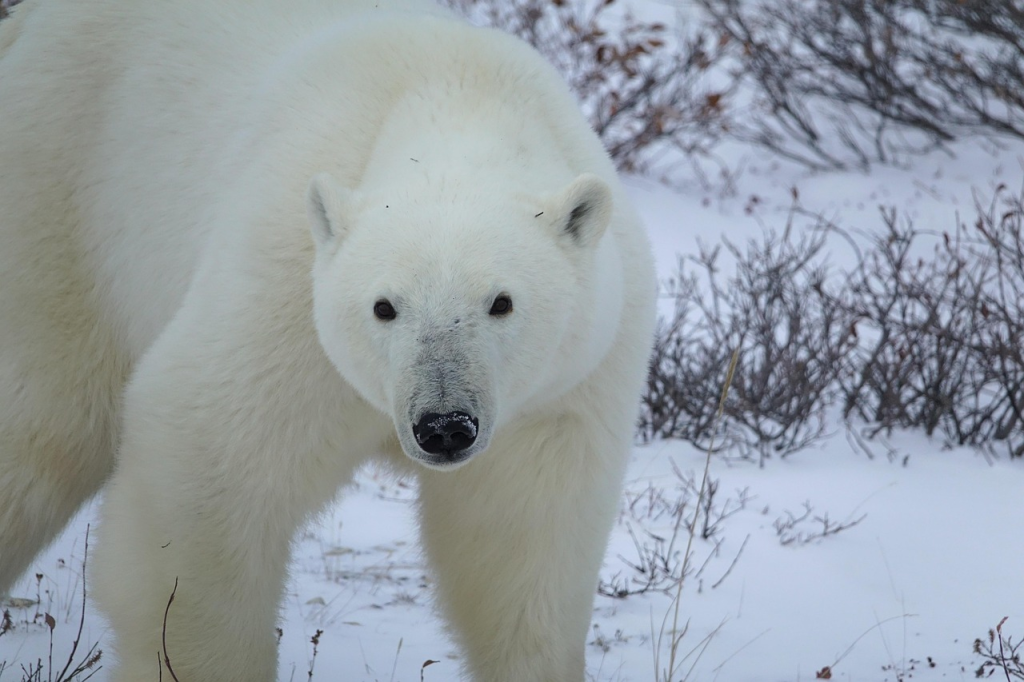
One of the world’s foremost polar bear experts, my friend and associate Jack Lentfer, is internationally respected by his peers. Here on the sea ice with a dart-drugged ursus maritimus under study and about to be radio-collared. Average weights range from 600 to 1,200 pounds and they stand 8 to 10 feet tall, while females weigh 400 to 700 pounds. Polar bears can live up to 25 years. The largest polar bear on record was a male shot in Kotzebue Sound, Alaska, in 1960, weighing 2,209 pounds as measured by helicopter scales.
A polar bear’s smell would alert a seal, its favored food, to its presence, even if these masters of stealth were approaching from downwind. There is a myth that a bear covers its giveaway black nose when stalking, but this has never been documented in the wild.
Few artists have captured the far north better than Fred Machetanz (February 20, 1908 – October 6, 2002). He was an Alaskan painter and illustrator who specialized in depictions of Alaskan scenes, people, and wildlife.
My friend Yemegaq Slwooko told me an ancient story as we sat on her floor in the village of Sivugaq in the Bering Strait, Alaska. A storm raged just beyond the door, its insistency shaking the house. The view through the ice-skinned window spoke volumes about the comfort we enjoyed within as she skinned the white foxes her husband had trapped the day before. Sitting straight-legged, weaving nets or grass baskets, skinning, and butchering game is all done sitting on the floor in the central room. We would call it the living room. Quasag is one name for such places, where, while working, one tells stories to pass on the ancient ways.
“In the culture of my ancestors,” she said, “the greatest gifts we can give or receive are those without material form: songs, dances, and stories.”
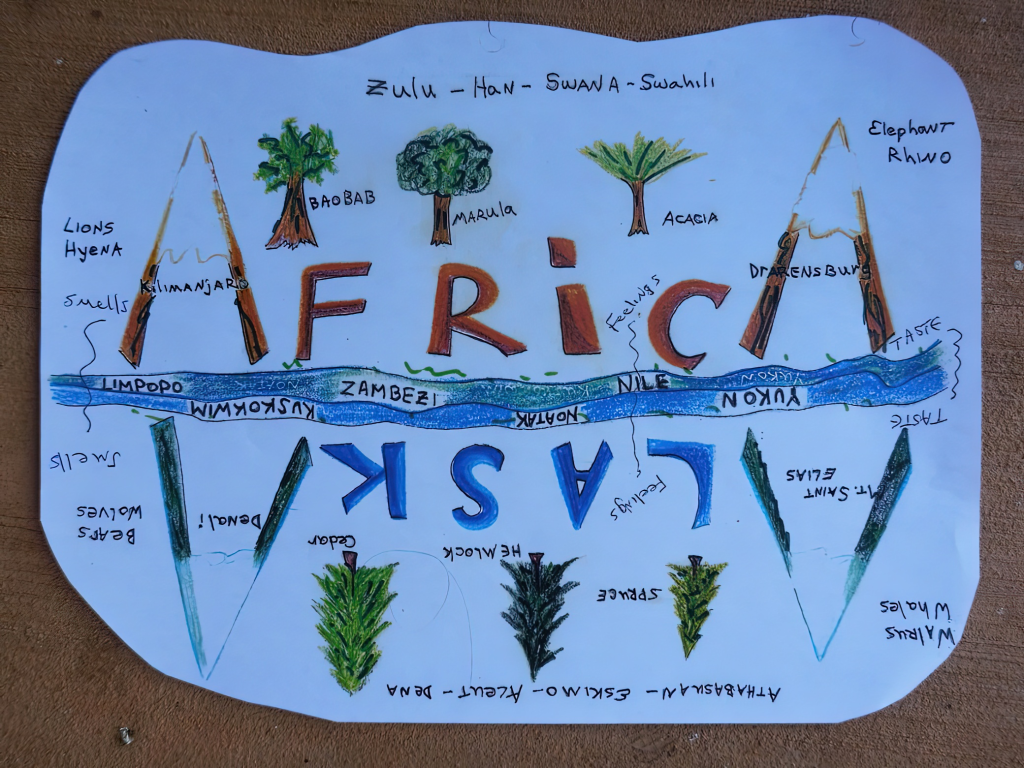
On the other side of the world, Alaska’s antipodes, in Africa, an imprisoned !Kung bushman of the Kalahari says that he is “waiting for the moon to turn back, that I may listen to the stories of my people, for I am here in a great city where they have put me in a cage and I do not obtain stories. I listen, watching for a story which I want to hear. I will turn my ears backward to the heels of my feet on which I wait, so that I can feel that a story is in the wind.” Lucky for us, one of the truly great raconteurs, Laurence Van der Post, saved this story for us, never imagining that it would reappear and have poignant relevance in remote Alaska.
Stories have always begun this way, the best ones perhaps told by elders, perhaps enhanced by a full moon and surging tides or the music of a talking river. There may be lightning or the call of owls, a crackling fire whose incense intoxicates. Wolves or lions may be speaking in the distance. Stories can communicate and need to communicate magic, but they need not take place in such exotic settings. The inner search or struggle for self-awareness may place the seeker in the greatest of all wildernesses, that within one’s own heart.
A few days ago, I was invited into the Zion Canyon workplace of a friend, the gifted potter and teacher. He handed me a moist lump of clay and with another in his hands, we each began to shape a sphere. The expectant lump was rounded until smooth. He instructed me to place my foot beside his on the stool in front of the potter’s wheel. Using the kneecap as a form, he gently but authoritatively smacked it on his knee, and I followed suit. Smack, turn, smack, turn, smack, turn. Then, using just our hands, we shaped and turned, lifting the walls, deepening the base. Our attention was directed to uniform thickness until a small crude bowl was formed, not much bigger than the cupped hand.
In those moments, we were as free from care as children. The left brain relaxed as the tactile senses came alive. The earthy smell of the clay was clean and heavy on our hands. The mind is more open when playing. There was a church-like quiet in the room. Motes danced on a beam of sunshine coming through a high window in the studio and encouraged a lightness of approach and freedom from desire and ambition. Basic, elemental, even primeval was this most ancient of creative expressions. In my life, I hope to be as open and expectant as a child at play.
Like the bushman, I will listen for the story. Like the Eskimo, I want to be appreciative of the insubstantial. The song and the dance and the story, real or imagined, hold greater value than we can know. Imagine now your own empty hand reaching out, cupped as if to catch water. I imagined being would be as naked as a sadhu in a Punjab alley whose raiment is only ash from the charnel fires, whose empty bowl is the only possession. To such a one, life itself is such a mysterious blessing that anything which comes to the bowl is like rubies and pearls.
On the opposite side of the earth, my good Cape Town friend Dr. Ian McCallum, brilliant author of Ecological Intelligence, describes a kudu stalking a shadowed shrub from downwind. With beautiful straight-up long curling horns, it favors a bush that is able to release a toxic smell and taste as soon as a kudu begins to graze on its delicious leaves. The clever kudu has learned that it is its smell that triggers the plant’s chemical defense, so it stalks from downwind and browses quickly before the offensive smell and taste is released.
The contrasts within the Alaskan/African Antipodes are nowhere more striking than in the parallels between the Alaskan Inupiat word “Malawi” and the Bantu Chewa word “malaŵí.” When I was with Credo Mutwa in his African homeland, I asked him, “You have an adjoining country called Malawi. Was the country named for its large lake, and what does Malawi mean?”
Malawi in Africa refers to a country in southeastern Africa, and the name itself is derived from the “Maravi” people, a Bantu ethnic group. The word essentially means “flames” in the local Chewa language, possibly referencing the sight of many kilns burning at night. The Maravi were known iron workers. It is the fourth largest freshwater lake in the world by volume and stretches almost the full north-south length of the country itself.
I told Credo about my time with my friends, the Inupiat people above the Arctic Circle, and about being out on the sea ice with my hunting partner, the best-known polar bear hunter in the village of Sivugaq. We were not interested in the polar bear, despite the giant tracks we were walking in, but rather wanted to collect, as we were asked to do, the unusual and little-known Spectacled Eider duck for museum collections in the US and abroad that did not have them.
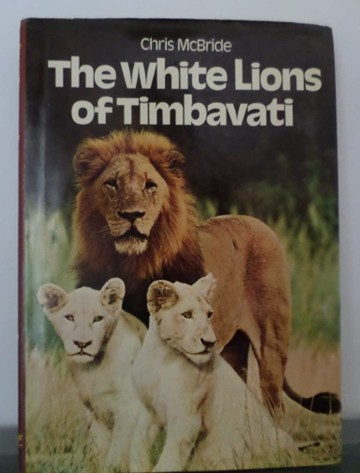
I considered the opposites of the African Timbavati lion as I walked on the ice in the dinner plate-sized polar bear tracks. The African and Eskimo word Melawi fell from the river of stars in both places I had experienced. How, other than by considering magic, can one accept this impossible coincidence that the African and Alaskan word Melawi are the same?
There was only ice for hundreds of miles in every direction. These were places where the people knew there was an under-ice current collision with an under-ice cliff, which then swirls upward to create a place of open water. These unique eiders are known to gather and overwinter in these places by the thousands. In addition to the rising food-carrying currents, the dabbling, wing-stretching, and paddling movements of the ducks stir the surface water just enough to prevent the forming of ice.
The big man, royally robed before me, was glistening in the heat. He drew on his many encyclopedias of memorized information and said, “Mr. McBride, there are numerous words in African languages that are the same in Inupiat,” and he recited a few. Of the millions of abstract questions I might have asked him, how could he possibly have known that? Credo’s intellect always amazes, dazzles, and leaves speechless those who interact with him.
This was not the first such revelation of his brilliance. Wondering if I could stump him on something obtuse, I asked if he knew anything about the Celtic roots of my children’s names, Morgan and Shannon. He launched, without pausing, into a long-detailed narrative that would have impressed Fiona Salmon or a PhD scholar in the history of Clan Donald of the Western Isles. Credo could have held a chair at Europe’s only Celtic University, Sabhal Mòr Ostaig of Skye in the parish of Kiltearn, Ross and Cromarty, Scotland. He could have been an honored guest at the festive table of the Chief of Clan Munro, Hector William Munro, in his castle home of Foulis. I wonder which of the many rooms would have been provided for Credo and his entourage?
Paths That Cross the Great White Bear
The somewhat random and loosely connected stories and observations that follow concerning polar bears demonstrate that even an Alaskan living far from these great white bears can recall many encounters. Each memory is vivid, perhaps because of the mysterious spiritual power the great white bear holds. I share these stories with respect to highlight how the northern people found uses for the bears beyond what we could imagine.
As supreme opportunists, these great bears can roam hundreds of square miles, wandering the trackless ice beneath the shimmering, multicolored aurora.
Though I live far from their life-supporting sea ice, polar bears have occasionally appeared on the Kodiak Island chain, which has a temperate continental climate. To get there, a bear would have to traverse the ice or shoreline of the Bering Sea, cross the Alaska Peninsula with its towering mountain chain, and swim the 30 miles across the open water of the Shelikov Strait.
I was once asked to escort a well-known author from Outside Magazine who was on assignment to explore exciting winter activities. My Piper PA-12 was equipped with straight skis at the time, so I flew him up to the remote Mountain Lake Camp (loonsonglakelodge.com) to experience the chilly delights of three feet of fresh powder snow. Bush flying on skis in winter is an adventure in itself, with severe cold and landings on frozen lakes, from which we ventured out on cross-country skis following the tracks of wolves, wolverines, and moose. The crackling of kindling splits is a sweet sound when rising in the blackness to start the day, accompanied by the chugging of the little coffee pot. The dancing, multicolored aurora before first light takes your breath away. There is much to love about winter in the bush—I am never disappointed.
I wore a polar bear fur hat made for me by my Arctic Native friends, which I generously loaned to the writer and never saw again. He was thrilled to have the REAL Alaskan experience with such an extraordinary hat! I was proud to own such a heritage piece of traditional village headgear, having seen one only once in an Arctic village. A person could stand in the lobby of the Anchorage International Airport for a year and never see one.
The most exotic polar bear item I ever encountered was the bear’s head, removed in such a way that the hide could be sold as a valuable rug, while the head became a large gathering bowl used for collecting radiola or storing hunters’ equipment or household items. I believe it might have had shamanic use because when you put it over your own head, it draped over your shoulders, plunging you into darkness. Your face aligned where the bear’s was, and light coming through the sewn-shut eyes, nose, and ears allowed your imagination to run wild as you assumed the bear’s spirit.
Shamans could and did become bears. Witness the Peter Kalifornski story of The Kustatan Bear, which terrorized a whole village and could only be killed with a magic bullet blessed and consecrated by a priest or perhaps by the shaman himself. Killing the great bear was killing the shaman who had become the terrible bear, bringing grief and destruction to the village. Shamans didn’t always earn “ice guy” awards.
Another item of clothing that has disappeared is polar bear pants. I have never seen them anywhere but in museums. In the past, they were the merit badge of a brave and successful hunter and of his wife, the skilled seamstress who, with her dexterity and cleverness, showed off her man.
The Power of Rhodiola
Rhodiola (Rhodiola rosea)1, was named for the rose-like fragrance of its freshly cut root. As a medicinal plant, its use dates back thousands of years in China and Tibet. Its medicinal use by everyone from Vikings to modern athletes and even cosmonauts aboard the International Space Station is well documented. The people mix the leaves and buds of rhodiola with seal and whale fat to ward off scurvy and give them energy. I was struck by the ingenuity driven by necessity when I helped skin a seal by drawing it out through its own mouth. On the “living room-quasiq floor,” this unusual skinning is often done on absorbent, surplus cardboard from the village AC Company General Store. Using a very short knife or a lithic tool like the one I found in Africa that fits perfectly between thumb and index finger, one peels back the lips, pushes the nose up and back, and cuts along the bone to release the skin. It takes a skilled practitioner to get the full hand into the mouth, cutting around the nose, eyes, and ears. It is slow and tedious, with lots of hard pulling as you release the flippers from the body; they remain attached to the hide. The slipperiness of the animal and the hide is so great that some kind of magic seems to come into play to complete the task. There it is: seal hide turned right side out, looking just like a deflated seal on the ice, and beside it—a cherished, delicious dinner with lots of fresh-as-it-gets seal oil. The eyes, ears, and vent are sewn leak-proof tight, and the skin is forcefully stuffed with nunivak, the heart-healthy rhodiola. When the cutting was going on, we took care to leave as much of the blubber or fat on the hide as possible. This live seal-looking container is now buried in the tundra under a cairn of rocks to thwart the sea-hungry sled dogs. The large amount of fat left on the skin breaks down with necrosis, and each bud and blade of the plant, rich in vitamin C, is so needed in this land of nothing green in sight from September to May.
Intuitively, the people knew that the plant could prevent the deadly scurvy. The traditional Inuit diet does include some berries, seaweed, and plants, but a carnivorous diet can supply all the essential nutrients, provided you eat the whole animal and eat it raw. Whale skin and seal brain both contain vitamin C. The Inuit may have a higher genetic tolerance for vitamin C insufficiency.
Clams are very rich in probiotics and vitamin C. People who lived with walrus got them from their stomachs. As filter feeders of phytoplankton and zooplankton, vitamin C from clams is an essential micronutrient in the marine food chain, and it’s carried by copepods and their fecal pellets. This makes copepods a potential pathway for vitamin C to reach higher trophic levels, such as fish larvae.
What has not disappeared from special Arctic attire, however, is the wolverine ruff, sewn circularly around the upturned parka hood. Even as the beards, eyebrows, and eyelashes froze with the cold when using wolf, coyote, or other furs, the wolverine helps to keep the face frost-free.
Considering where, when, and how often these mysterious bears appear in my own space, it is worth translocating for a moment into the ancient Native world to consider the shamanistic view of this animal and perhaps even its power over modern white people like us today. There is a very thin and diaphanous veil separating us from the bear and the shaman. Its thinness is clearly seen as the distance between bear and seal. If the seal were a little faster and more clever, there would be no bears. If the bear were a little more cunning and faster, there might be no seals, thus also with lions and their prey at the antipodes. To consider these separations perhaps requires that we be more open-minded and open-hearted to unexplainable mystery.
Imagination is more important than intelligence, Einstein.?
Thinking beyond current limitations is often more valuable than simply accumulating facts and knowledge alone; it is considered the driving force behind innovation and progress.
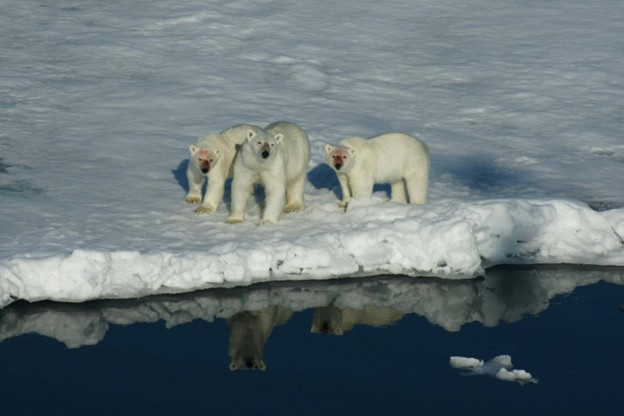
Image Credits
Walking in their footprints…
Pixabay Image
Image by Margo Tanenbaum from Pixabay
- https://www.webmd.com/vitamins/ai/ingredientmono-883/rhodiola [↩]