Black Currents and Ancient Messengers
The force that breathes life into this story comes from a magical place, where land meets sea, and where the ancient people lived in harmony with the spirits of the land.
In a season marked by the vagaries of sun and rain, a crop of black currants appeared—unlike any we had seen before. While the vines grow in scattered patches along the coastline of our bay, they flourish most abundantly atop archaeological sites that dot this south-facing shoreline. It is as if the berries draw sustenance from the accumulated remains, perhaps even the bones of those who lived here for thousands of years.
Across this stretch of Alaska’s coast, countless archaeological sites exist—silent remnants of early inhabitants. Like us, those first residents chose their homes with careful consideration. In the circumpolar north, a southern exposure is vital—the difference between light and darkness, between endurance and hardship. Pity the person whose home is shrouded in shadow on December 21, the shortest day of the year.
Even in this prime location, our winter solstice grants us only thirty minutes of direct sunlight—yet that fleeting golden glow transforms the mood of all who bask in its touch.
A hundred paces east of the lodge, the footprint of a Native barabara—a semi-subterranean home—remains visible where I have cleared away the forest floor debris. When sharing this place with visitors, I kneel, push aside an imaginary heavy bear hide, and enter, crouching. Pointing toward the southern notch in the mountain, I explain:
“Even on the shortest day, the winter door could be thrown open, allowing a direct path of sunlight to reach the center of the home—the hearth, the heart of life.”
Middens: Layers of Time
The Eskimo, Aleut, Indian, and Sugpiak civilizations left behind piles of discarded shells, bones, and organic material just beyond the entrances to their homes. Archaeologists call these middens, yet to those who lived here, they were simply part of daily life—a testament to survival, ritual, and the rhythms of the land and sea.
and the past reveals itself as history emerges beneath your feet:
White clam shells, shining like the remembered flames of seal-oil lamps.
Blue mussel shells, rich deep hues contrasting against urchin tests and bracken.
Bones of local animals, mixed with fire-cracked rock, remnants of ancient cooking fires.
And burials, too, must lie everywhere.
Late winter, early spring—the season of starvation. Supplies dwindled, and unless the weather was kind and hunters skilled, survival was uncertain. The very old and very young perished first, and while their people sought to honor them, energy was scarce.
In the deep freeze of winter, the ground was iron-hard. But within the middens, where decomposition warmed the earth, a shallow pit could be scraped—a place for a quiet resting place, where body and earth would intertwine once more.
The chemical dance of decay—calcareous limes, ash, and the tannic soil—created a nurturing medium, an unexpected gift to the thriving berry vines.
And so, in the whispering wind, among the currants born from centuries past, the land carries forward its ancient messengers.
Hunting, Gathering, and Food Preparation
For thousands of years, the survival of these Indigenous communities depended on their intimate understanding of seasonal cycles and the resources available to them. Their methods—shaped by skill, patience, and deep respect for nature—were passed down through generations, ensuring continuity between past and future hunters, gatherers, and caretakers of the land.
The people of this region were exceptional hunters, navigating vast tundras and icy waters with precision and reverence. Hunting was never merely an act of taking—it was a relationship with the land and its creatures, guided by respect and necessity.
Seals and whales provided essential fat, meat, and bones, their hunts requiring communal effort and coordination.
Caribou migrations dictated seasonal movements, as families tracked herds and used well-established techniques for trapping and pursuit.
Waterfowl and fish were gathered using woven nets, bone hooks, and clever strategies that took advantage of currents and nesting sites.
The hunter was not simply seeking prey—he was waiting for the right animal to present itself, believing that success depended on being “right with the world.”
Gathering & Preparation
Equally important was the knowledge of plants, roots, and berries, which sustained families through the harshest winters.
Black currants, cranberries, and wild blueberries were gathered with care, their arrival in late summer signaling an abundance that must be quickly preserved.
Seaweed and edible roots supplemented diets with essential nutrients, often dried and stored for months of scarcity.
Fire-cracked rocks in the middens reveal the presence of ancient cooking methods, where stones were heated and used to prepare meals.
Cornelius Osgood’s 1932 Yale Press[1] work Ethnography of the De’Naina documents many of these traditional practices—recording how early Arctic societies preserved food, adapted to changing conditions, and balanced consumption with conservation.
And so, woven into middens and burial sites, into the scattered bones of hunted animals, and into the black currants thriving above ancient fires, lies the unbroken thread of survival—a testament to resilience, adaptation, and the enduring relationship between people and the land.
Traces of the First Peoples
Radiocarbon dating of the oldest archaeological material in China Poot Bay reveals a profound truth—people lived here long before the pyramids of Cheops rose in Cairo, before even the earlier step pyramids took shape.
Yet, without written records, we do not know what these ancient ones called themselves. We refer to them as the people of the Arctic Small Tool Tradition—a name given to those whose presence across the far north shaped the early lifeways of this land.
The passage of time is difficult to grasp in its fullest measure.
The stories of Christ, Buddha, Confucius, Lao Tse, and Mohammed take us back just two thousand years. Six thousand years bring us to the dawn of civilization, when writing first emerged in the Fertile Crescent, across the Tigris and Euphrates in lands now known as Persia, Afghanistan, Iraq, and Iran.
But here, along the rugged Alaskan coast, the past endures in a different way—woven into the land itself, carried forward by the quiet persistence of nature.The first people arrived tens of thousands of years ago, migrating across the Bering Land Bridge, a vast, now-submerged corridor connecting Asia to North America. These early travelers, bound by necessity and curiosity, followed ice-age landscapes, navigating coastal routes and inland pathways where resources sustained their existence.
Over centuries, these communities became masters of the North, shaping their world through keen observation, deep reverence for nature, and unmatched survival skills.
They understood the tides, the winds, and the language of the animals. Their settlements—now buried beneath layers of earth—tell of their knowledge, their movement, their ability to adapt.
The Arctic Small Tool Tradition, spanning from Siberia through Alaska and into Canada and Greenland, brought sophisticated methods of toolmaking, hunting, and community building. These traditions, passed through countless generations, formed the foundation of modern Indigenous cultures still deeply tied to this land.
And so, while time moves forward, the stories remain—etched into the bones of the earth, whispered through the black currants that thrive above ancient burial sites, reminding us that the past is never truly gone.
Echoes in the Land
Among the many signs of ancient presence, none speak louder than the black currants. The berries thrive upon archaeological sites, their vines stretching across burial grounds, middens, and long-forgotten hearths. It is as if they are nourished by the spirits who once lived here.
The skins of the fruit are so dark, they seem to draw the ebony tarnish from the remains of long-extinguished fires. With each season, the berries bloom from the soil as blossoms in spring, only to fall back into shadow in their time.
I believe that every square inch of China Poot Bay has witnessed the fullness of life—birth, death, joy and sorrow, celebration and grief. The passage of this time is staggering. The stories of Christ, Buddha, Confucius, Lao Tse, and Mohammed take us back about 2,000 years. But 6,000 years ago—that’s the dawn of civilization as we know it.
Dances were performed for wide-eyed children while stories stretched long into the star-filled nights, the storm surf booming on adjacent beaches. Battles raged here; war parties set forth.
The great and the small lived here—some returned chanting in triumph, others moaning in defeat.
Kayakers paddled into these quiet coves, paddles held erect, blades lifted in peace. Others ventured out into the waves, never to return, leaving wives and children to wonder at their provider’s fate.
And somehow—the berries remember it all.
For those who pause to listen, kneeling low enough to breathe the damp air rising from the soil, the past is still alive.
The Language of the Ancient Ones
To the ancient people, the world was not divided between human, animal, and plant—it was all interwoven, all alive.
Stones in sacred places were given offerings, treated as if they had souls. Trees had voices, carrying good or bad tidings.
Successful hunters became the animals they pursued, mimicking their calls with near-perfect accuracy.
We are told that, long ago, animals and people spoke the same language.
A hunter did not simply seek prey—he ventured forth to see which animals were willing to present themselves. If he was “right” with the world, he would find success.
This understanding, this bond, is woven deep into the land.
The Communion of the Berries
In Christian tradition, the bread and wine of communion are believed to embody or symbolize the body and blood of Christ.
Is it such a stretch to believe that these berries are a part of the body and blood of the people?
The scented stems reach for the sun. The roots probe deep into the soil, drawing nourishment from the bones of those ceremonially laid to rest or fallen here.
The skins of the purple fruit are so dark, you might imagine they draw their ebony hue from the remains of ancient fires. The berries rise from the soil as blossoms in spring, then drop back into the shadows from whence they came.
Each summer, at berry-picking time, one kneels to uncover their hidden clusters. It is a reverent act, turning back the leaves and stems, revealing the secret places where the berries wait.
I sink low into the shadows, among the devil’s club and spreading ferns, searching them out.
Last fall, as I harvested from a massive vine curling around a giant stump, the land offered up more than five pounds of fruit—a treasure left for me to find.
Nearby, a stubby-tailed winter wren (Troglodytes troglodytes) paused, questioning me in her own way:
“What business do you have in my dominion?”
I assured her I would leave plenty for her and her kin.
She spoke. I spoke. We understood each other.
Neither of us was surprised.
What the Land Can Teach Us
Consider this—millions of people have walked this earth, yet for thousands of years, those who lived here left virtually no mark upon the land.
Modern humanity, however, in just a few hundred years, has already begun to reshape the planet itself.
What lesson lies in this for Alaska’s recent colonists—those who have been here barely a lifetime?
The Russian occupation began with Vitus Bering and Baranov in the late 1700s, lasting 125 years. America purchased Alaska in 1867, yet the United States only made Alaska a state in 1959—a mere 66 years ago.
Our time here is short. We have only just exceeded the length of Russian occupation.
How do we measure our impact against the millennia during which The First People lived in harmony with this land?
A Tribute to the Ancestors
She is now with her ancestors—the grandmother whose name was given to her.
She was the one who set me bread, tea, and dried salmon, when she had little to give.
She was the one who stitched skins for my family, who told me long stories of her ancestors “up Point Hope way.”
To her, I repeat her own good words:
“If I ever didn’t do right by you folks, I am sorry. You folks been good to me; God been good to me; I don’t wanna have no grudge against God.”
And I recall the words of another Native friend—the beautiful Inupiat elder and traditional healer, Aght-gle-gaq.
The Living Room of Stories
My friend Yemegaq Slwooko shared an ancient story as we sat together on the floor of her home in Sivugaq, a village on the Bering Strait. Outside, a storm raged, shaking the house with its relentless insistence.
Through the ice-skimmed window, the world beyond looked cold and unforgiving, yet inside, we were wrapped in warmth and tradition. Yemegaq sat straight-legged, skinning the white foxes her husband had trapped the day before—hands steady, movements practiced.
Here, in this space, life was carried forward through ritual and skill—weaving nets, braiding grass baskets, preparing food—all done on the floor of the central room, what we might call a living room, though its true essence was something deeper.
Among her people, such spaces were known as quasag—gathering places where, amid work, the ancient ways were passed down through stories.
She glanced up as the storm howled outside, her voice steady and certain:
“In the culture of my ancestors, the greatest gifts we can give or receive are those without material form—songs, dances, and stories.”
Listening for Stories in the Wind
On the other side of the world, an imprisoned Han bushman of the Kalahari speaks of waiting—waiting for the moon to turn back, for the moment when he may once again hear the stories of his people.
“I am here in a great city, and I do not obtain stories. I listen, watching for a story I long to hear. I will turn my ears backward to the heels of my feet on which I wait—so that I may feel when a story is in the wind.”
Stories have always begun this way—whispered into existence, shaped by elders, strengthened by a full moon, surging tides, or the voice of a talking river.
There may be lightning overhead, or the distant call of owls and lions, their voices carried by the night. A spruce or combretum fire may crackle, its incense thick and intoxicating. Somewhere beyond, wolves and lions speak, weaving their own untold tales.
Yet stories need not unfold in such exotic landscapes to be magical.
The greatest wilderness is often within one’s own heart, where the inner search for meaning becomes its own journey—an untraveled dominion waiting to be explored.
Each of us steps forward as a first-time explorer, seeking understanding, using the resources we have to make the world a better place.
The Shape of Creation
A few days ago, I was invited into the Zion Canyon workplace of Greg Worthington, a gifted potter and teacher. He handed me a lump of clay, mirroring the one in his own hands.
Together, we began to shape—rounding the expectant clay, smoothing its surface with patient turns.
Greg motioned for me to place my foot beside his on the stool in front of the potter’s wheel. With deliberate precision, he used his kneecap as a form, gently but firmly smacking the clay against it. Smack, turn. Smack, turn. Smack, turn.
I followed, trusting the rhythm, feeling the clay respond.
Then, with only our hands, we shaped and lifted—raising the walls, deepening the base. Our focus turned to uniform thickness, coaxing the form into something recognizable—a small, crude bowl, not much larger than a cupped hand.
A Return to Play
In those moments, we were as free from care as children. The left brain quieted, yielding to the tactile senses—alive, alert, instinctive.
The earthy scent of wet clay hung in the air, clean, grounding, heavy on our hands.
A church-like stillness filled the room, where even the smallest movement felt deliberate. Motes of dust drifted in a crepuscular beam of sunlight slanting through the high studio window, inviting a lightness of approach, a freedom from desire and ambition.
It was basic. Elemental. Primeval.
A connection to something ancient—one of the first creative expressions known to humankind.
Listening for the Story
As I reflect on these images, I hope to remain as open and expectant as a child at play—to listen as the bushman listens for the wind, to appreciate the insubstantial, as the Eskimo honors the unseen.
Because song, dance, and story hold greater value than we can know.
Imagine now, your empty hand, reaching outward—cupped, waiting—as if to catch the miracle of water.
I would be as bare as a sadhu in a cluttered Punjab alley, his only raiment the ash of charnel fires, his empty bowl his sole possession.
To such a one, life itself is a mysterious blessing—so much so that anything placed in the bowl becomes rubies and pearls.
Gathering Stories Among the Berry Canes
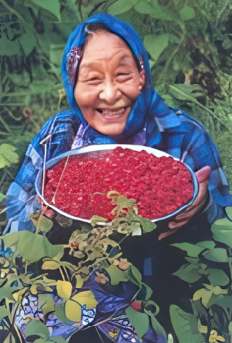
One day, as I knelt beside a beautiful elderly woman, gathering berries from the damp earth, I realized that this act was as sacred to her as receiving communion might be to a true believer.
The berry canes surrounded us, creating a quiet refuge—even curious owls would struggle to see within.
She told me a story from her ancestors, her voice steady, yet softened by memory. Perhaps this red bounty reminded her of girlhood days on the Arctic tundra, where life was light, where movement was free.
Her spirit soared—transported, almost—but for the sticky sweetness clinging to her fingers, forcing her to pause, to lick them clean.
“T’is so much joy; t’is so much joy,” she whispered.
A Tribute to Her Name
She is now with her ancestors, with the grandmother whose name was given to her.
She was the one who once set me bread, tea, and dried salmon, even when she had little to give.
She was the one who stitched skins for my family, who told me long stories of her people “up Point Hope way.”
To her, I offer her own good words once more:
“If I ever didn’t do right by you folks, I am sorry. You folks been good to me; God been good to me; I don’t wanna have no grudge against God.”
A Life on the Tundra
She was raised “outa’ town,” far from settlements, where her father had been hired by the tribe to live year-round among the caribou.
A harder life is difficult to imagine.
She once told me of a time when her baby sister, still nursing, fell ill—”stopped up.”
Her mother turned to her father, issuing simple, direct instructions:
“You go out there and kill a caribou, bring back that little bit of gut, and we will make the baby an enema. Put that piece under your arm so it don’t freeze.”
Few words. A glimpse into a world of raw survival, of resourcefulness, of deep-rooted wisdom.
I am grateful I was able to save this piece of ancient lore—a quiet but profound echo from the past.
Guardians of Tradition
I recall the voice, the smile, the laughter of another friend—Aght-gle-gaq, a beautiful Inupiat elder and traditional healer.
I remember the presence of Terry Rofkar, the celebrated Tlingit weaver of Raven Tail Blankets and master Basketmaker.
Like their brothers and sisters, they carry the weight of preserving the traditions of their ancestors, ensuring that stories, skills, and heritage are not lost to time.
Native Influences and Legacy
The land remembers.
Though centuries have passed, though the tides have swallowed footprints and time has buried voices, the legacy of the First Peoples remains woven into the very fabric of this place.
It lingers in the rhythms of the wind, the tides, the growing seasons, in the unfolding patterns of survival that guided those who came before.
Across the Arctic, from the high tundras to the forested coastlines, Indigenous knowledge shaped the land as much as the land shaped its people.
The Arctic Small Tool Tradition, spanning thousands of years, gave rise to lifeways so intricately adapted to the harsh realities of the north that remnants of their wisdom endure—in hunting practices, food preparation, craftsmanship, and ecological stewardship.
The Art of Survival
The early inhabitants understood that survival was not merely about taking from the land—it was about balance, about knowing when to hunt, gather, and prepare, and when to give back.
Their techniques, handed down through oral tradition, reflected an understanding that modern conservationists are only beginning to articulate—the land provides, but only when respected.
Even today, echoes of this knowledge remain:
- Subsistence hunting and fishing, where practices still mirror ancient traditions that emphasized only taking what is needed.
- Traditional food preservation methods, like drying salmon, fermenting berries, and using natural ice caves for storage.
- Navigation by environmental cues, where the grass, light, wind, and sea guided travel and survival.
The Unbroken Thread
Despite the disruptions of colonization, forced assimilation, and the encroachment of modern industry, Indigenous communities continue to preserve and pass down knowledge—ensuring that the thread of tradition remains unbroken.
Though roads and technology now lace the landscape, though governments attempt to define and contain Indigenous sovereignty, the connection between land and people remains intact.
And as the black currants rise each season from the soil—roots nourished by the ancient ones beneath—so too does the wisdom of those who lived before, carried forward by those who refuse to let it fade.
Their influence is not a memory—it is a living presence, woven into the earth, the harvest, the sea, and the stories that refuse to be forgotten.
[1] The title of Cornelius Osgood’s 1932 Yale Press work is The Ethnography of the Great Bear Lake Indians.