
Under the Bering Sea
by Michael McBride
IN A SCUBA DRY SUIT BENEATH THE BERING SEA, I worked to save a disabled king crabber as gale-force winds—approaching eighty knots—threatened to drive the vessel aground and take the crew with it.
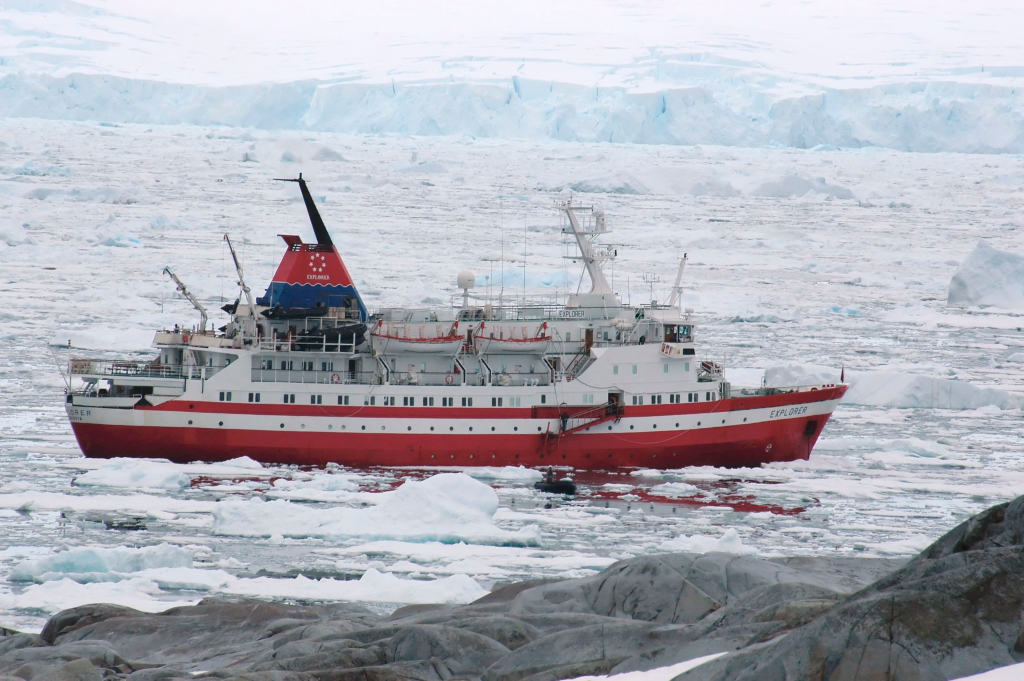
The Lindblad Explorer, famed for its Antarctic expeditions, happened to be nearby. I was serving as Expedition Leader aboard her at the time of the incident.
Sharing the bridge with German Captain Verner Volkersdorfer, I navigated the renamed Explorer—based out of Seattle—carrying ninety-six passengers and thirty-four crew. We diverted course to pick up a passenger in Prince Rupert en route to Nome, with plans to visit the rarely seen Pribilof Islands.
These islands—little more than treeless, tundra-covered hills—are home to the Aleut communities of St. George and St. Paul, with populations of about one hundred eleven and four hundred, respectively. Despite their remoteness, the shorelines and cliffs teem with life, making them a haven for birders and wildlife enthusiasts. Often called the “Galápagos of the North,” these islands attract those drawn to rare wild abundance: whirlpools of seabirds, herds of marine mammals, and congregations of whales.
Some come seeking to notch “Galápagos” into their travel log, only to find themselves equally mesmerized in the middle of the Bering Sea. Go figure. Chill bumps, after all, have no fixed geography.
The National Oceanographic and Atmospheric Administration attributes this biological bounty to enhanced tidal mixing—nutrient-rich slope waters rising into the euphotic zone. Copepods, crucial links between phytoplankton and predators, flourish here, feeding fish, seabirds, and whales in a food web of astonishing complexity.
The Pribilofs are the world’s largest Unangax̂ villages, where the languages spoken are St. George Unangam Tunuu and St. Paul Unangam Tanax̂ Amix̂. For English speakers, the bilabial pronunciations can be challenging.
Historically, the Unangax̂ traveled to the Pribilofs seasonally for hunting. But in 1786, when Russian fur trader Gavrill Pribylov arrived at St. George, the islands were uninhabited. That changed abruptly: for two years, the Russian-American Company enslaved and forcibly relocated Indigenous people from Siberia and the Aleutians to hunt fur seals. The descendants of those first captives still live there today.
Overhunting drove the fur seals to near-collapse, and the once-resilient Unangax̂ communities fell into poverty.
Now…
Now the islands are part of the Alaska Maritime National Wildlife Refuge and are known for their exceptional birding and vast gatherings of northern fur seals.
Commercial fishing—particularly for halibut—and seasonal work in local fish processing plants make up the backbone of the modern economy. Subsistence practices also remain essential, carried out with vigor and ancestral knowledge.
Each summer, more than two and a half million seabirds representing over two hundred species fill the cliffs, tundra, wetlands, and beaches. Even more staggering: over one million northern fur seals return to these shores to breed and raise their young—the largest such gathering of marine mammals anywhere on Earth.
Viewing blinds dot the beaches, offering close glimpses not only of fur seals, but also of Steller sea lions, walruses, and sea otters—each part of the deep rhythm of life in these islands adrift between continents.
As we approached, we maintained contact with the St. Paul harbormaster via marine VHF radio, which can reach across the sea for about one hundred miles. Through sizzling static, he confirmed our estimated arrival time and asked whether we had a diver aboard.
He spoke slowly and clearly, informing us that a large Bering Sea crabber lay disabled with line in its wheel—adrift in shallow water on the island’s windward side—and that a deep low-pressure front was approaching from the northwest, with predicted winds nearing eighty miles per hour.
I reminded the captain that I was a certified open water dry suit diver and had my equipment stowed in the bosun’s locker. I trusted Pedro Megano, our bo’s’n, to serve as my tender for what would be a challenging and possibly dangerous rescue attempt.
A high-wind warning had already been issued for the Pribilofs: eighty-mile-per-hour gusts expected from the north-northwest. The crabber and her crew—five or six men—were in grave danger. There would be no hope of salvation unless a diver could remove the fouled line and free the vessel before the storm arrived.
The sea was not heavy as the Lindblad Explorer hovered upwind from the crabber, “hanging on the hook.” Still, even in moderate swells, the anchor and heavy chain groaned and protested—an unnerving sound as Pedro and I clambered aboard.
Our twelve-foot black Avon raft pitched wildly, rising and dropping with each swell. The transfer to the crabber—a leap of faith—was tenuous at best. We quite literally tumbled over the bulwarks after first heaving our dive tanks and gear aboard.
The crew understood too well that their lives depended on me freeing that line. A spotlight was trained on my position as I moved aft to assess the current. I was more than aware that an anti-cyclonic tidal flow encircles these islands—complex, dynamic, and far from forgiving.
The bow’s orientation could have been influenced by either wind or current. What I saw disturbed me deeply. The current appeared to be flowing at nearly five knots—enough to make me seriously consider abandoning the crabber to her fate.
I understood the basics: warmer, slightly fresher surface water mixes downward, while colder, more saline water rises—driven by strong tidal movement. Bottom configuration adds further variables, and I knew there was no feasible way to enter from the stern and work my way forward to the prop in my cumbersome gear.
My only choice was to enter from the bow and belay myself aft.
The crabber’s bow, curved steeply upward, loomed what felt like light-years above the waterline. I turned to the captain and asked—half-joking, fully serious—whether he had any duct tape.
His look said everything, but he obliged. In the wheelhouse, I applied a foot-long strip across the engine start button. If I was going under that boat and hanging on to the prop, there was no way I was becoming crab bait due to someone’s careless mistake.
Next, I lashed a lead line to one of the large orange bumper buoys tied to the rail and tossed it overboard. If I failed or was swept downstream, I hoped to catch the trailing line and save myself.
I was not at all sure I had the strength to perform the series of underwater gymnastics required to get from Point A (bow entry) to Point B (entangled prop). I tried to picture the transition—while wearing a heavy dive tank and sufficient lead weight to neutralize the suit’s buoyancy. It was more than a little complicated.
Another mantra whispered to me: Beware of the unseen and unknown in unfamiliar situations.
Whether piloting a bush plane, a vessel, or simply driving a car, my personal rule is, “If in doubt—don’t.” The yellow traffic light is a warning. The next one is red. And I had no interest in meeting red beneath a disabled crabber in the Bering Sea.
Two cold-water swimmers offered me lifelong wisdom in moments like this.
Diana Nyad—movie-famous and still a dear friend—taught me the vital importance of breath control during high-stress underwater conditions. I assisted her once during her swim from China Poot Bay to Homer in Kachemak Bay.
Then there’s Lewis Pugh—Alaska’s antipodal counterpart, swimming in defense of fragile ecosystems around the world. Dubbed the “Sir Edmund Hillary of ice-water swimming,” Lewis became the first to complete long-distance swims in every ocean on Earth. Way to go, Lewis. Keep swimming.
Calm, they had both told me, was the secret.
That might be easy to say, but it is an art—an art that demands practice. And there was no time for practice. The storm didn’t care.
Over the side I went.
Immediately, I was gripped by the sheer force of the current and horrified by the monstrous razor-edged barnacles encasing the hull. These weren’t like the ones I’d lived with on my salt-kissed doorstep. These were serrated sabers.
My thirty-five-hundred-dollar Viking dry suit had no warranty against shredding itself on crustaceans. One tear, and my dive—and the crabber’s last hope—was over.
I remembered another dive: cold water, wrench in hand, when my neck seal tore. “I can take forty-degree water,” I thought. “I’ll finish the job.”
Old Neptune had other plans. He whispered back in his briny tongue:
“No sirree, Mr. McBride. Get your skinny butt out of my ocean—now.”
I complied, shivering, tail between my fins.
Somehow, this time, I avoided tearing the suit.
Reaching the prop, I nearly gave up. There were fathoms of five-sixteenths-inch polyline fused tight around the shaft and bossings. Unless I had a miniature underwater chainsaw, I couldn’t see how I would clear it.
My freshly sharpened nine-inch dive knife suddenly felt like a toothpick defending against a grizzly bear.
Then came the whisper, perhaps from some inner ancestor: “Faint heart never won a fair maid.”
So I attacked—with full force, though I cursed my choice not to pack a serrated blade. A diver under stress consumes far more oxygen, and I was stressed. That, I promise you.
Where to begin?
Just holding on to the hull in that fierce current felt like all I could manage. To untangle the problem, I had to shift angles constantly—fore to aft, port to starboard—searching for a solution from every perspective. I thanked all the yoga classes I’d ever taken and the four years of discipline from my military school days as a Navy SEAL. In underwater difficulty, calmness and breath control are everything.
A fathom at a time. Then another. And another. What felt like three hours—though it was surely less—passed before I began to believe I might succeed.
Few divers have ever been more relieved to break the surface than I was when I hauled myself from the sea and was helped aboard by the skipper—whose name I never did catch.
“What can I do for you?” he asked, still breathless.
“I’d love a spool of your net-mending twine,” I said. “It’s useful in more ways than you might imagine.”
He handed it over. That was that.
The dive had broken a cardinal rule—never dive alone—but there was another time, equally treacherous, when my solo descent nearly cost me everything.
When I first envisioned the Center for Alaskan Coastal Studies, it never crossed my mind that the dream might try to kill me. Yet there I was, helping build the Marine Science Field Station near the wilderness lodge, with no easy way to bring students ashore from the main transport vessel. Captain Jack Montgomery of the Rainbow Connection ferried kids back and forth from town with the kind of skill that makes it look easy. I knew the site intimately—I had kept a floating sawmill there, anchored with massive logs as I cut the lumber for the Center.
I’d found a three-thousand-five-hundred-pound concrete cube—three feet by three feet by three feet—to use as an all-weather mooring for the student raft. Board member Boyd Walker and I had constructed the raft from logs, rigged with a pulley system and a long splice in the line so it ran freely—no knots to jam—as we ferried kids from the Rainbow to shore.
But one day, I had to move the anchor into deeper water. And once again, from the salty depths rose that old mantra: never dive alone.
My friend, state legislator Drew Scalzi—the man who championed the Seafarers Memorial on the Homer Spit—owned a handsome tender called the Anna Lane. She was anchored nearby in Peterson Bay. Sixty-two feet long with a crew of four, the Anna Lane could hold forty thousand pounds of halibut or sixty-five thousand pounds of salmon in refrigerated seawater.
The anchor sat at the base of a steep, forty-five-degree slope. Beneath a layer of gravel lay three feet of glacial mud—fine as flour. Disturb it, and a thick cloud rises, blotting out all visibility.
I asked the skipper to help me move the anchor.
“Sure,” he said. “I’ll be glad to.”
Despite our care, we fouled the line in the prop, rendering the boat dead in the water. The Anna Lane was under contract to a cannery, and if they called and we couldn’t respond, the skipper risked losing a valuable agreement.
Without hesitation, I pulled on my scuba gear and dove in.
I fought through the tangle, locked in a knotted battle with a mess of heavy lines, when something touched my flipper—something that shouldn’t have been there.
At first, I thought a seal was nosing me, curious.
But through the dense brown cloud, I saw it—the underwater cliff looming near. The Anna was drifting on the slow tide toward the rock face, and I—wedged between iron hull and stone wall—was about to be crushed like a water bug.
I struggled harder. The line gave.
Back aboard, trembling in the safety of the galley, a hot cup of coffee in hand, I made a quiet vow to myself: never again, not like that. Never dive alone.

Image Credits:
Polar expedition vessel image by Constantine – Own work, via Wikipedia. Licensed under CC BY-SA 4.0.