Author: CaS

  • AWI Old Brands – Amelia’s Legacy

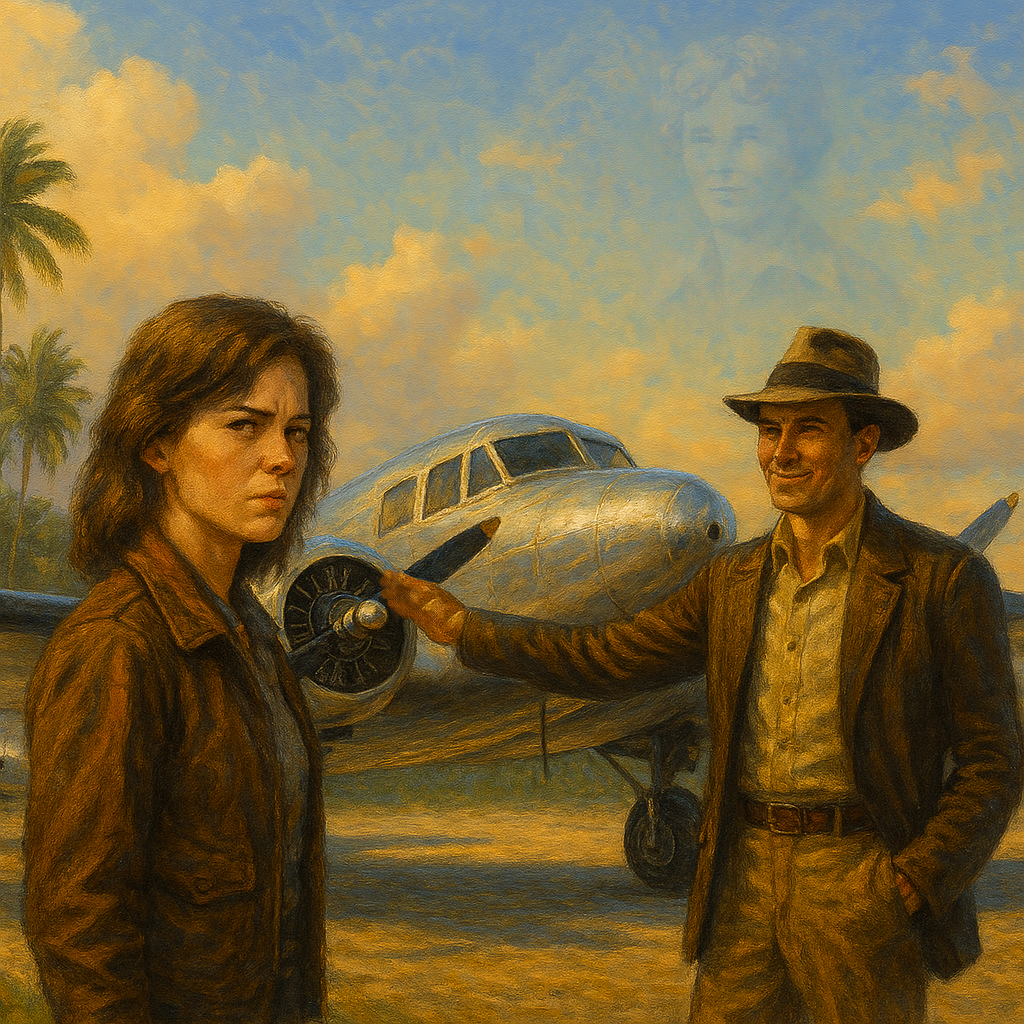
    A man and woman in conversation in front of a shiny Electra aircraft sitting on a runway on a tropical island. The ghostly specter of Amelia Earhart faintly appears in the clouds above.

    Amelia’s Legacy

    by CS Norwood

    © 1992, 2026 CS Norwood. All rights Reserved

    The sun had long ago reached its apex and was beginning a slow descent behind a line of billowing silver-tipped clouds. There it produced a fiery mix of evening orange and deep purple that mellowed to grey where it blended into the far line of the oceanic horizon. Possibly it was the changing light that finally woke her. She did not move immediately, however. Not only was she exhausted, sore and disheveled, but she thought she was probably suffering from a bad case of sunburn as well.

    She lay still for several minutes until she could no longer tolerate her awkward position. Slowly, in spite of the pain, she sat up. Pulling her leather jacket from the sand near her feet, she used it as a cushion to rest her sore back on the trunk of a palm. Though extremely weary and still a little dazed, she began to assess her situation. Looking behind her, she took in the island upon whose shores she rested. From what she could see, which wasn’t a great deal, it consisted of a dense tangle of vines, coconut palms, and mangos, all of which starkly contrasted with the shimmering blueness that encircled it.

    Georgiana was still reeling from the crash. For someone usually as verbal as herself, “endless” was the only word she could come up with to describe her Pacific view. “Lush” was the only word she could use to describe the jungle behind her. Ironically, that was also the only word she could come up with to describe the man who was responsible for her being here, utterly alone, for all she knew. Matthew Youngblood. What if he really was killed in the crash? The plane went down, where? Out there, in the gentle surf? It was so beautiful. What right had they to crash headlong into such beauty? She wrapped her arms across her chests the temperature had begun to drop fast with the setting sun, and her teeth began to chatter. She put the jacket on and would have left the beach, the jungle might be warmer, but she needed time to think and, out here, things might be a little clearer, less tangled.

    Matt had enticed her on this journey, this odyssey, this catastrophe, she thought, her anger rising. Why had she let him talk her into this?

    She let her mind wander back to a few days ago. She had been comfortable, resting in the hotel on Papua after the long shoot. It seemed the older she got, the quicker she tired of the 12 and 14-hour days on location, and she had decided to stay over for an extra weekend after the rest of the crew had flown back to L.A. She had not realized that Matt Youngblood, a freelance photographer, had been staying in the same hotel until she ran into him in the Melbourne Room bar.

    “Georgiana Hyatt…!”

    She lifted her eyes in the dim, smoke-filled room and saw him making hi way through the packed bar toward her. She did not know how she had missed seeing him the moment she walked in. Matt was, as always, breathtakingly handsome. Tall, rakish, yet with boyish charm, he had an adventurer’s look about him. He wore his brown fedora “Indiana Jones” style, although he was a little taller and darker than the movie hero. Each time she saw him again, and the absences usually spanned several years, she wondered anew why they had never slept together. He was as close to an Adonis as anyone she had ever seen. Maybe that was it. Maybe he was a little too perfect, too magnificent.

    “…Georgie!” He swept her into his arms as they came together, their lips met and she felt the fire of his intense passion as he kissed her long and hard. Suddenly, time and place no longer mattered, and any resistance she may had felt left her. She submitted to his will. Matt was the center of the universe, all she had ever longed for. Then, suddenly, he released his iron grip on her limp body, the moment passing. Awkwardly she returned to reality.

    “Where’s the hubby?” he said, still holding her, smiling mischievously.

    “Ah…Matt…it is so good to see you again. I’m not married,” she mumbled, still locked in his spell.  She wondered, idiotically, if she should perhaps shake his hand now. Instead she stood, catching her breath, studying those boyish features, drowning his deep, dark eyes.

    “In that case, may I join you?” he already held a Scotch whiskey in his hand. She hadn’t noticed it when he crossed the room. Before she could reply, he pulled out her chair and another for himself.

    “What’er you doing on Papua, Georgie?” He listened intently as she told him of the new line of South Pacific swimwear Intaglio Design was promoting, and how she was now their top model. He downed his Scotch, ordered another for himself and a vodka Collins for her. By the time the waiter brought their drinks, he had explained that he had just finished a World Environs assignment on New Guinea and just flown over to Papua for some change of scenery.

    “I discovered this great old twin-engine Lockheed Electra. Bought it on the spot. Completely restored. I’ve been flying myself all over the islands, paying my way by shipping off photos at each stop. It’s been terrific, Georgie. I wish you could take some more time off and come with me. I’m flying off to the Marshal’s tomorrow. I need to stop on Guam…”

    Similar backgrounds and mutual acquaintances allowed the conversation to flow easily between the supermodel, just passing her prime, and the world-class photographer. The two sat together long into the evening, sipping their drinks, talking of the people they knew and the places they had been, the near misses, and the times they had connected. Later, walking the beach barefoot, both speaking of other things, but telling of the thousand reasons they were each still alone, he held her again, and he whispered again, softly, so enticing, “…come with me Georgie.”

    That night, perhaps because of the magic of the South Pacific, perhaps because of their long unrequited desire, they did not remain apart. Their lovemaking was as Georgie had always imagined, made so much more by passionate by the longing, the sea air, and the faraway island that held them close.
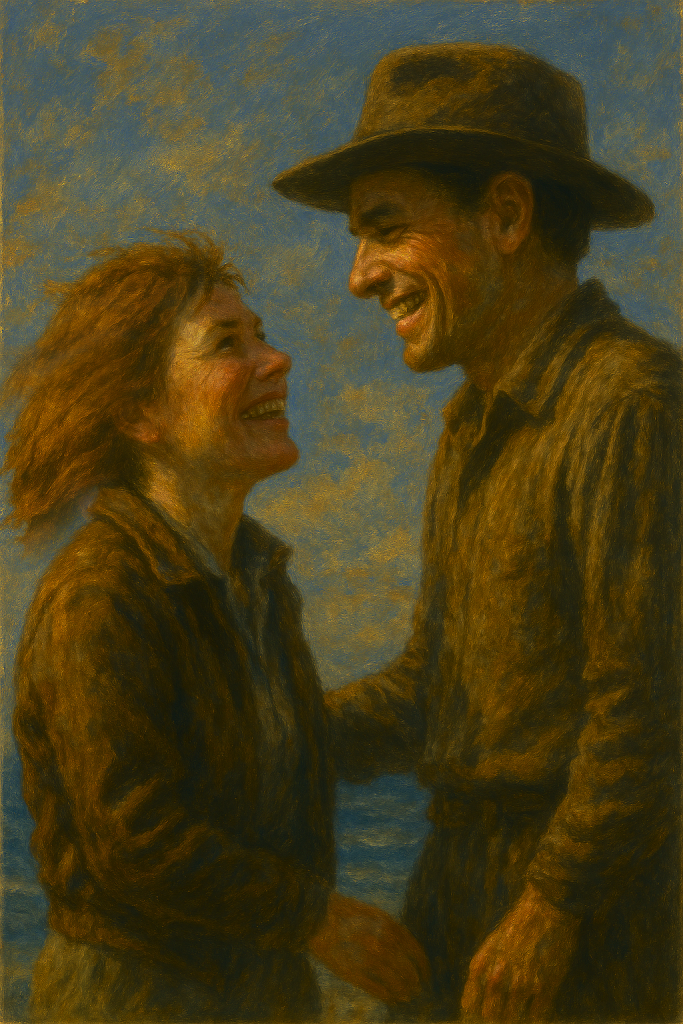
    In the morning, Matt took her to see the Electra. It was beautiful, sleek and shining, a silver aluminum masterpiece. It belonged in the sky, she thought.

    “Come and fly with me, Georgie. It’ll great up there together, you’ll see! Fly with me.” Matt would not be denied.

    “It’s so old…is it safe to fly?”

    “Perfectly. It’s been completely and meticulously restored,” he said, patting the fuselage. “I updated the radio and added a few bells and whistles, of course. But this beauty will take us anywhere we want to go in these islands.”

    Standing back, Georgie frowned, her hands shoved deep in the pockets of her leather jacket. “Something … something seems so familiar about this plane,” she said.

    “Maybe you remember seeing photos of one just like it. It’s the same model Earhart and Noonan were flying when they disappeared out here.”

    “Oh, God!”

    “Hold on, Georgie! It’s not the same plane. It’s one like it. Anyway, they probably went down because of navigational problems, off course, out of gas, you know. There weren’t any malfunctions of the aircraft.”

    “How do you know?” she demanded.

    A man and woman in conversation in front of a shiny Electra aircraft sitting on a runway on a tropical island. The ghostly specter of Amelia Earhart faintly appears in the clouds above.

    “Relax, Georgie. This baby’s sound as a 747,” he said reassuringly. Then her folded her in his powerful arms and kissed her long and deep, and she forgot everything else, even her apprehensions.

    “Okay, so where’re we going?” she asked as she fastened her seat belt.

    “Well, we’re headed for Howland. I’ve got to get some natural-habitat photos…”

    “Did you say Howland?” Georgie screamed above the roar of the engine as the aircraft lifted into flight.

    “Yeah! There’s a small strip there. Marine biologists use it all the time. Won’t be any problem landing there.”

    “Isn’t that the same damn field Earhart landed on just before she vanished?!” This was all a little beyond coincidental; Georgie began to worry.

    “You’re not superstitious, are you Georgie?”
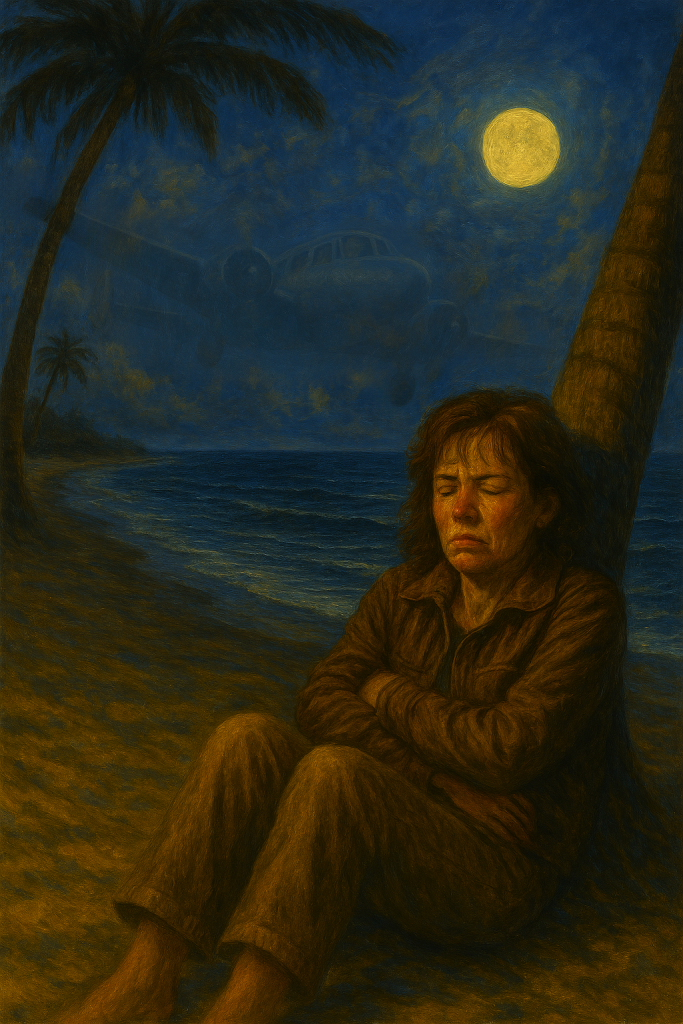
    Girl in kaki slacks and leather flight jacket huddles beneath a palm tree on a beach. The moon shines brightly and the spectral image of an Electra aircraft is in the sky above.

    Sitting here now, darkness closing in around her, she damn well wished she had been superstitious. She wished she had demanded that Matt turn the plane around that very instant and take her back. But that was yesterday.

    A full moon hung directly above now, playing its flickering yellow-white light across the waves in a phantom, iridescent glow. A canopy of stars, hanging just above her head, adorned the indigo sky. Waves washed onto the beach in a steady, low roar, moving ever closer with the rising tide. They licked at the sand near her feet, hissed softly, then receded into the smooth, wet sand. Georgie huddled beneath the palm, wrapped against the night breeze, lonelier than she had ever been in her life. She needed water and food. Tomorrow could not come soon enough.

    Thirst and hunger gnawed at her. The mindless bliss of sleep eluded her. The sandwiches and thermos of strong coffee they had shared to clear their heads from the liquor of the previous night had long since disappeared…drinks together a few nights ago…an age ago, she thought. The rest of the food on board certainly went down with the Electra. Her head dropped to her hands, her elbows on her bent knees.

    She couldn’t remember much about the actual plane crash, she realized. Did they land in the ocean or on this island? She couldn’t see any debris around her. She did remember that they somehow got off course and were running low on fuel. Of course, the radio had gone out and the radar wasn’t working right either. It was like something straight out of a very bad movie. She laughed out loud at the irony of it all, while steady streams of silent tears coursed the smudges on her face.

    Suddenly she remembered watching in horror as Matt fought for control of the airplane. Her last words came back to her now. “We’re dead, aren’t we, Matt!” She couldn’t remember his reply or even if he did reply. Overwhelmed, Georgie abandoned herself to her tears and the lonely, starry night.

    Finally, she slept, although fitfully tossing from side to side. She was never able to find a comfortable position, and she was not used to the incessant roar of the ocean. By morning, she was famished, and her tongue was swollen from thirst. She was cramped so badly that she was not certain she would be able to walk, but she knew she had to try; she had to pee. Every movement seemed a monumental effort, hardly worth it. First her swollen tongue, then her stiff neck, arms, back, and finally, she stretched her cramped legs, groaning with every new effort. All systems go! If nothing else worked, she would bully her body into compliance. With all the strength she could muster, she pushed to her feet and walked into the dense underbrush to relieve herself. Modesty first.

    “I don’t know why I’m being so damned modest,” she said aloud, astonished at the loudness of her own voice.

    “Well, you damned well ought to be in a tropical paradise like this; you never know who the hell’s going to be combing these beaches,” a masculine voice replied to her own.

    Georgie’s heart skipped several beats. When she came out of the cover of the vines, her heart was still pounding crazily from her sudden fright.

    She struggled with the thought of killing him on the spot — if she wasn’t certain she wasn’t already dead, she might consider it — an instantaneous thought. Instead, she rushed into his arms in gratitude for being alive, here with her. She wasn’t alone after all.

    “Matthew” My God, what happened to you? Where in hell were you? I looked all up and down this beach for you yesterday. I didn’t see a trace.…”

    He drew her reluctant body to him and held her close to his chest. “When the plane hit the water, it flipped. You must have been thrown clear almost instantly. I stayed with it as long as I could … get out as much gear as I could. I got a few supplies before she went down, flashlight, batteries, some of our food and some drinking water, not much really. The tide carried you in before I could get to you. The plane rested on the edge of the reef for a while, and I had to keep diving as long as I could. When the tide changed. It pulled the plane off the ledge, and it went down into deep water.”

    “Did you get a chance…”

    “No,” he said softly. “the plane was too old. It didn’t have a transponder. There was no way to send an emergency signal. Com’on, come with me. I hauled everything around to the north side of the island. I got a chance to spot a little lagoon surrounded by some cliffs. We can probably find some shelter there, and you need some water and something to eat. I’ve already laid in a supply of really fresh coconuts this morning,” he said with his old characteristic smile.

    Georgie looked into his sunburned face, already polished to a shine by the Pacific wind. A stubble of beard adorned his angular jaw.

    “This isn’t a joke, Matt. It’s not a game or some…some wild adventure photo shoot of yours! We are lost out here, and no one knows where we are!”

    “Com’on Georgie! It doesn’t help a damned thing for you to get hysterical over this! We’re here now and, by God, we’re gonna make the best of it! Now com’on.” He grabbed her arm and pulled. She winced, jerked her arm free, glared at him, and then followed stiffly when he turned his back and walked off. She looked back up her beach one last time. Perhaps she might need to come back — retrace her steps for some reason — but the tide had already washed their tracks away.

    He led her in a short cut through the scraggly palms that adorned the eastern tip of the island. Presently, they emerged on the northern shore. It was as if they had entered a completely different world. The beach she had just left had been clean and white, but what little beach she could see here was littered with sharp lava, volcanic rock, and odd flotsam.
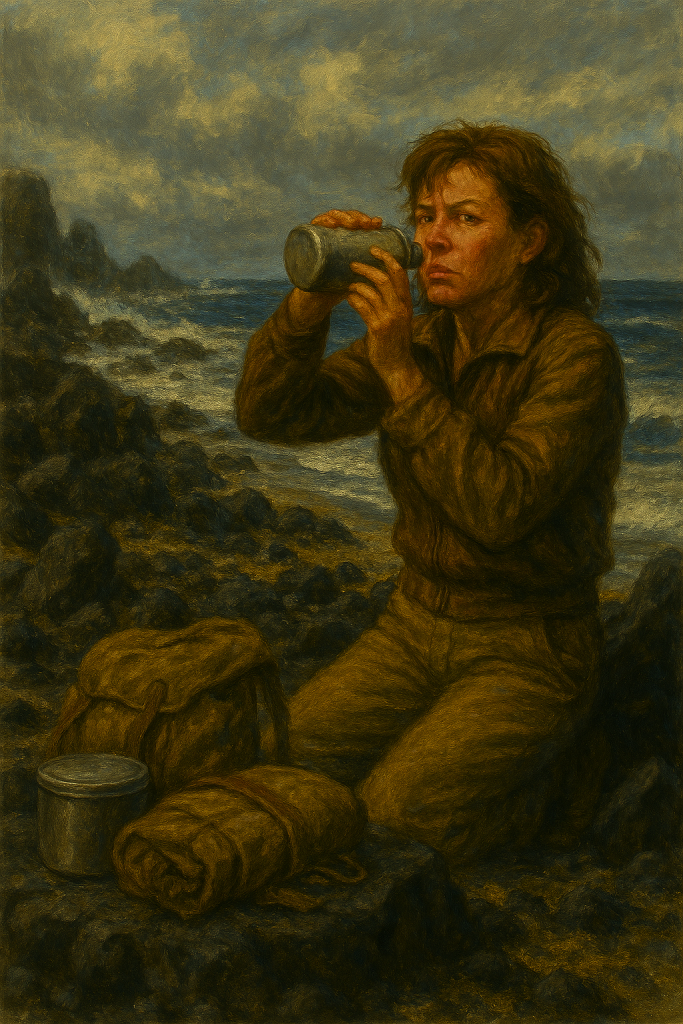
    A woman dressed in flight jacked and khaki slacks drinks from a thermos. She's seated on a rock-strewn beach.

    “I’ve just about got everything over here already,” he said, satisfied with his own efforts. He handed her a canteen of water and opened a watertight container that held the last of their sandwiches. “Easy on the water until we can locate some here,” he said. “Coconut water can keep us alive, but it’ll give ya the runs, too.”

    She looked at him now with a growing realization of the real gravity of their plight.

    “If worse comes to worse,” he held up a fistful of crumpled plastic wrap, “I can rig a little contraption to catch condensation.”

    She knew he was doing his best to reassure her.

    “Why did you wait so long to find me. You should have come looking for me right away, Matt,” she said, accusation rising in her voice. She was mad at herself the instant she said it. She needed Matt on her side more than ever now. It served little purpose to make him an enemy now. Still, she was finding it hard not to blame him for their situation.

    “I did,” he said, unruffled by her accusing tone. “I found you last night. You were asleep. I didn’t want to wake you, so I just kept working till daylight. I kept an eye on you. You’re not saying you wanted to help me move everything last night, are you?”

    “No…”

    “Com’on. See that lagoon over there?” He pointed to a small horseshoe curve in the shoreline about a quarter of a mile away. “I waited for you to check it out.”
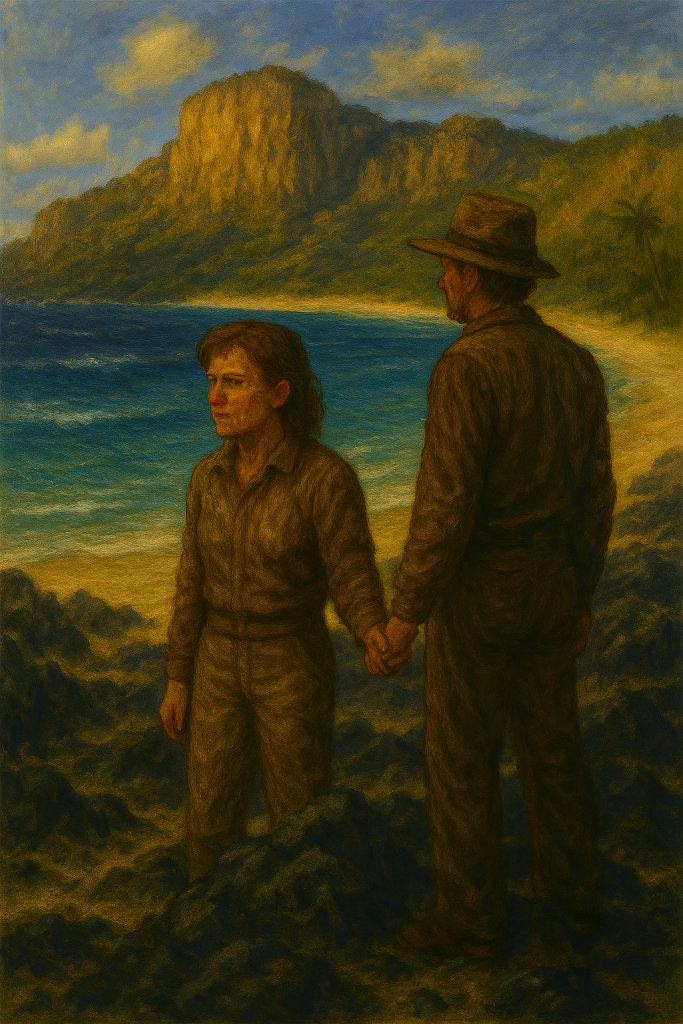
    She followed him along the rocky shoreline and onto the little beach that surrounded the calm, crystal clear lagoon on three sides. The white sand stretched from the water’s edge about thirty yards back up the island where it suddenly rose sharply into a rocky cliff. He led her away from the water’s edge, back along the rock-strewn base of the cliff. The going was tricky and she was becoming tired, her thoughts wandering to what she would be doing today if she were back in L.A., working as usual, when suddenly, they were back on the sandy floor of a beach facing a hollow in the cliff’s wall.

    “A cave!”

    “You wait here…”

    “Not on your life,” she said. “I’m not going to stay here while you wander in there and get lost forever!”

    He studied her face for a moment, “You’re right. That was foolish. We should stick together now. Let’s go back and get the flashlight and the rope.”

    He was headed back up the beach before she could protest.

    “Alright, we’re tied off,” he said as he finished wedging the piece of driftwood between two rocks at the cave’s entrance. He tested it with a couple of full-body tugs, nodded to himself and stepped into the dark, gaping hole. Georgie followed; actually, she had little choice as they were tied together, “Just in case,” Matt had said.

    “Do you think there are bats in here?”

    “No. There are no bats on these islands. You’re safe, Georgie,” he said. “You’re only imagining bats because it’s a cave.

    Georgie swallowed her rising fear. She had always been slightly claustrophobic, and her imagined bats certainly were not going to help this situation. She would still rather be with Matt, though, than outside, waiting and wondering, she rationalized.

    They followed the opening about twenty more feet before the light beam revealed a narrow passage, turning sharply to the left. “Let’s go,” Matt said. So far, they had crouched through the cave, but as soon as they stepped through the passageway, they found themselves in a large, high-ceilinged chamber, they could stand upright now. Remarkably, the chamber was not completely black. Light filtered through a slice in the rocks on the sloping wall to their right, and in the stillness, they could hear the steady, echoing drip of water from a seep in the rocks onto the chamber floor.

    Matt quickly located the water source beneath the chamber’s window. The water tasted slightly of minerals, but it was fresh. He set his canteen beneath the drip to collect the precious liquid.

    “This solves our drinking-water problem,” he said.

    Georgie rested beside the seep as Matt, freed from his tether, began to explore. She closed her eyes in the dim light, moved her hand back to brace her still-sore back and gave a startled cry. Matt rushed back toward her.

    “What is it?”

    “Something … there!” She pointed down.

    He played the light on the ground surrounding them. There, just to the right of the seep, lay an old leather flight jacket, similar to the ones they now wore, only much, much older. Matt was reaching for the jacket when his light caught something else. About ten feet away were the remnants of an old fire pit, barely discernable in the layer of dust and debris that covered it.

    “Someone’s been living here, Georgie,” he said.

    He played the light beam around the perimeter of the little nook of the chamber at the water seep.

    “Look!”

    Both of them cautiously walked closer to the chalky gray mass.

    “My God. It’s a human skeleton,” Georgie said in horror.

    “Must be the owner of this jacket. By the looks of what’s left, whoever it was, was broken up pretty badly. Look,” Matt said, “the ribcage is busted all to pieces. The left leg is fractured, and the right arm is broken up pretty good, too.”

    Matt stepped closer for a better look and kicked something loose with his foot.

    “What is that?”

    “Well,” he retrieved a round leather tube from beneath his foot. “It looks like some kind of document carrier. He took the handkerchief from his back pocket and wiped off a layer of dust.

    “Here, hold the flashlight. Look, there are some initials embossed on it, an F and, I believe that’s an N.” He paused thoughtfully before repeating the initials. “F.N.”

    “You don’t suppose…” Georgie said.

    “Suppose what?”

    “That that’s Fred Noonan’s case…that that’s Fred Noonan!” She pointed to the skeletal remains that leaned on the side of the chamber.

    “What…no! You’re letting your imagination run wild now,” Matt said, yet there was a hint of uncertainty in his rebuke.

    “What’s in there?”

    He opened the case. “Nothing, it’s empty.”

    “Damn!”

    “What did you think? You’d solved the puzzle of Amelia Earhart?” He laughed. “You’re being sort of romantic, aren’t you?”

    “Maybe. It would be exciting, though, wouldn’t it? To finally solve the mystery. Besides, there’s nothing that says that isn’t the body of Fred Noonan, is there? After all, isn’t this real close to where they were last heard from?”

    “Well, I guess…” He shrugged his broad shoulders and grinned his boyish grin.

    Suddenly he stopped short, frozen in place.

    “What!?” Her eyes followed his to the gapping fissure, the window in the chamber wall. There was nothing.

    “Nothing!” He appeared shaken, but regrouped quickly, drawing her attention back to himself. “Nothing … You were saying…?”

    She eyed him suspiciously but continued, “I was saying that those are Fred Noonan’s remains, and Amelia Earhart’s remains must be somewhere close by, right on this very island!” She spoke almost triumphantly.

    “Well let’s just go get our shovels and get busy and we can probably dig ‘em up real quick-like!” Matt was sarcastically mocking her now. His impatience was evident with his rising voice. The two faced off in the dim light.

    “Let’s get out of here.” Matt broke the ice that had suddenly developed between them. “We shouldn’t use up all the juice in these flashlight batteries.”

    As soon as they emerged into the strong light and fresh air of the lagoon, Georgie stopped him.

    “What is wrong with you? Just because I think those are Fred Noonan’s remains, you’re angry with me? What gives here, Matt?”

    “Not a damned thing gives here, Georgie!” He tore himself from her grasp and headed off down the beach toward their meager salvaged possessions.

    He was becoming extremely short with her now, and she didn’t like it…not one bit. She ran after him.

    “Look, Matt! Just because I’m a romantic, and it would be sort of neat to maybe be the ones to solve a real mystery that’s over fifty years old…”

    “Alright! You solved it! Okay!?”

    His words sent her reeling. “What?” she said to his once-again retreating form. And once again, she had to run to stop him.

    “Where are you going in such a hurry. What do you mean, ‘I solved it?’ Stop!

    “No. I’ve got to check on our stuff, now.”

    “Why the rush. We’re alone here, aren’t we?” She held him now by his jacket lapels. “What did you mean when you said I solved the mystery of Amelia Earhart? What’s going…”

    She felt his body suddenly tense as he gasped, holding his breath. She turned and followed his gaze, transfixed on something behind her at the top of the cliff.

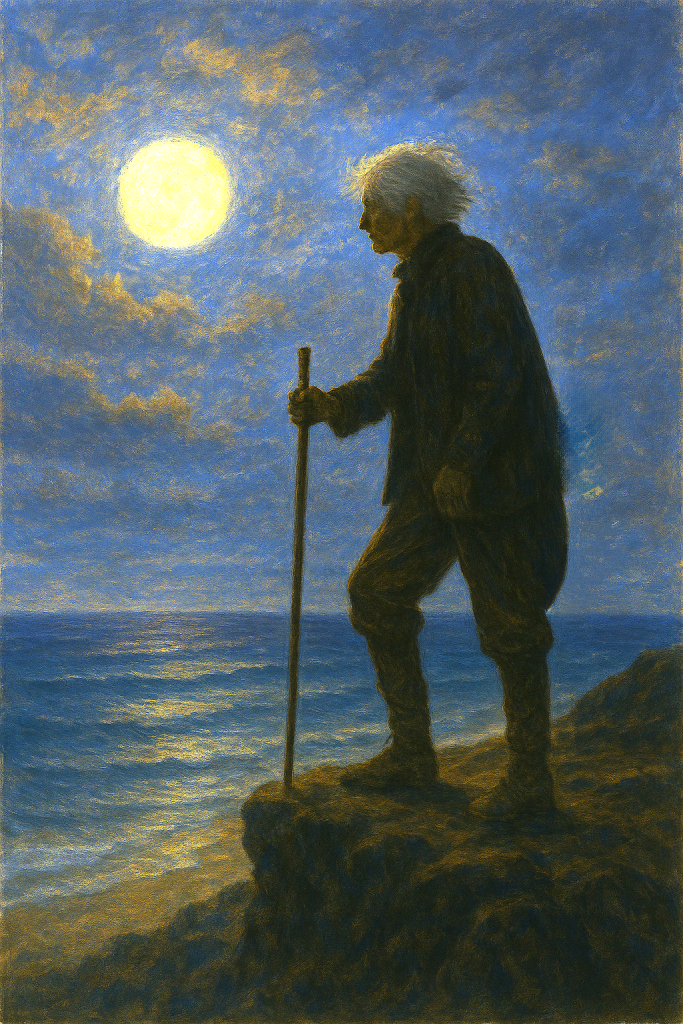
    There, silhouetted along the top of the rocky ledge, stood a frightfully thin figure, leaning on a long staff. Although bent and aged, it was obvious, even from this distance, that the old woman had once been tall, lithe, even aristocratic. As Georgie stared in awe, the woman’s wispy short grey hair feathered in the trade winds from the sea.

    “A…Amelia…” Georgie suddenly lunged in the direction of the lone figure. Matt grabbed her and held her.

    “It’s her. I saw her looking at us through the rock crevice in the cavern. It is her, Georgie. She’s old, but it’d be hard to mistake those features.”

    “Matt! We’ve found her! We’ve rescued Amelia Earhart! We’ve…”

    “Stop it, Georgie!” He held her hard and shook her. Tears of joy and confusion streaked her beautiful face. “Stop!” His voice had softened now. “Think about this, Georgie. That’s Amelia Earhart up there! She’s been stranded on this island for over fifty years, Georgie!”

    “What? What are you saying, Matt? We’ve found…”

    “Georgie,” he stroked the soft tangle of her long hair, looked deeply into her tear-filled eyes, then drew her to him. He held her close, rocking her gently in his embrace.

    “I suppose her final flight — her legend, this island, were her legacy, my darling … and now it’s ours. Fifty years,” he whispered, “and no one ever came to her rescue, Georgie…what makes you think anyone is coming to ours?”
  • AWI Old Brands – Motherlode

    Motherlode

    by CS Norwood

    ©1992, 2026 CS Norwood. All rights reserved.

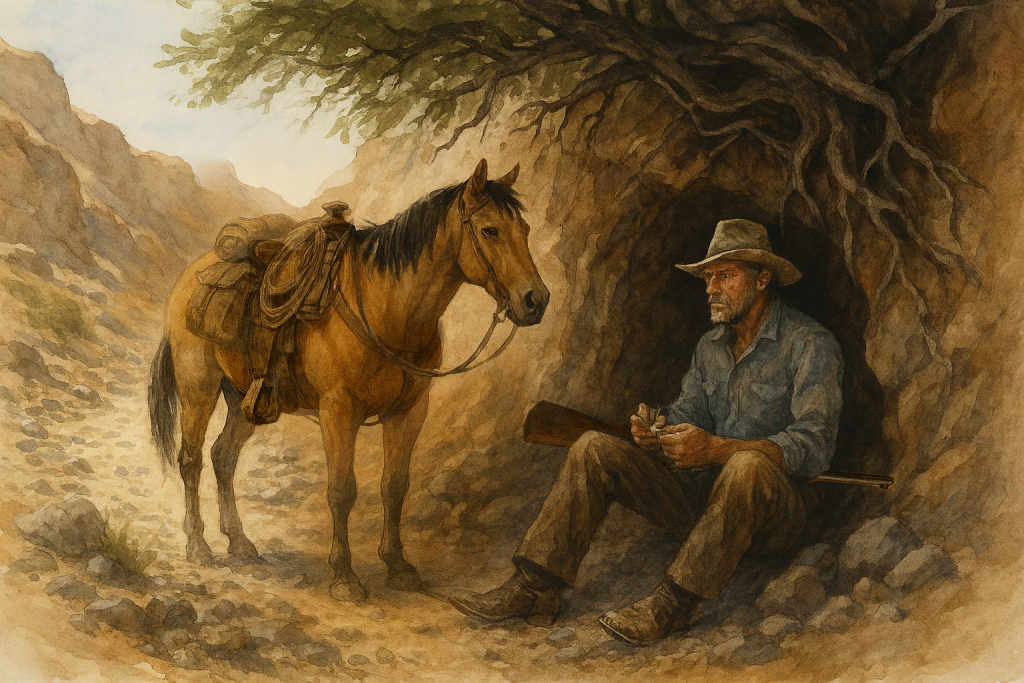
    Travis Danner gave the big line-backed dun a free rein and allowed the horse to pick his way across the loose basalt and patches of gravel and scree that littered the dry wash. Just before the arroyo bent in a blind curve to the left, he reined Dunny into a pocket along the wall. Near the end of the winter months, during the season that some natives called the Corn Planting Moon, relentless rains buffeting the not-too-distant mountains sent torrents of water racing down the slopes and into the gullies and arroyos that zigzagged their way across the desert floor. Carved into the wall of the arroyo by the last flash-flood waters, the pocket Travis rode into provided a welcome resting place for the man and his horse. Canopied by the exposed gnarled roots of a lone mesquite above, it was a place of shadowed coolness. As the season of corn planting was past, he had no fear of floodwater today. Now he could rest and wait for his two brothers in the shadows, out of sight of any roaming Apache bands, although that was unlikely. Not many had been seen in the area for several months now, he’d heard in town. Rumer was they were moving south, heading for strongholds. Still, a man never left caution to rumor out here. Those who did usually met their end unceremoniously and rather quickly. He was a rough man, but a cautious man and he was still here. Though, at forty-one, Travis was beginning to feel his age, mostly while on the ground, but sometimes while still in the saddle. Dunny shifted under him.

    “Yer feelin’ it now, ain’t ya old boy?” Man and horse had been partnered for seven years now and been through some tough scrapes together, yet they wore their scars only on the surface. A fairly deep stab wound in Dunny’s neck from a mad cow, and a nick or two from a stray bullet in Travis’ side and on his dally hand were the most visible scars if anyone cared to look hard enough. Travis laid his fingers in the dimple left behind in Dunny’s neck as memories of those wild days rounding up feral cattle in Texas brushland threatened to flood back in. Days of blazing sunrises, sweat, and danger capped off with peaceful moments of beans and flatbread cooked over wilderness campfires. There were cherished memories of Carmen in the border-town cantina, as well.

    No time for that now, though. No regrets. Just sore bones for an aging cowboy who knew nothing but the brutally tough and dangerous life of a cowhand who owned nothing but the saddle horse he rode in on. “I still have my bedroll,” he smiled sardonically as he checked his pocket watch—an hour before noon—then pulled out his cigarette makings although he would not smoke out here. The smell of burning tobacco was an obvious tell. He was idle, but his mind wandered on. The future was just that, the rest of the day; tomorrow was always a long way off, and there was nothing more to look forward to than a peaceful night under a starry sky. His thoughts and memories were clouding in on him again. His sigh was audible, and something he rarely did—make sounds in dangerous territory. He needed to think differently or he could bring trouble raining down from where, he didn’t know, but he knew it was never very far away.

    He had about half an hour before the telegram said his brothers would meet him at the small seep known as Carson Spring. It was only a mile or so east of where he sat now, and he could cover that distance easily in less than a quarter of an hour. He shifted his seat once again as Dunny shifted his feet, and his thoughts shifted to the man they were coming together to meet.

    He had become sort of a legend in these parts. Over in the nearest settlement—despite its small population it carried the rather large moniker of Lyman City—they called him “Hazelnut.” Their uncle, Hazel Daughtry never seemed to mind what folks called him. Travis exhaled slowly, wondering why, after all these years, his brothers had telegraphed him in Carson City to meet them here. The reunion would certainly be nice—but why had Uncle Hazel telegraphed Joel and Reedy, telling them they needed to locate Travis wherever he was and be at Carson Spring at noon on the twenty-fifth of July. Suddenly the gelding’s head shot up and his nostrils flared. Travis had long ago learned to trust his mount’s keen sight and sense of smell. He guessed by Dunny’s ears pricked forward and tense alertness, even before he saw or heard anything, that at least one rider was approaching.

    A single stroke along Dunny’s neck signaled stillness and readiness for the trail wise animal as Travis eased his Sharps carbine from its boot. Then the motionless horse and rider waited; whoever was coming up the arroyo was still on the other side of the bend, out of sight. Now Travis heard them, more than one rider was coming. They were moving as quietly as they could, but he could tell by the sound of the horses hooves on the stones, that there were at least two riders, maybe three, but he doubted that, and that they were shod horses; that meant that he wasn’t going to have to face a warrior band in the next few seconds.

    Reedy Danner, his youngest brother, rounded the bend first, with Joel riding a dusty bay beside him. Travis made no move but let his two younger brothers ride almost beside him before he spurred the dun’s flanks and exploded him out of the pocket.

    Reedy and Joel Danner drew their revolvers simultaneously, almost before a man could blink.

    “They still hang a man in these parts, even if it is for shootin’ his own brother, don’t they?” Travis grinned.

    Reedy was the first to react. He spurred his horse forward to cover the few short yards to meet his brother.

    “Travis! Hang it all, big brother, you sure did give us a start!” He reached across the gap and, grabbing Travis, pulled them both from their horses. The two men landed in a cloud of dust, hugging and laughing.

    Joel steadied his own rearing mount as he re-holstered his revolver, then dismounted and crossed to his brothers.

    “Darn, Travis! You always did know how to make an entrance,” Joel said as he reached a gauntleted hand to first Travis and then Reedy. “Git up outta that dust, and let’s have a look at yer sorry self.” He extended a hand to Travis who moved just a little slower now than the younger man.

    “I been hearin’ all these stories about you, riding the long trails, fightin’ outlaws and leavin’ yer mark ever’where you go, brother!”

    Joel and Travis embraced. It had been almost ten years since the three Danner brothers had been together in one place. The last time was at their mother’s funeral.

    “Well, Joel, the tall tales about you are runnin’ pretty rampant, too, I’d say. What’s this about you foilin’ that holdup the Wallace’s tried on the Abilene train?” Travis’ broad smile cut his chiseled features—weathered from a hard life in sun and wind.

    “T’wern’t nothin’. I was just a little handier than that sorry lot’s all.”

    “Nothin’ my eye,” exclaimed Reedy as he slapped another cloud of dust from Travis’ back. “He made the Eastern papers! He’s a hero, Travis! I got some catching up to do to make the same mark’s my brothers’er makin’,” he laughed without rancor.

    “Rightly so…about the hero and the catchin’ up, I reckon!” Travis laughed, and the three brothers faced each other quietly, smiling, each trying in his own silence to account for the long years since they had last met.

    Travis broke the silence. “Reedy, yer the youngest and still able to move; get those danged horses, will ya?” he commanded as he retrieved his fallen Stetson and slapped it across his chap to loosen the dust.

    “Yes, sir, big brother,” Reedy grinned and hurried off.

    The three men rode out of the arroyo together, headed east for Carson Spring. All three brothers were strong, lean men, almost equally tall, but Travis was the tallest at two inches over six feet. Reedy was the shortest but not by much. Travis and Joel were dark of hair and skin like their mother, who was Cherokee. The two older brothers favored her in mannerisms as well as looks. They were apt to be taciturn men, their actions often speaking louder than their words. John Danner, their father, a burly man of Scotch-Irish descent, was fairer, but not pale. Reedy inherited his father’s sandy hair and steely-blue eyes, his quick grin, and love of conversation.

    “It’s been a lotta years since I laid eyes on Uncle Hazel.”

    “Us, too!” Reedy the more talkative of the three said. “Why, Joel and I were sayin’, before you ambushed us, that is, that it’s been nigh onta fifteen years! You heard they’s a rumor he struck it rich last year, didn’t ya, Travis?” Reedy continued without waiting for an answer. “Still won’t come outta them mountains, though. Holed up there too many years now, I reckon, “ Reedy grinned broadly, showing his even white teeth as he motioned to the stark specter of ragged peaks in the near distance. The look of them was almost intimidating. They seemed to have pierced the desert’s tough hide, from its belly out, as if the gut of the earth could no longer contain them. The sight brought silence as do most grandly contrasting visions—the flat desert floor and the stark mountain peaks.

    They rode in silence now, as horses stepped softly into the desert sand. A bit clanked occasionally, and Dunny blew dust from his nostrils in their lazy walk. The sounds these quiet men and their horses made were enough to fill the void of the lonely land ahead.

    Carson Spring, the place Uncle Hazel was to meet them, lay at the foot of those ragged peaks, nestled in a cottonwood draw. “Let’s step it up brothers,” Joel said, “or we’ll late for our meetin’.” With that, the brothers eased their mounts into a slow gallop.

    Apache people called the mountains “ghost “ mountains. They had roamed this land for centuries but usually skirted these particular mountains. They had never been happy about Hazel Daughtry prospecting there, but they had never been able to rout him, either. He was as elusive and ghost-like as one of their ancestors, possessing the ability to fade into the granite that surrounded him. As the years passed and Hazel remained, he became as much a part of the ghost mountains as the rocks themselves. In Lyman City as the cavalry began to chase out the remaining Apache people, leaving only the tough desert marauders to fight for their homes, people began to drop the Ghost Mountain moniker and just call them the “Hazelnuts.”

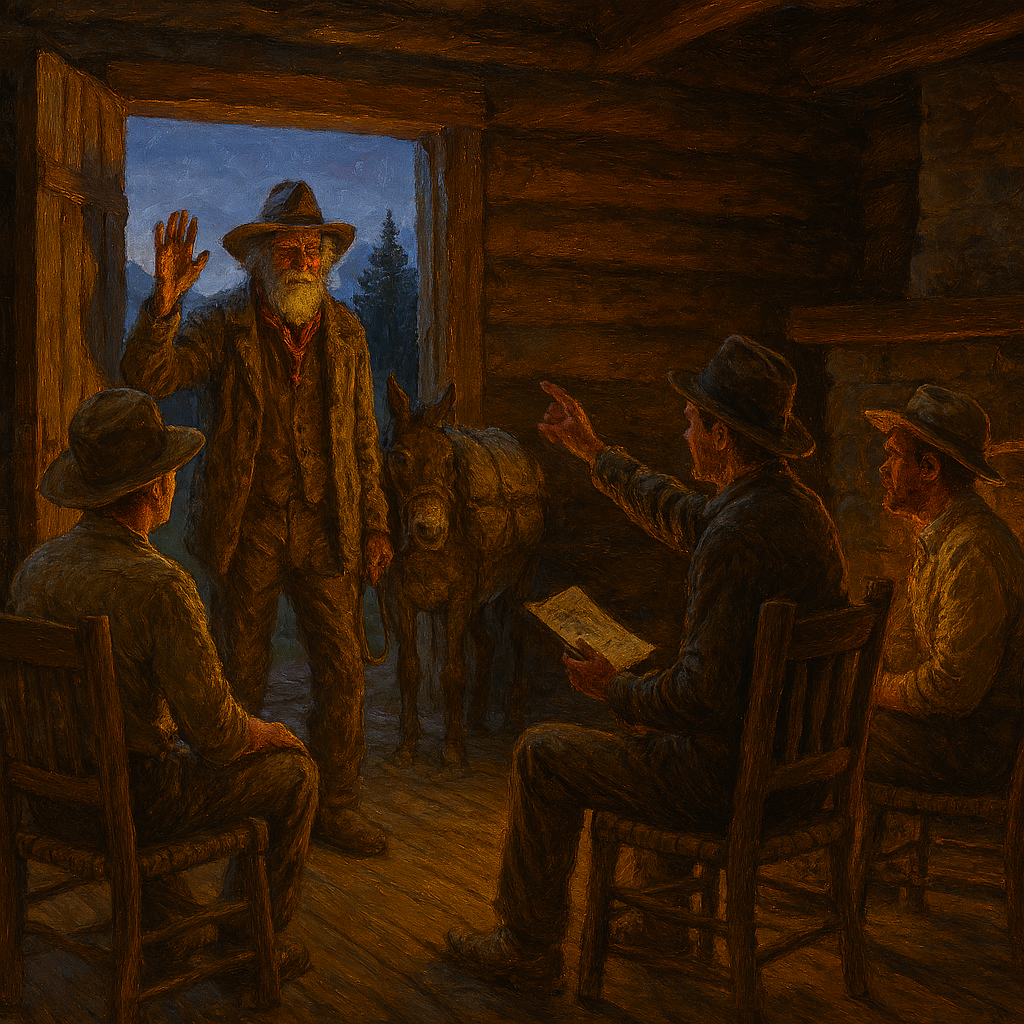
    Hazel paid little attention to what people called them. He cared little for the ways of city folk yet always drew attention when he wandered in with his faithful burro, Biscuit, in tow. His last trip was a little earlier than town’s folk expected. Usually, Hazel’s sparse supplies lasted for months at a time, but this was his second trip in a month.

    He was always a curious sight with his battered hat and dusty clothes from the long walk down the mountains and across the miles of desert. His long hair and beard had long ago turned silver-gray, and his face was a deep bronze. His hands were calloused and almost as tough as the rocks he dug. Yet if all this were not the quintessential picture of a grizzled desert prospector, his most striking feature was his eyes. As blue as a crystal mountain lake, they seemed to focus always on something just ahead, even when the merchants in town addressed him directly, he looked at them but focused on something beyond their faces. People started saying that he was always looking at that “sack of gold.” Like his two oldest nephews, sons of his half-sister, he spoke little, procured his rations with gold dust, leaving rumors abounding in his wake.

    The last time he came down to Lyman City, however, looking the same as usual in a town that was constantly changing, he did something he had never done before. He went directly to the town telegrapher and sent a message to his youngest nephew at the last place anyone in Lyman City had heard from him, Yuma, Arizona. Hazel penciled the message in hard-pressed scribble and Bartum Bixby sent it clicking off over the wire. As soon as it was gone, Hazel left the office, walked to the hitching rail, tightened the ties on Biscuit’s load and trudged back along the same street he’d walked in on. The entire event caused a stir and Bartum did not hesitate to spread the word that the Danner brothers were coming home. Uncle Hazel needed their help desperately, he had said in the wire.

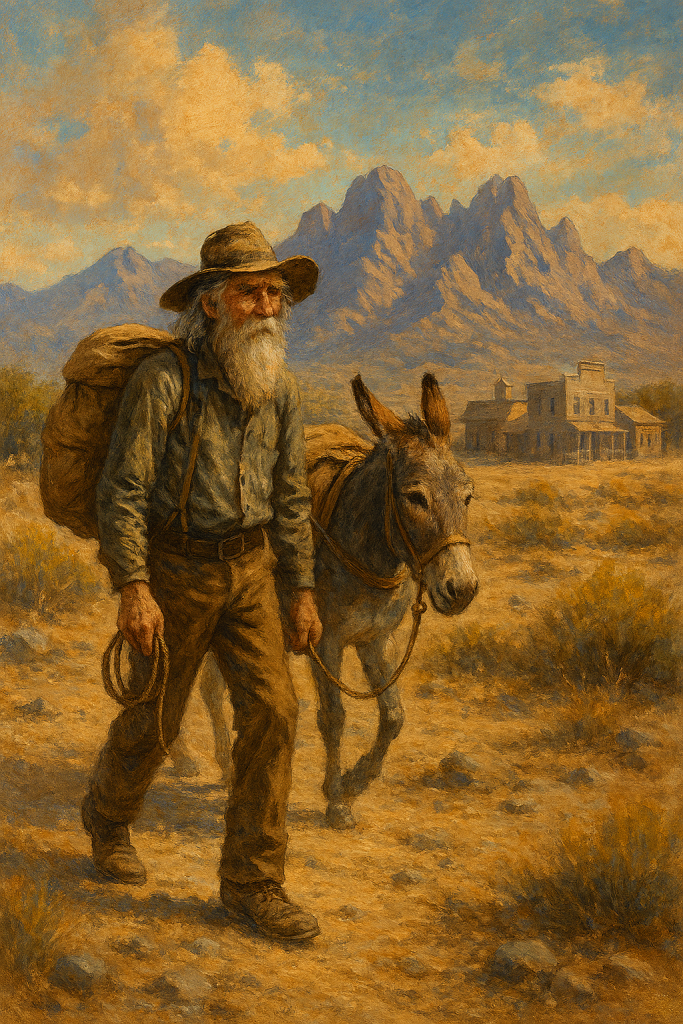
    Old prospector, Uncle Hazel and his burro named Biscuit walk into town from the rocky desert landscape.

    Immediately, and almost out of thin air, rumor had it that crazy Hazelnut Daughtry had found the motherlode. But this fairytale was just the nugget these seedy characters were waiting for. Crow and Wiley resolved to attend the Danner family reunion. After all, four men travelling together could not simply vanish into thin air like that one crazy old prospector could. They would easily leave a trail large enough for anyone to follow, even a pair of born losers like Crow and Wiley. They rode out of town at sunrise, trailing the Danner brothers who had ridden in the day before and left at first light the next morning—the twenty-fifth of July.


    Carson Spring, a small trickle of water this time of year, created a little pool and then ran a hundred yards out into the desert, finally disappearing beneath the scorched sand. The three brothers dismounted and let their horses drink.

    “Hotter ‘n hell out here,” Joel dipped his neckerchief in the cool water and wiped his brow. Travis turned his gaze to the surrounding mountain face. At first glance, it appeared impenetrable. His eyes narrowed as he studied the terrain; he could pick out at least two avenues of ascent. One was straight ahead, while the other appeared to be a small deer track farther back up the wash. It wound through some low cottonwoods, disappeared around a rock outcropping, and then reappeared about two hundred feet above before it left the ledge and disappeared altogether. It was the steeper of the two, and the one more exposed to snipers. Travis guessed that Uncle Hazel would come down the closer trail. Flanked by large boulders, it rounded a steep slope and disappeared almost immediately. Certainly, there was always the possibility there were other trails known only to local tribes or Uncle Hazel. These two were only the most obvious from his vantage point.

    Some minutes passed without a sound when suddenly, Hazel Doughtry was standing there with them. He seemed to materialize from the rocks behind the spring head. It was so unexpected that even the unscrupulous pair lying in wait to dry gulch them were taken off guard.

    “Oh, Lord have mercy! “ Reedy exclaimed as he jumped when he caught sight of the grizzly apparition that was his only uncle. “Where ‘n hell’d you come from?”

    “That’s not where I cum from, boy—that might be where I’m headin’, though!”The old man said matter-of-factly, and then chuckled, as if, after ruminating on the idea a moment, he had stumbled on some sort of truth.

    “Which one ’er you? I cain’t ‘member.”

    “I’m Reedy, Uncle Hazel,” the youngest brother recovered from his fright and extended a damp hand. Travis looked on as the sinewy little prospector shook it in a grasp not unlike the slow closure of a steel vise. He could see Reedy wince. Old Uncle Hazel might be as wiry as a catamount, but he was as strong as a grizzly, Travis thought.

    “You look so much like yer Pa … fair like him ’n me. We just let the sun cook us dark, is all. I sure do miss that crazy Irishman,” he said with a hint of sadness in his voice.

    “And yer Travis,” he pointed correctly without waiting to be introduced. “Ya got yer Maw’s looks—just like a Cherokee,” he said without rancor, a note of respect in his voice. “You too…”

    “Joel…”

    “That’s it! Joel! … only not quite’s much like her as yer brother here,” he said.

    The re-introductions to his nephews complete, the three brothers stood silently as their uncle looked from one to the other. It was not an uncomfortable silence, however, for these men were, each in his own way, used to the solitary life, a life where a man is most comfortable when the air is still and silent, so he can pick out the voices of the wind and trees, the birds, and animals that surround him, especially the deadliest of all: the two legged variety who wear side arms and carry death in their hearts. Travis, Joel, and Reedy were drifters, working cattle when those jobs were to be had, the odd job of riding shotgun guard on the Butterfield Stage, marshalling for a boom town—the toughest job a man could ask for—or just mending fence for some rancher over in Texas. On a smaller scale, Uncle Hazel was a drifter too.

    The old prospector had spent the last twenty years of his life wandering through his Ghost Mountains, always searching up a little higher, or around the next outcropping for his elusive motherlode, always looking somewhere up ahead to fill his sack with gold nuggets.

    When Travis finally broke the silence, his voice was just above a whisper, “I think there are two of ’em. Do you know ’em, Uncle?” No one moved but remained as if they were still in conversation.

     “I’d lay odds it’s that pair from over Lyman City way. I kinda expected they’d show up at this here at our reunion,” Hazel replied. “They’re out there about fifty yards, crawling along that gully. Can you boys take ‘em?”

    “What’s say we just send ’em packin’ before we get down to business?” Joel asked. “When I drop my hat…”

    Travis nodded.

    By the time Joel’s hat touched the ground, the three brothers had drawn their pistols and wheeled in unison toward their targets. After their lightning draw, the thunder of exploding guns came as bullets split the desert air and bit into the rim of the gully, sending pieces of gravel showering atop the crouching figures of Crow and Wiley. The two ne’r-do-wells ducked and scurried back along the ever deepening channel as they dodged the rain of bullets that followed their course. The scoundrels reached their already frantic horses, mounted, and whipped them out of the gully into a hasty retreat. The four men by the spring laughed at the retreating figures.

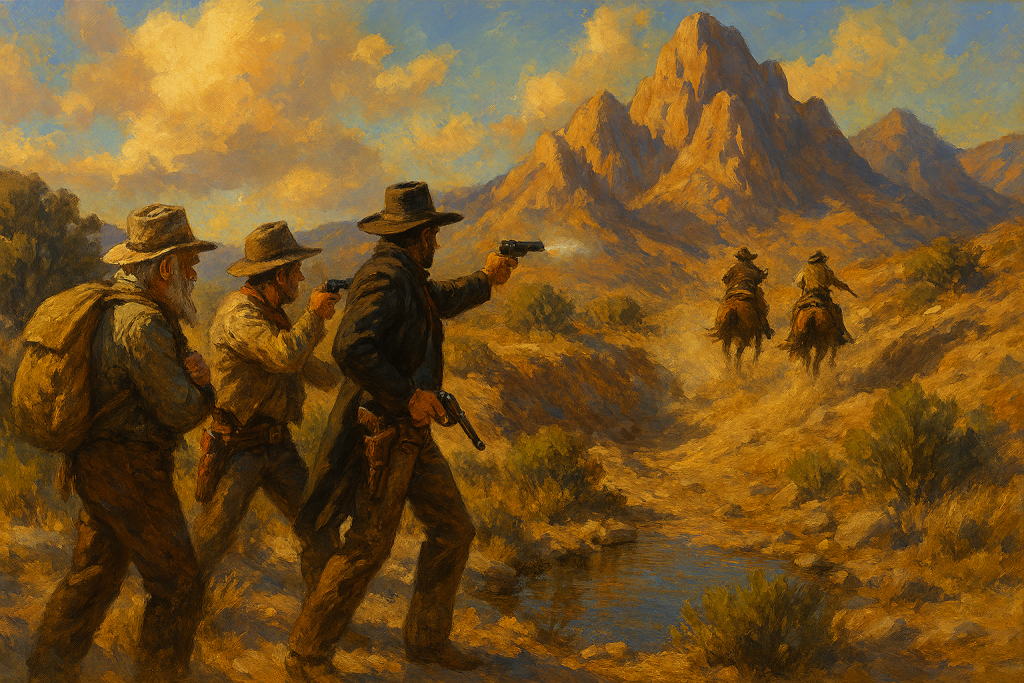
    Western gunfight along a desert draw. Guns are blazing from three men near a spring, and two claim-jumpers are riding their horses away as quickly as possible.

    “Fine work boys. Ya sent ’em packin’ pronto without nary a drop a blood spilt here taday.” Uncle Hazel laughed and practically danced in his glee.

    “Now that we’ve taken care of those hombres, Uncle, just what is this reunion all about?” Travis asked the old man as he reloaded, then holstered the Colt.


    The prospector looked at the face of each nephew in turn, eyeing them closely. He studied the men before him until Travis noticed a change in his uncle’s eyes. One moment he had been carefully gaging each one, and the next it was as if he was looking right through them to something a little beyond the point where they stood.

    “Common, boys!” Hazel broke the spell and suddenly erupted into motion. He waved them to follow, and almost before they could move, disappeared among the same rocks he had sprung from earlier. As the brothers looked on in amazement, Uncle Hazel re-emerged from behind the rocks climbing up the near trail that Travis had spotted.

    “We best hurry before he disappears again!” Joel said.

    They collected their horses’ reins quickly and led off single file up the narrow trail, first Joel, then Reedy. Travis brought up the rear, his eyes constantly surveying the trail behind until he was certain they were not followed by anyone.

    For the next hour they climbed a narrow path, switching back on itself through intricate turns and loops around boulders, precipitously clinging jack pines and tough manzanita thickets. Travis studied the trail behind him at each turn, marking his route, but it would not be an easy backtrail; it was traveled little and not well defined. A man could become hopelessly lost up here with what appeared to be only one way out. False trails lead to shear ledges that dropped off into thin air, the desert floor hundreds of feet below. This was a dangerous place to get lost in, he realized.

    They had entered a strangely different world here, where the wind blew down through hidden copes of trees, whispering in a rustling sough as it passed. The air became cooler and seemed fresher as they climbed.

    Desert floor sage, tumbleweed, and prickly pear, were replaced by yucca and juniper and then by the red tangle of manzanita thickets. While tenacious jack pines clung to the rocky ledges, taller cottonwoods mingled with longleaf pines in ever thickening forests. The foursome eventually left the mountain’s face and followed the trail that entered into the heart of these ghostly mountains. Now they began a gradual descent. Trees, protected from the harsh environs of the mountain face, grew taller here. Presently, they entered the forest, remounted, and after another hour of riding along a more or less horizontal path, suddenly rode out onto a clearing beside a small lake. The change took everyone by surprise, except, of course, Uncle Hazel, who continued his headlong journey. Not once had he spoken, nor, for that matter, stopped to rest, since they left the desert floor.

    Travis, Joel, and Reedy pulled their horses to a halt for a quick breather. Each leaned forward on his saddle horn while taking in the panorama.

    The water was crystal clear and reflected the color of the intensely blue sky. Above, the cry of a hunting eagle caught their attention as it soared, talons first, to the lake’s surface lifting off with his evening meal, a mountain trout.

    The lake was about a quarter of a mile long and twice that at its widest point, Travis speculated. He inhaled deeply of the sweet pine and faint pungent odor of fish. It was one of the most beautiful sights he had ever seen. Surrounded first by a border of tall reeds and lush grasses, then by towering pines and white oaks, the entire view was capped off by a backdrop of rocky mountain peaks. This is what paradise looks like, he thought. A man could rest his weary bones in peace in a place like this.

    “Where’d he go?” Reedy broke the spell the tired trio had slipped into.

    “Dang it all!” Joel cursed lifting the reins as his horse stepped forward. “Whoa, now! I’ll be hanged if that uncle of ours ain’t the real ghost in these here mountains!”

    “Beats anything I ever saw,” added Travis as he picked up his own reins.

    “Common, boys!” The shout skipped across the lake. It was Uncle Hazel. He was waving and calling them from the far side.


    “Well, this is it! My home, boys! Pull up a chair. I suppose yer wonderin’ why l sent you that there telegram, ain’t ya?” They had entered a stout roomy log cabin, well hidden among the trees, about a hundred yards from the lake’s shore.

    There were plenty of split oak chairs around the fireplace for a man who lived alone. Reedy remarked on this.

    “Got nothin’ ta do in my spare time, boy. I’m gettin’ old. Give up minin’ last F’brary. Got blasted cold up here! I figured no Injuns—nobody gonna come after me all the way up here. So, I settled in, thought about you boys, and built ya some chairs for when ya comed visitin’.”

    Uncle Hazel finished with a self-satisfied smile for each of his nephews.

    “What, exactly, did you get us all the way up here visitin’ for Uncle Hazel?” Travis straddled a chair, leaning forward to cross his arms over the back. He was bone weary. It had been a long day’s ride, not to mention the long mountain climb afoot, and he was in the mood for some answers. “And who were those two we had to run off back yonder at the spring?”

    “Oh!” He waved Travis’ questions off in characteristic style. “Them’s just that pesky old Jim Crow and Jeb Wiley. They’re the sorry pair a varmints been tryin’ ta trail me ta my digs over two year now. I expected they’d get wind of my telegram pretty quick and follow you boys ta the spring. Ya handled ’em just like I knew ya would. Just like I ’member yer Ma taught ya! ‘Ain’t no need ta kill ’em when you can scare ’em ta death!’ she’d say.” Remembering his half-sister’s words seemed to tickle Uncle Hazel.

    “What’s this deal?” Joel’s voice held its own edge of weariness and impatience. “You didn’t get us all the way up here to just stop some two-bit claim jumpers. Gotta be somethin’ more to this, Uncle Hazel.”

    Hazel got up, took a can of coffee from a shelf, and carefully poured a measure into the coffeepot. He ladled in some water, moved to the crane on the fireplace and swung the pot over the fire he had poked back into life when he first entered his cabin. Having done all this in silence, he tuned to face his kin.

    “I found it.”

    “Found what?”

    “The motherlode.”

    The brothers straighten their tired backs, all attention now.

    “You mean…” Reedy began.

    “I mean, boys. I’m a tired old man. I been up here, alone, nigh onta twenty year now, and I’ve hammered and picked and dug on about ever’ square inch a these consarned mountains. I’ve fought off claim jumpers, and Apache braves fer the right ta stay here. I’ve learned how ta pretty-near be a phantom ta survive. I staked a legal claim on ever’ inch of it, and me and the Apache bands, and the U.S. government have kept everyone else off’n my claim up until now. And it’s just been this past F’brary that I discovered it. After all these years … ” He stopped. His voice choking, he wiped a tear from his eye as his three nephews sat in respectful silence.

    “After all these years a diggin’ an scratching in this heat n cold, I have finally found my motherlode, and I want you boys—my onliest kin—ta inherit it…”

     “Gold!” Reedy exclaimed. “Brothers! We’re gonna be rich!”

    “Yer gonna be rich, all right. “Uncle Hazel continued. “But it ain’t gold I’m talkin’ about…”

    “What? What are you talkin’ about?” chorused the three.

    “But you said you found the motherlode, Uncle Hazel? Ain’t there no gold up here?” Reedy asked, puzzled.

    “Ah, sure,” Uncle Hazel waved, “they’s plenty a gold—gold dust, an little veins a gold all over these here mountains. There may even be a motherlode vein running beneath that lake out yonder…but it’d cost ya a king’s ransom ta dig ’er up! No, boy, the motherlode I’m leavin’ with ya is worth more’n any a my puny little digs a gold.”

    “Here,” Uncle Hazel walked to the fireplace and carefully removed one of the stones along its base. He reached into a hollow space in the stones and pulled out a sheaf of papers.

    This, boys…this is my motherlode.” He held the sheaf up high to emphasize his point. “It’s the reason I been up here fer all these years, and I didn’t even figure it all out till F’brary this year!”

    He handed the papers to Travis first.

    “Why, these are deeds, Uncle Hazel.” Travis appearing a bit confused, looked the papers over quickly then handed them to Joel.

    “Don’t ya see it? Ever time I cum across a new little vein a gold, er panned enough dust outta that stream up yonder behind the cabin, the one that feeds the lake, I’d pack up old Biscuit ’n go down ta Lyman City an buy me a legal deed ta some more a these here mountains. Nobody down there wanted the land. They just wanted the gold they thought’s in it. But nobody’d risk comin’ up here cause a the Apache raiders, and ghost superstitions, n danger n lonesomeness ’er what not.”

    “You’re saying you own a deed to these mountains?” Travis wanted this thing clarified. It was beginning to slowly dawn on him exactly what his uncle was offering them.

    “Yep,” Uncle Hazel replied proudly, “ever blasted wonderful inch. Don’t ya see how ironical it is? It took me twenty consarned years bustin’ my back a lookin’ under rocks to see what was all surroundin’ me all the time, boys…These mountains are my motherlode! These mountains are why I stayed, t’wern’t the gold at’ll! I could’a picked up stakes n gone somewhere’s else to find a better claim, but I never could leave here, and I wasn’t figuring out why when my pannin’ and diggin’ was only providin’ me deeds n grub. Then one day it come to me all of a sudden like. I was sittin’ where you boys parked yer horses earlier, and I saw it…and it was purest gold…and it was paradise, boys…” His voice trailed off.

    “And it’s all yours from today on. There’s enough gold up here ta give ya a grubstake, but if it’s a place to call yer own ya been lookin’ for, well don’t look nowhere’s else. Build ya a couple more cabins, find ya each a good wife, raise ya some young’uns n live out yer lives in peace, but don’t go chasin’ no pots o’ gold. Nothin’ll make ya any richer or make ya any happier than what I’m givin’ ya right here, right now if ya’ll have it.”

    The boys sat in silence, but Travis knew there was nothing except these mountains left for him. This was what he was looking for—what he had longed for. He would ride for his own brand now and perhaps ride down to see if Carmen was still at the cantina.

    “But now,” Uncle Hazel slapped his hands on the table then continued as he began hefting packs loaded with flour, salted venison, and coffee. “…now I’m too old to protect it anymore, it’s bigger’n and tougher’n me. So, that’s why I’m leavin’ the whole shebang ta you boys—my only livin’ kin. That last paper there,” he pointed to a large, clean legal document in Joel’s hand, “that’s my last will an testament there. Leave’s the whole shebang to you and Joel and Travis ta divey up how-some-ever you see fit,” he addressed Travis.

    “Guard ’er well nephews! Remember, they’ll always be somebody’ll think they can just waltz right up here an take ’er away from ya. I tested you boys today… set ’er up so’s that pair could follow ya easy, wanted ta see how ya’d handle yerselves anybody comes claim jumpin’ after yer gold dust…well, my guess is they’ll be fryin’ in hell’s fryin’ pan afore they know what hit ’em!” He laughed as he raised the wooden latch on his door. “And I want my only livin’ relations to have it all! By the way, that trail out’s a might tricky. I wouldn’t try ’er tonight…if ya get my drift.”

    As he opened the door, the cool night air rushed in to stir the flames in the fireplace. An owl hooted in the trees close by and somewhere off in the distance a lone wolf called for his mate.

    “Wait a minute! Where’re you headed for Uncle Hazel?” Travis called after his uncle as the old man stepped through the doorway.

    “Oh,” Uncle Hazel waved again, “Me ’n ole Biscuit, we’re just headin’ out to check on the motherlode.”

    And with that, the old prospector gathered the lead of his little burro, turned away, and disappeared into the shadows one last time … or so goes the legend of the motherlode.


    THE END

  • AWI Old Brands – A Texas Story

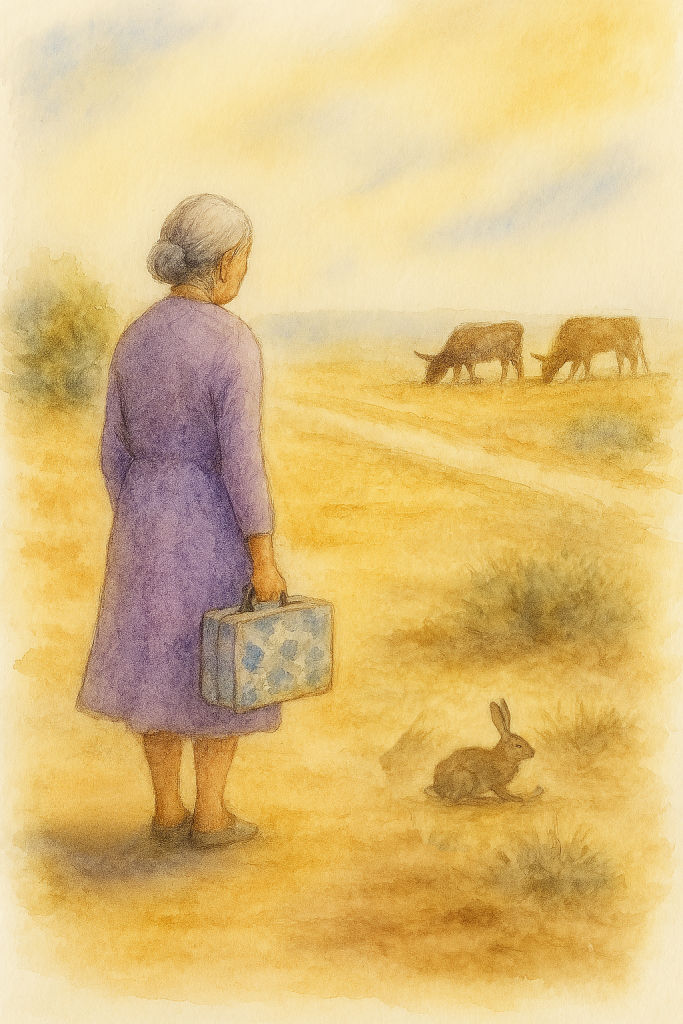
    Old lady in lavender dress with flower valise stands beside a dry Texas road with a jackrabbit nearby and longhorn cattle grazing in a field on the other side of the road. She stands alone.

    A Texas Story

    by CS Norwood

    ©1992, 2026 CS Norwood. All rights reserved.

    The flat light of midafternoon washed the solitary lavender-clad figure almost as pale as the bleached brown dust she stood in. A lone crow cawed from his perch in the mesquite thicket at the end of the draw as two red and white speckled longhorns across the roadway stepped forward in unison, heads bowed as they cropped the sparse, dry blades of grass. None of them, however, seemed mindful of the old woman who endured the silence and tolerated the air of indifference in her usual manner. She stood with her head held unnaturally high, looking neither right nor left, but with eyes focused straight ahead on what may have been some far-off thought. Even the powerful Texas-sized jackrabbit that hopped in slow motion, kangaroo style, not ten feet from her side paid her any notion. In a world of butterflies, lazy buzzing bees, jackrabbits and longhorn cattle, Violet Sheldon stood alone and virtually colorless.

    “It’s about damn time,” she mumbled flatly, as first the drone of the powerful engine and then the silver dome of the Greyhound topped the rise. She bent her knees and retrieved the blue flower-covered valise at her side as the bus slid to a stop in front of her, stirring a cloud of dust to accompany the noisy hiss and metallic squeak of air brakes and automatic doors.

    As Violet gave herself up to the sleek beast, not even the jackrabbit poised motionless in the dry thistle took notice.

    “Pardon me, is this seat taken?”

    A slight blonde teenager in blue jeans and jacket, appearing to be wired directly into a yellow Walkman radio, lifted her eyes rather blankly at Violet’s question, then cast scornfully about at the dozen or so empty seats surrounding them. She shrugged her angular shoulders, focused straight through Violet’s eye sockets, and pinpointed somewhere on the other side of her skull.

    “Be my guest, lady,” she clipped, and turned her head to stare at the blur of the roadside. At once the girl resumed her head bobbing and chin jutting that Violet assumed coincided with the musical rhythm emanating from the Walkman.

    Violet Sheldon seated herself beside the silent, undulating girl and was, again, alone in the world.

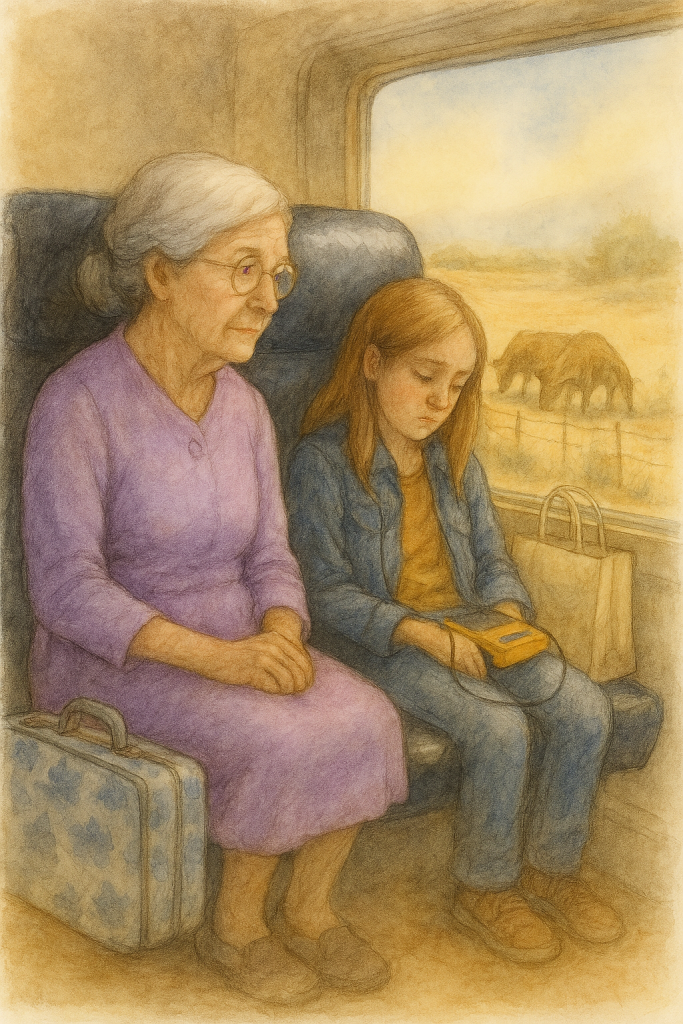
    Old lady in lavender dress seated beside a teenage girl on a bus. Outside the window is the passing Texas scenery.
    Violet and Laurie travel and talk…

    “Dammit!”

    The sudden expletive jarred Violet’s sweaty half-sleep. She moved her sore neck slowly and wiped the drool from the corner of her mouth. The highway sped by as she collected herself.

    “Damn…lady, ya got any triple A’s in that purse a yers?” The teen drawled as she mashed buttons and snapped tiny compartments on the radio.

    “I’m not accustomed to carrying ‘triple A’s’ with me.” Violet retorted as she  smoothed some invisible creases on her dress.

    “Well, that cuts it!” Teen snapped as she yanked the headset from her ears. Violet wondered how long this young girl would survive disconnected from what seemed to be her life support system. “What’m I gonna do for the rest of this bor-ing trip!?” The girl flung her head back onto the black vinyl of the seat in a gesture of total dejection.

    “Well, we could talk…” Violet offered.

    The round-faced teenager stared at her as if she had just dropped in form another planet. “Talk? About what?”

    “Well…my name is Violet Sheldon. I’m from this side of Bronte. My house is just down that lane where I got on the bus. About a quarter of a mile…” She hesitated. When there was no response, she continued, “I’m on my way to see my sister in Dallas; it’s my birthday tomorrow. And Lydia—Daddy and I just called her Sissy, you know—Sissy always invites me to spend the day with her on my birthday. Sort of a little tradition, you know.”

    Her words drifted off into silence, but when the silence continued and Violet was certain the girl’s life must be ebbing away, she prompted, “…and you are?”

    “Oh, ‘scuse me. I’m Laurie Fallman. From San Angelo. At least that’s where my dad lives now. I live there too, with him. My mom lives in Fort Worth. I’m going up there to see her. I guess it’s kind of a coincidence. It’s my mom’s birthday tomorrow, too.” Laurie indicated a designer shopping bag wedged between the side of the bus and her feet. “I didn’t get her much. Not that it’s any big deal or anything…”

    Laurie’s voice trailed off as she turned to stare at the receding landscape. Baked brown hills covered with wiry, tenacious honey mesquite and interspersed with prickly pear, yucca and dusty clumps of broom grass monopolized the view. Occasionally, behind the ever-present barriers of cattle fence and barbed wire could be seen deer grazing with the lean Brahmas or fat Herefords Texas cattlemen doted on.

    “God, there’s nothin’ out here. What’s it like livin’ so far from anything? I’d be bored outta my skull!” Laurie emphasized the last three words but never looked at Violet’s face for her reply.

    “Oh, it’s not so bad as you might think, my dear.”

    “But there aren’t even any boys out here,” she whined.

    “Maybe not so many now, but things were a little different here when I was a girl your age,” Violet said. “We’re almost to Abilene. Lots of cowboys in Abilene when I was a girl. Over in Sweetwater, too.

    “Yeah?” Laurie was listening now, intently studying Violet’s face for the first time.

    Oh, the wrinkles, Violet thought. She restrained the hand that threatened to call attention to the lines and valleys that marked her years. That’s all anyone ever sees anymore. If only this shallow little girl could have seen me when I was young. When I was the most beautiful girl this side of Dallas! And everyone knew it!

    “My daddy named me for my violet eyes, you know.”

    “Really?” The girl looked closer, peering into Violet’s eyes. “Hey, they really are violet, aren’t they!”

    Violet, ignoring the girl—she surmised that Laurie was probably not very bright, and probably totally self-absorbed anyway—continued her soliloquy.

    “I was the apple of my daddy’s eyes. He was rich too, you know!”

    “Really?”

    Violet paused again, lifted her chin, and looked through her bifocals at this monosyllabic adolescent. “Yes, my dear, really.” She was hoping her abruptness would serve to curb Laurie’s interruptions.

    “He liked me much better than Sissy, or even Mamma for that matter! He was a wealthy man…owned acres and acres of land. Why, we had the largest ranch in Bronte, back then. Of course, when the war started, he had to leave. Well, when he was killed ‘somewhere in the Pacific,’ you know, well—I did believe my heart was going to bust wide open, and everything inside me would spill out on the ground!”

    Her slight fist tapped her chest and then she flung her arms wide. Tears welled in her eyes as she spoke, and hard little lines tightened downward at the corners of her mouth. Almost immediately, however, she recovered with a sigh and a smile.

    “When I was nineteen, Daddy bought a brand-new Packard automobile. It was the most beautiful automobile I’d ever seen. All black and shiny. Hum,” she laughed. “Why, I can still see my reflection in that car!” She rested her head on the back of the seat and closed her eyes to drink in the memory. “Those seats were the finest, plushest velour, too. Not this old vinyl stuff they started usin’ after the war!” Violet grimaced and slapped the seat covering in disdain.

    “Did he let you drive the car much?”

    Violet remembered the girl and shot her a withering look.

    “Why, of course! Curtis Mahan lived down the road a few miles from us. Down in Tennyson, maybe you remember passin’ it before my stop?”

    Laurie shook her head and returned a blank stare and half smile.

    “Anyway,” Violet waved her off, “as soon’s my Daddy brought that car home, I grabbed Sissy, who really was a sissy, you know, couldn’t even drive a stick shift automobile, even though she was a year older than me, and we drove straight down to see Curtis.

    “His daddy owned a very large ranch in Tennyson. The biggest spread there. Over 3,000 acres. Not quite as large as my Daddy’s though, you know. Well, Curtis Mahan was without a doubt the handsomest boy outside of Abilene and, mind you, there were some handsome fellas in Abilene. He was tall, dark as an Indian, and Oh! He was strong. I was so in love with Curtis,” she sighed. “Everyone said that we were the perfect couple. We were going to get married that very summer. I thought then that I was the luckiest girl in the whole wide world. I had my Daddy, and I would soon be Mrs. Curtis Mahan!”

    Ecstasy of past memories lit her face and then suddenly vanished. After a moment, she continued, “I didn’t know it then, the day Sissy and I first drove that Packard down to see Curtis, but I found out later—Sissy was in love with Curtis, too. She turned his head. That little tramp…” Violet’s jaw tightened, her face became hard, her eyes narrowed, full of hatred. Her fists clenched until the thin, translucent skin of her knuckles seemed to disappear across the white bone beneath. Then, suddenly, she seemed to remember where she was, and that time had far removed her from the day she discovered the treachery of the man she loved and her own sister.

    “Look, we’re in Abilene, the bus is pulling in.” Laurie, appearing grateful for the opportunity, interrupted Violet. “I have to use the john. You better go too, Mrs. Sheldon; it’s gonna be a long ride from here to Fort Worth.”

    “It’s Miss Sheldon, my dear. I never married.”

    “Oh…well. You might need a Coke or something.”

    Violet emerged into the late evening glow of the once bustling cattle town. The vermillion orb of the setting sunbathed the streets and buildings in its peculiar light. The intensity of the summer heat softened with the setting sun and the bent, stoop-shouldered little woman pulled on her sweater.

    The bus driver called a ten-minute stop. As Laurie ran first for new batteries and then for the lady’s room, Violet dug for a few quarters and deposited them in the Coke machine. It rattled and clanked, then delivered the dewy red and silver can with a vengeance. Never having trusted these things, she was certain that by the time the can had made its furious descent, the liquid was so shaken and jostled that its contents would explode. She held the can at arm’s length before she snapped the top open.

    Violet stood in the fading light, sipping delicately, as a soft breeze ruffled the hem of her chiffon. The breeze carried with it the soft scent of sage and dry desert. Her eyes looked beyond the station, beyond the town, out across the barrens of the surrounding hills. These were the same hills she and Curtis had roamed wild and free that summer before the war. The wind rose and she could almost hear Curtis’s voice carrying on it.

    Laurie returned presently, batteries in hand, examining the zipper fly of her jeans.

    “That’s where it happened, you know.” Violet indicated with a nod toward the east. To Laurie’s puzzled look, she continued, “Up on that ridge. That’s where they found Curtis’ body. It was after the war…still in ’45. Curtis finished serving his country. He didn’t seem to be scared by the fighting like some of the other boys around here. It’s ironic, isn’t it? To come through an entire world war without so much as a scratch—They said his horse must have been spooked by a rattlesnake or badger or something. Plenty of both up there.”

    The old woman and young girl stood silently together, gazing back across time, one caught in her past, the other not yet old enough or wise enough to understand that each heartbeat gone by was her past.

    “Time to go, ladies,” the driver called.

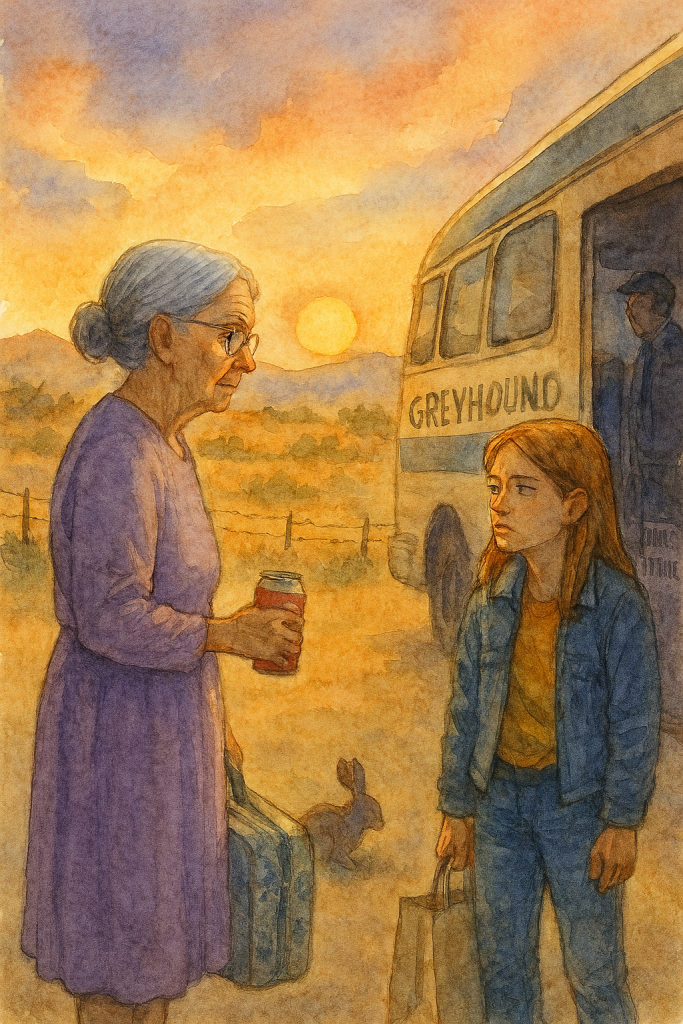
    Old lady in lavender dress and teenage girl talk outside the bus at a evening stop in Texas hill country.
    Violet and Laurie continue the story…

    Laurie spent the next few hours plugged in to her life support system. Violet dozed.

    “Looks like we’re almost to Fort Worth,” Laurie remarked.

    Outside their window, the night scenery had changed from occasional sights emanating from the low, squat ranch houses to spotlights on the facades of towering, overdone mansions sporting Greco-Roman columns and ghostly floor-to-ceiling windows. Soon the east-bound highway lanes increased from two to three, then four, and restless buildings began to crowd in upon one another in a hodgepodge of old and new, large and small, business and domicile.

    “I’m sure your mother will be very happy to see you.” Violet spoke softly in the dimness of the bus.

    “Yeah, like I said, I didn’t get her much. Just a paisley scarf.” She indicated the package again. “I hope she likes it. She was a 60s flowerchild, and I thought she might like paisley…sort of for remembering when she was my age, you know. So maybe she’s gonna like it.”

    “I’m certain she will like it very much,” Violet said.

    “I was thinking, while you were asleep and all, about what you told me. That’s really sad. I mean, about losing your dad and then Curtis like that,” Laurie said.

    Violet bent her head and smoothed her dress.

    “You said you didn’t know that Sissy and Curtis were in love that day, the day you drove the car over, that day before the war. When did you find out?” she asked.

    Violet’s gaze focused again on nothing in particular, but turned inward, on the past.

    “I didn’t find out for certain until after the war. It was the day he came home.” Her voice could not hide the bitterness she felt. “Oh! How I remember that day!

    “By the time Curtis was discharged,” she continued, “Daddy had been dead for almost a year.

    What with him gone, and Mamma not a very good manager and everything, we were already starting to sell off our grazing land. I was near total despair. Mamma’s heart was broken. She was almost as devastated as I was, but I still had Curtis, you see. And when Curtis got off that train in Abilene, I fairly flew into his arms. I could feel his arms around me, but Sissy had come with me to meet him, too, and even in Curtis’s arms again after what seemed to be an eternity apart…well, I was such a sensitive girl—I felt—I knew, that something was not right. Something had changed. Maybe it was that he just didn’t hold me as tight as before…something…I knew! I pushed him off at arms’ length so I could study his face, and then I saw it. He wasn’t even looking at me! There was nothing for me, nothing but pure longing in his eyes looking right past me at Sissy. They were actually holding each other with their eyes…

    “‘Curtis! My darling! No!’ I looked from one of them to the other, and I can remember shoutin’ and blubberin’ like a little baby. I could hear the questioning and the fear in my own voice. I can still hear it. I wanted to shake him to pieces; I know I tried. My whole world had just ripped apart! I was literally pleading for him to pay attention to me, but it was no use. They were infatuated with each other, irreversibly drawn together. Sissy tried her best to explain it to me later, to say how so very sorry she was…they couldn’t deny their true love for each other. What could I do…”

    She looked down at the shadows of the large blue veins that ran like highway routes across the maps that were her hands. Why do they look so much more ancient at night, she wondered and sighed.

    The driver maneuvered the bus expertly into the Fort Worth terminal, and the doors swung open.

    Laurie searched the platform. “There’s my mom! I’ve got to get my bag. Come with me to meet her.”

    The three stood on the platform of the bus terminal exchanging pleasantries until the driver again called for Violet to board the bus. She had spoken kindly and glowingly to Laurie’s mother in praise of the girl’s company. She was polite enough not to mention her thoughts that the mother’s daughter was rather shallow and might benefit from at least a trial separation from her Walkman.

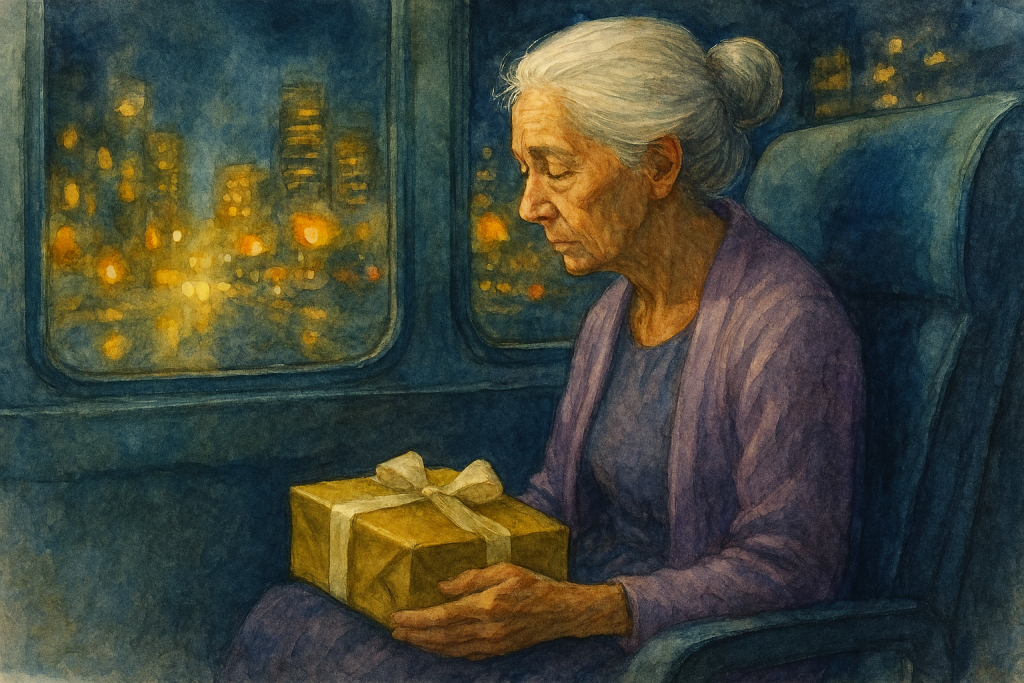
    In the absence of her young friend, Violet moved to the window seat. The bus moved steadily through the empty streets, and she was settling into the rhythm of flashing streetlights and the glare of headlights from passing cars when something brushed her leg. With a start she realized that it was Laurie’s package—her birthday present for her mother. She slipped the gold foil-wrapped gift from its designer shopping bag. The flawlessly wrapped box was tied together with ivory ribbon looped in the center into a perfect bow. Obviously, Laurie had had the gift shop-warped, Violet thought. The job was too perfect for something the girl would have done herself.

    “Well, it will do no good to try to find your owner,” she said as she ran her fingers over the perfect package. “I wouldn’t have a clue where to start to find Laurie.”

    Violet held the package on her lap and stared out into the passing night. She dozed.


    “We’re here, Ma’am.” She felt the driver’s hand gently touch her shoulder.

    Old lady in lavender dress seated on bus with gold-wrapped package on her lap and Texas city lights outside the window.
    Almost there…

    “Oh! Yes. We are in Dallas, aren’t we?”

    She collected her things, her sweater, purse, blue flower-covered valise, and the designer shopping bag containing the perfectly wrapped paisley scarf, then stepped into the damp coolness of the Dallas night.

    Violet left the terminal and walked the block-and-a-half to the Ardmore Hotel. There she roused the disgruntled desk clerk and registered for two nights. The dim, shabby elevator lifted her and all her belongings to the second floor and Room 210.

    The room was stale and stuffy and smelled slightly of cigarettes and old wine, but Violet had become accustomed to it over the years.

    She sat on the edge of the broken-down mattress with its stained bedspread rumpled beneath her and rested a moment.

    “I need a bath,” she mumbled. Wearily and with an effort, she forced herself into the bathroom.

    After she had adjusted the water to a steamy temperature, she returned to the bed and removed her lavender chiffon. She left her slip on as she laid the dress across the foot of the bed. Suddenly, her attention was again drawn to the designer shopping bag. She removed Laurie’s mother’s birthday present and lay it in the center of the dingy mattress. It looked so out of place — almost glowing in the shadowy room. Violet stood staring at the package for a few moments, then padded on stockinged feet into the bathroom and turned the water off.

    She returned to sit on the edge of the bed and placed the present on her lap.

    “I am so tired of being alone,” she whispered and then, as if speaking to Laurie, she said:

    “You know, Sissy doesn’t really live in Dallas. Actually, I don’t know where Sissy lives. Hum, I don’t even know if she’s still alive. I think she is…I believe I would have felt it somehow…if she had died.

    “Every year on my birthday, I come back here, to this same shoddy, dump of a hotel. You’d think they’d remember me here, but they don’t.

    “Why do I come here?” Her fingers played across the satiny softness of the ribbon as she looked to her side, as if she were again seated beside Laurie.

    “Because…I suppose I have to keep up appearances…the neighbors, you know.”

    “You see, after Daddy was killed in the war, and after Curtis died up there on the ridge and Mamma died of her broken heart and Sissy ran off and vowed never to lay eyes on me again…well, I lost all the land. Everything except the house and garden. I was totally despondent, you see.

    “Everyone blamed me for killing Curtis, and…and I suppose I did…” Frown lines creased her brow, and the corners of her mouth turned downward as she stared at the ancient carpet.

    As if puzzled now, she continued, “You know, I remember wanting him dead. I remember that hunting trip up on the ridge. Sissy and Curtis were riding along the ridge together, and I…I stepped out on the rail in front of them. I slipped when I fired my rifle…I must have jumped out on some loose shale…everything was so fast. I was going to kill them both, you see. Curtis and Sissy. But the rifle fired into the air, and Curtis’s horse reared and he fell backwards, and his head smashed open and his brains poured out on the rocks. Sissy’s horse spooked and wheeled and ran back down the trail toward our campsite. I just stood there, holding my rifle and watching her on her horse and Curtis’s horse running off down the trail. Mr. Mahan, Curtis’s dad, pulled her off her horse when they stampeded into camp. He said she was in hysterics, and all he could understand was her screaming that Curtis was dead.

    “He died instantly. I dropped my rifle and ran to him as soon as Sissy was gone. I can still see him lying there, just staring up at the sky. I kissed him goodbye and closed his eyes, you know. He belonged to me, after all.

    “Sissy never told anyone what I had done, I suppose. She just left one day and never came back. I think Mr. Mahan guessed. He never spoke to me again and never looked at me again, either. People around town started pointing, and sometimes I heard them all whispering behind my back, but I didn’t pay them any mind at all, you know.

    “I got lonesome, though, after they were all gone, so I started coming here, to Dallas, every year on my birthday. Used to, I’d just come here and find some company for a few days, you know…a gentleman friend. Now I just come here. People back home think I come up to Dallas because Sissy invites me for my birthday every year.”

    With the faint sound of dripping water in the bath, she bowed her head, paused, and wiped a stray tear from her cheek, then carefully untied the ivory ribbon from the gold box. Gently she lifted the paisley scarf from the folds of tissue paper surrounding it.

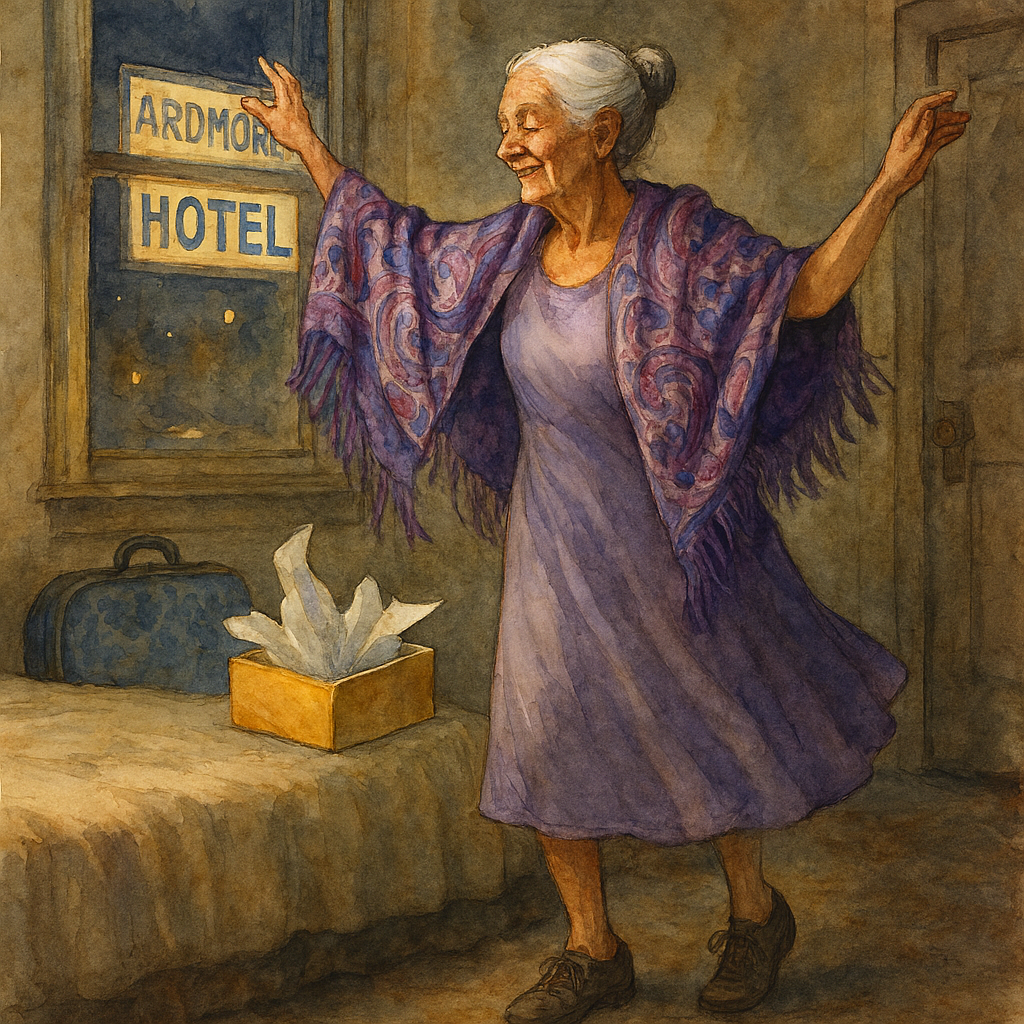
    “Why! It’s got violet in it, and shades of lavender, too!” she exclaimed, holding the shimmering scarf out in the dim light. Then she jumped to her feet, laughing merrily as she wrapped the perfect paisley scarf around her thin, bare shoulders. “Sissy, darling! It’s exquisite! What a wonderful birthday present! It really is true! You definitely are the most wonderful sister in the whole wide world!”

    And in a world filled with streetlights, passing cars, honking horns, and wine-besotted derelicts, Violet Sheldon danced, danced, danced around the dingy room—alone again.

    The old lady in lavender dawns a lavender and blue paisley scarf and dances around a shoddy hotel room... alone again.
    Violet’s stolen moment of joy…

    THE END

  • TGA-Chapter 6 Polar Bears

    Walking in the Footprints of
    Polar Bears

    by Michael McBride

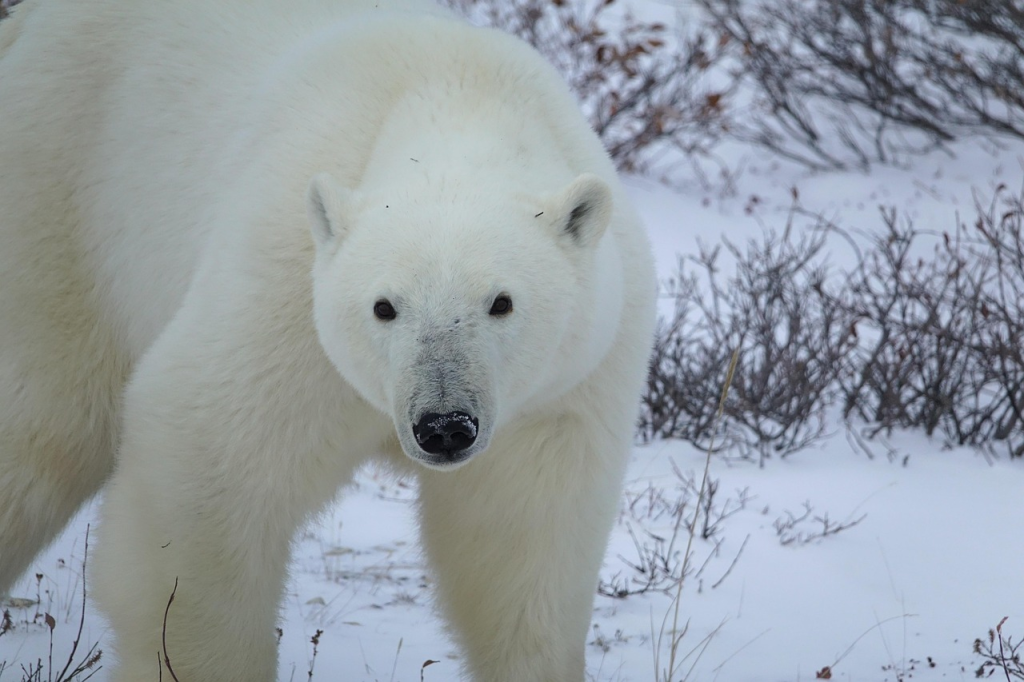
    Polar bear facing camera in a snowy, low brush covered wilderness.
    Walking in their footprints…

    Survival, Storytelling, and the Wild Pulse of the Arctic

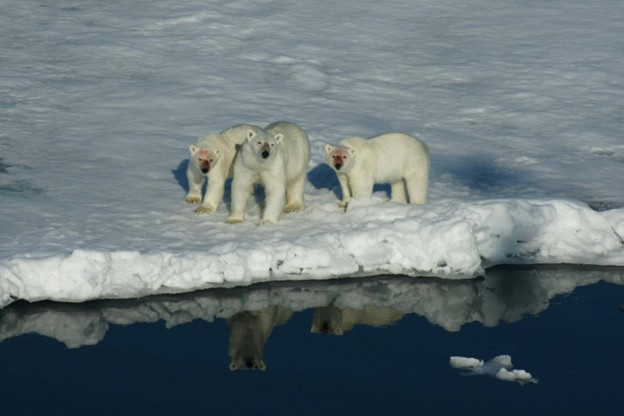
    One of the world’s foremost polar bear experts, my friend and associate Jack Lentfer, is internationally respected by his peers. Here on the sea ice with a dart-drugged ursus maritimus under study and about to be radio-collared. Average weights range from 600 to 1,200 pounds and they stand 8 to 10 feet tall, while females weigh 400 to 700 pounds. Polar bears can live up to 25 years. The largest polar bear on record was a male shot in Kotzebue Sound, Alaska, in 1960, weighing 2,209 pounds as measured by helicopter scales.

    A polar bear’s smell would alert a seal, its favored food, to its presence, even if these masters of stealth were approaching from downwind. There is a myth that a bear covers its giveaway black nose when stalking, but this has never been documented in the wild.

    Few artists have captured the far north better than Fred Machetanz (February 20, 1908 – October 6, 2002). He was an Alaskan painter and illustrator who specialized in depictions of Alaskan scenes, people, and wildlife.

    My friend Yemegaq Slwooko told me an ancient story as we sat on her floor in the village of Sivugaq in the Bering Strait, Alaska. A storm raged just beyond the door, its insistency shaking the house. The view through the ice-skinned window spoke volumes about the comfort we enjoyed within as she skinned the white foxes her husband had trapped the day before. Sitting straight-legged, weaving nets or grass baskets, skinning, and butchering game is all done sitting on the floor in the central room. We would call it the living room. Quasag is one name for such places, where, while working, one tells stories to pass on the ancient ways.

    “In the culture of my ancestors,” she said, “the greatest gifts we can give or receive are those without material form: songs, dances, and stories.”

    On the other side of the world, Alaska’s antipodes, in Africa, an imprisoned !Kung bushman of the Kalahari says that he is “waiting for the moon to turn back, that I may listen to the stories of my people, for I am here in a great city where they have put me in a cage and I do not obtain stories. I listen, watching for a story which I want to hear. I will turn my ears backward to the heels of my feet on which I wait, so that I can feel that a story is in the wind.” Lucky for us, one of the truly great raconteurs, Laurence Van der Post, saved this story for us, never imagining that it would reappear and have poignant relevance in remote Alaska.

    Stories have always begun this way, the best ones perhaps told by elders, perhaps enhanced by a full moon and surging tides or the music of a talking river. There may be lightning or the call of owls, a crackling fire whose incense intoxicates. Wolves or lions may be speaking in the distance. Stories can communicate and need to communicate magic, but they need not take place in such exotic settings. The inner search or struggle for self-awareness may place the seeker in the greatest of all wildernesses, that within one’s own heart.

    A few days ago, I was invited into the Zion Canyon workplace of a friend, the gifted potter and teacher. He handed me a moist lump of clay and with another in his hands, we each began to shape a sphere. The expectant lump was rounded until smooth. He instructed me to place my foot beside his on the stool in front of the potter’s wheel. Using the kneecap as a form, he gently but authoritatively smacked it on his knee, and I followed suit. Smack, turn, smack, turn, smack, turn. Then, using just our hands, we shaped and turned, lifting the walls, deepening the base. Our attention was directed to uniform thickness until a small crude bowl was formed, not much bigger than the cupped hand.

    In those moments, we were as free from care as children. The left brain relaxed as the tactile senses came alive. The earthy smell of the clay was clean and heavy on our hands. The mind is more open when playing. There was a church-like quiet in the room. Motes danced on a beam of sunshine coming through a high window in the studio and encouraged a lightness of approach and freedom from desire and ambition. Basic, elemental, even primeval was this most ancient of creative expressions. In my life, I hope to be as open and expectant as a child at play.

    Like the bushman, I will listen for the story. Like the Eskimo, I want to be appreciative of the insubstantial. The song and the dance and the story, real or imagined, hold greater value than we can know. Imagine now your own empty hand reaching out, cupped as if to catch water. I imagined being would be as naked as a sadhu in a Punjab alley whose raiment is only ash from the charnel fires, whose empty bowl is the only possession. To such a one, life itself is such a mysterious blessing that anything which comes to the bowl is like rubies and pearls.

    On the opposite side of the earth, my good Cape Town friend Dr. Ian McCallum, brilliant author of Ecological Intelligence, describes a kudu stalking a shadowed shrub from downwind. With beautiful straight-up long curling horns, it favors a bush that is able to release a toxic smell and taste as soon as a kudu begins to graze on its delicious leaves. The clever kudu has learned that it is its smell that triggers the plant’s chemical defense, so it stalks from downwind and browses quickly before the offensive smell and taste is released.

    The contrasts within the Alaskan/African Antipodes are nowhere more striking than in the parallels between the Alaskan Inupiat word “Malawi” and the Bantu Chewa word “malaŵí.” When I was with Credo Mutwa in his African homeland, I asked him, “You have an adjoining country called Malawi. Was the country named for its large lake, and what does Malawi mean?”

    Malawi in Africa refers to a country in southeastern Africa, and the name itself is derived from the “Maravi” people, a Bantu ethnic group. The word essentially means “flames” in the local Chewa language, possibly referencing the sight of many kilns burning at night. The Maravi were known iron workers. It is the fourth largest freshwater lake in the world by volume and stretches almost the full north-south length of the country itself.

    I told Credo about my time with my friends, the Inupiat people above the Arctic Circle, and about being out on the sea ice with my hunting partner, the best-known polar bear hunter in the village of Sivugaq. We were not interested in the polar bear, despite the giant tracks we were walking in, but rather wanted to collect, as we were asked to do, the unusual and little-known Spectacled Eider duck for museum collections in the US and abroad that did not have them.

    I considered the opposites of the African Timbavati lion as I walked on the ice in the dinner plate-sized polar bear tracks. The African and Eskimo word Melawi fell from the river of stars in both places I had experienced. How, other than by considering magic, can one accept this impossible coincidence that the African and Alaskan word Melawi are the same?

    There was only ice for hundreds of miles in every direction. These were places where the people knew there was an under-ice current collision with an under-ice cliff, which then swirls upward to create a place of open water. These unique eiders are known to gather and overwinter in these places by the thousands. In addition to the rising food-carrying currents, the dabbling, wing-stretching, and paddling movements of the ducks stir the surface water just enough to prevent the forming of ice.

    The big man, royally robed before me, was glistening in the heat. He drew on his many encyclopedias of memorized information and said, “Mr. McBride, there are numerous words in African languages that are the same in Inupiat,” and he recited a few. Of the millions of abstract questions I might have asked him, how could he possibly have known that? Credo’s intellect always amazes, dazzles, and leaves speechless those who interact with him.

    This was not the first such revelation of his brilliance. Wondering if I could stump him on something obtuse, I asked if he knew anything about the Celtic roots of my children’s names, Morgan and Shannon. He launched, without pausing, into a long-detailed narrative that would have impressed Fiona Salmon or a PhD scholar in the history of Clan Donald of the Western Isles. Credo could have held a chair at Europe’s only Celtic University, Sabhal Mòr Ostaig of Skye in the parish of Kiltearn, Ross and Cromarty, Scotland. He could have been an honored guest at the festive table of the Chief of Clan Munro, Hector William Munro, in his castle home of Foulis. I wonder which of the many rooms would have been provided for Credo and his entourage?

    Paths That Cross the Great White Bear

    The somewhat random and loosely connected stories and observations that follow concerning polar bears demonstrate that even an Alaskan living far from these great white bears can recall many encounters. Each memory is vivid, perhaps because of the mysterious spiritual power the great white bear holds. I share these stories with respect to highlight how the northern people found uses for the bears beyond what we could imagine.

    As supreme opportunists, these great bears can roam hundreds of square miles, wandering the trackless ice beneath the shimmering, multicolored aurora.

    Though I live far from their life-supporting sea ice, polar bears have occasionally appeared on the Kodiak Island chain, which has a temperate continental climate. To get there, a bear would have to traverse the ice or shoreline of the Bering Sea, cross the Alaska Peninsula with its towering mountain chain, and swim the 30 miles across the open water of the Shelikov Strait.

    I was once asked to escort a well-known author from Outside Magazine who was on assignment to explore exciting winter activities. My Piper PA-12 was equipped with straight skis at the time, so I flew him up to the remote Mountain Lake Camp (loonsonglakelodge.com) to experience the chilly delights of three feet of fresh powder snow. Bush flying on skis in winter is an adventure in itself, with severe cold and landings on frozen lakes, from which we ventured out on cross-country skis following the tracks of wolves, wolverines, and moose. The crackling of kindling splits is a sweet sound when rising in the blackness to start the day, accompanied by the chugging of the little coffee pot. The dancing, multicolored aurora before first light takes your breath away. There is much to love about winter in the bush—I am never disappointed.

    I wore a polar bear fur hat made for me by my Arctic Native friends, which I generously loaned to the writer and never saw again. He was thrilled to have the REAL Alaskan experience with such an extraordinary hat! I was proud to own such a heritage piece of traditional village headgear, having seen one only once in an Arctic village. A person could stand in the lobby of the Anchorage International Airport for a year and never see one.

    The most exotic polar bear item I ever encountered was the bear’s head, removed in such a way that the hide could be sold as a valuable rug, while the head became a large gathering bowl used for collecting radiola or storing hunters’ equipment or household items. I believe it might have had shamanic use because when you put it over your own head, it draped over your shoulders, plunging you into darkness. Your face aligned where the bear’s was, and light coming through the sewn-shut eyes, nose, and ears allowed your imagination to run wild as you assumed the bear’s spirit.

    Shamans could and did become bears. Witness the Peter Kalifornski story of The Kustatan Bear, which terrorized a whole village and could only be killed with a magic bullet blessed and consecrated by a priest or perhaps by the shaman himself. Killing the great bear was killing the shaman who had become the terrible bear, bringing grief and destruction to the village. Shamans didn’t always earn “ice guy” awards.

    Another item of clothing that has disappeared is polar bear pants. I have never seen them anywhere but in museums. In the past, they were the merit badge of a brave and successful hunter and of his wife, the skilled seamstress who, with her dexterity and cleverness, showed off her man.

    The Power of Rhodiola

    Rhodiola (Rhodiola rosea)1, was named for the rose-like fragrance of its freshly cut root. As a medicinal plant, its use dates back thousands of years in China and Tibet. Its medicinal use by everyone from Vikings to modern athletes and even cosmonauts aboard the International Space Station is well documented. The people mix the leaves and buds of rhodiola with seal and whale fat to ward off scurvy and give them energy. I was struck by the ingenuity driven by necessity when I helped skin a seal by drawing it out through its own mouth. On the “living room-quasiq floor,” this unusual skinning is often done on absorbent, surplus cardboard from the village AC Company General Store. Using a very short knife or a lithic tool like the one I found in Africa that fits perfectly between thumb and index finger, one peels back the lips, pushes the nose up and back, and cuts along the bone to release the skin. It takes a skilled practitioner to get the full hand into the mouth, cutting around the nose, eyes, and ears. It is slow and tedious, with lots of hard pulling as you release the flippers from the body; they remain attached to the hide. The slipperiness of the animal and the hide is so great that some kind of magic seems to come into play to complete the task. There it is: seal hide turned right side out, looking just like a deflated seal on the ice, and beside it—a cherished, delicious dinner with lots of fresh-as-it-gets seal oil. The eyes, ears, and vent are sewn leak-proof tight, and the skin is forcefully stuffed with nunivak, the heart-healthy rhodiola. When the cutting was going on, we took care to leave as much of the blubber or fat on the hide as possible. This live seal-looking container is now buried in the tundra under a cairn of rocks to thwart the sea-hungry sled dogs. The large amount of fat left on the skin breaks down with necrosis, and each bud and blade of the plant, rich in vitamin C, is so needed in this land of nothing green in sight from September to May.

    Intuitively, the people knew that the plant could prevent the deadly scurvy. The traditional Inuit diet does include some berries, seaweed, and plants, but a carnivorous diet can supply all the essential nutrients, provided you eat the whole animal and eat it raw. Whale skin and seal brain both contain vitamin C. The Inuit may have a higher genetic tolerance for vitamin C insufficiency.

    Clams are very rich in probiotics and vitamin C. People who lived with walrus got them from their stomachs. As filter feeders of phytoplankton and zooplankton, vitamin C from clams is an essential micronutrient in the marine food chain, and it’s carried by copepods and their fecal pellets. This makes copepods a potential pathway for vitamin C to reach higher trophic levels, such as fish larvae.

    What has not disappeared from special Arctic attire, however, is the wolverine ruff, sewn circularly around the upturned parka hood. Even as the beards, eyebrows, and eyelashes froze with the cold when using wolf, coyote, or other furs, the wolverine helps to keep the face frost-free.

    Considering where, when, and how often these mysterious bears appear in my own space, it is worth translocating for a moment into the ancient Native world to consider the shamanistic view of this animal and perhaps even its power over modern white people like us today. There is a very thin and diaphanous veil separating us from the bear and the shaman. Its thinness is clearly seen as the distance between bear and seal. If the seal were a little faster and more clever, there would be no bears. If the bear were a little more cunning and faster, there might be no seals, thus also with lions and their prey at the antipodes. To consider these separations perhaps requires that we be more open-minded and open-hearted to unexplainable mystery.

    Imagination is more important than intelligence, Einstein.?

    Thinking beyond current limitations is often more valuable than simply accumulating facts and knowledge alone; it is considered the driving force behind innovation and progress.

    Three polar bears on the edge on the icy sea edge
     Three Polar Bears at ice edge (by Michael McBride, 1987).
    An ideal Polar Bear habitat (by Michael McBride, 1987).

    Image Credits

    Walking in their footprints…
    Pixabay Image
    Image by Margo Tanenbaum from Pixabay


    1. https://www.webmd.com/vitamins/ai/ingredientmono-883/rhodiola []
  • TGA-Chapter 5 Okavango Delta

    Into the Okavango Delta

    by Michael McBride

    Into that vast swamp with Chris and Robert McBride
    In Botswana’s Okavango Delta—on foot and by mokoro

    “Adventures are not always pony rides in May sunshine.”
    —Thus spake Bilbo Baggins of Bag End

    The Makgadikgadi Pans of Botswana lie along one of Africa’s great migration routes, teeming seasonally with wildebeest, zebra, waterbuck, and impala. Since Chris, Robert McBride, and I were there during the dry season, we also encountered oryx, eland, red hartebeest, and a countless flood of other animals.

    The book referenced above was written by my cousin, the almost-famous author Chris McBride, distinguished yet humble soul, already known for The White Lions of Timbavati.

    This nearly worthwhile fellow invited me to join him in Botswana’s Okavango Delta while he was still working on his second book, Liontide. Timidly stepping forward at the chance to return to Africa’s wild country with “my brother,” I offered to bring along my underwater Nikonos camera, my French cologne, and—for the sake of campfire decorum—my nightgown with lambswool slippers. We would see if there was any potential for an instructive underwater photo to add to the book’s questionable authority.

    I did bring the camera. I even managed several shots that felt worthy of publication. But upon leaving the country by commercial jet, I foolishly left my camera case—film still exposed—under the seat.

    The moment I stepped off the plane, the mistake struck me like a blow. I raced to the gate agent and pleaded for help. It was the last time I saw any of that irreplaceable film.

    As one of my heroes, Andrés Segovia, once wrote:

    “Fate often likes to put impediments in the path of an artist’s career, perhaps with the wise purpose of testing him, so that he might ascend, without descending, the steep pathway to success.”1

    Bittersweet words—but my only consolation.

    Our watery highway was the Boro River system, just northeast of Chief’s Island.

    The journey began in Alaska—at the antipodes of Maun. I descended the fifty-two steps from my remote, cliffside home to the high-tide shoreline. Hoisting my single Seda kayak from its cradle on the dock to my shoulder, I clipped on my life vest, sealed my cell phone in a ziplock, and paddled into the rushing tide.

    Anchored just offshore sat the eighteen-foot Boston Whaler Outrage—secured in deep water, as always. With tidal shifts reaching up to twenty-four vertical feet in six hours, mooring at the dock is out of the question. Boats must anchor out, where they can rise and fall with the living sea.

    The journey began with a thirty-minute drive across open ocean, hoping for calm seas. In rough weather, one doesn’t attempt the mooring at all—it’s safer to stay ashore, away from Neptune’s icy grip. When the southwesterly sea winds rage, launching becomes an hour-long battle against salt spray, the horizon dissolving into white mist.

    The nearest boat harbor is in Homer, where—on gentler days—a vessel can rest at a floating dock. From there, a pickup truck carries travelers along one of the world’s longest natural sand spits to the airport a few miles away. But that road is a gamble when the winds rise, sending rocks and logs hurtling through the air. It was not uncommon to be stranded—either on the mainland or at the spit’s end—waiting for nature’s fury to pass.

    Next stop: Johannesburg, where I joined my cousin Chris.

    From there, we drove four and a half hours to Gaborone, the capital of Botswana, in a friend’s vehicle. Waiting for me was a bed and a glass of wine at the Ambassador’s home—hosted by Melissa Maino, daughter of “The Honorable” Ted, a Reagan appointee and longtime family acquaintance.

    I fully expected Chris to sleep in the bushes well beyond the Ambassador’s gate, lest his tattered Harris Tweed introduce unwelcome crawlies into diplomatic quarters.

    Arriving there, however, I was surprised to see men in camouflage uniforms with machine guns stationed on the rooftop. Knowing I’d soon be venturing far off-grid, the sight of armed guards stirred some apprehension.

    No cause for worry, as it turned out—perhaps just standard State Department policy for safeguarding diplomats in Africa.

    The following day, Maun was still six hours away—our route taking us through Francistown, renowned for its ability to tan entire elephant hides.

    That final leg by vehicle meant crossing the Makgadikgadi Pans of the Kalahari—a land of relentless daytime heat and desolation. My backpack, packed with bare essentials and first aid, lacked one critical item: a broad-brimmed hat. We searched the few shops along dirt streets, nearly ready to abandon the hunt when—Eureka!—one was found.

    Chris’ “kit,” meanwhile, consisted of whatever happened to be in his pockets at that moment—likely kudu biltong and a crumbling rusk.

    Wherever water was available, I plunged my cotton treasure into it, then placed it back on my head, leaving a small pool within to trickle cool relief down into my sun-glassed eyes.

    By this point, we still had no solid plan for crossing the intimidating Kalahari.

    Enter James McBride—a fresh-from-Ireland character we met at a local bar and casino. His Gaelic brogue was thick, his humor even thicker—keeping us doubled over in laughter about his homeland, his mother, and his pals back home.

    When James—the slot-machine repairman—heard of our destination, he latched onto the idea like a rat on a Cheeto. Without hesitation, he offered to be our chauffeur, neatly uniformed for the occasion.

    We might have imagined a sturdy, time-tested Land Rover for this desert crossing. Instead, his car was barely bigger than a breadbox.

    Three grown men and gear for the wild—two men too many. Running alongside seemed an unwise alternative, so we poured ourselves in, knees to chins.

    We waited for midnight, then—with a full tank of gas—roared off into the star-filled African night.

    I tingled with excitement. Chris slept like a stone. The third McBride—the “real McBride,” fresh from the old sod—had the wheel.

    His foot was lead-heavy on the pedal, pushing us across barren wastes before dawn.

    Several hours in, Chris and I were jolted awake by a bone-crunching impact—a zebra, flying into our right-side door at terrific speed.

    Chris muttered something about a leopard stampeding the herd.

    The collision sent us skidding to a dusty halt. The door never opened again.

    No brass band welcomed our early-morning arrival in Maun, beside the usually dry Thamalakane riverbed.

    The Duck Inn was closed—so much for a scotch-and-water reward after the trauma of that desert crossing.

    Waiting ahead lay the Boro N’yane River, flowing from the Okavango Delta.

    It would be our gateway into the wet/dry wilderness—and as far as we knew, no one had ever done what we planned to do by mokoro.

    The Duck Inn a happy watering hole in Maun Botswana where Michael and Chris were able to “wet their whistle” before crossing the Kalahari. (Photo by Michael McBride)

    We woke our Doctors Without Borders friend in Maun, rolling out our sleeping mats on his floor—not at all troubled by the cobra curled in the cold ashes of the fireplace. Or rather, we hoped it was sleeping. The flick of its tongue, sampling the air, suggested otherwise.

    Yes, fireplace; yes, nights can be surprisingly cool in the Kalahari. And, yes, I was less than pleased with such an evil-eyed roommate.

    Chris had graduated from Witwatersrand University in Johannesburg in 1965 with a degree in English and Zulu. Soon after, he ventured alone—guided only by his instincts and curiosity—into the depths of the Okavango, searching out what he described as the last of the San River Bushmen.

    He found two traditional, Kiganima and Matturu, thought to have diverged from other humans one hundred thousand to two hundred thousand years ago—holding tight to traditions fading elsewhere.

    Before leaving that first time, Chris loaned his double-barrel shotgun to a Swana friend, promising to return for it one day.

    Now, here we were, returning and hoping and needing to recover the shotgun.

    We found a guide, whom we nick-named “Gilly-Billy”, a Swana man whose real name defied our tongues—and hired him, along with his twenty-foot mokoro, a thin-hulled vessel hand-carved from the sausage tree (Kigelia Africana).

    Before steel tools were available, locals shaped the boats by controlled burning, hollowing the tree’s core with fire.

    Our mokoro was long, narrow, and impossibly streamlined, its bow and stern forming elegant points. Some of these handcrafted boats carried subtle, snake-like curves, depending on the tree’s natural bend and the skill of the builder.

    The pole,balancing delicately upright,maneuvered with a long push-pole, its duckbill-shaped tip spreading as it pressed into the mud, then closing as the mokoro glided forward.

    The art lies in finesse: push too hard, and retrieving the pole robs you of forward momentum. It is a rhythm,a conversation between force and surrender, yet another example of the opposites of the antipodes.

    We launched into the world’s largest inland delta with precious few supplies; cornmeal, salt, oil, kudu biltong, and our greatest treasure: a pellet gun purchased in Maun for one hundred fifteen pula.With scant pula left—the Setswana word for “rain” and Botswana’s currency—we had gambled heavily on the gun.

    A single lever stroke compressed enough air to send a tiny lead pellet fifty feet, enough to drop a green pigeon from the trees. We ate scores of them in the days ahead,each shot fired with careful restraint, not just for accuracy but for preserving our dwindling pellet supply.

    Fishing hooks and twine allowed us to snare the ever-present catfish, though their taste was muddy and thick.

    Ketlhatlogile Mosepele at the Botswana University writes of the nutritional richness of bream fish, which we found to be far more palatable.

    Silver catfish(Lerehe in Setswana)—were easily caught, as were the three-spot tilapia, known locally as Mbweya.

    With little money left, we sought to buy our own mokoro—a cheaper solution that would allow us to hire a guide independently.

    We arrived at a tiny village on a too-small island, hoping to negotiate.

    Following tradition, we were brought to the chief—a wiry man seated before his crude shelter. One of his wives appeared with bowls of fish stew.

    The stew had more sharp bones than meat, but we slurped loudly, mimicking the chief’s own eating style, eager to show respect.

    I tried not to stare at one of his wives, though my attempts were in vain.

    She, like the other women, was stark naked save for a small leather modesty belt.

    Her sign of relative wealth was far more memorable—a bright pink knitted jersey, worn to near ruin. Through well-worn holes, protruded two of the most pointed, erectile breasts the gods had ever shaped.

    Had she been handed two balloons, she might well have clasped her hands behind her back and popped them both with a single stab.

    The chief had two bowls before him—one for fish bones, one for eating.

    From time to time, his young son emptied the bone bowl into his own, re-sucking the scraps that had already been consumed once before.

    Such was the scarcity of food among these thin, wiry people.

    That full-moon night, drums echoed across the delta.

    Somewhere, the solitary crocodile specialist—the one we had met earlier—was out there, searching for hidden nests among the reeds.

    In the distance, basso drumbeats reverberated, mimicking the heartbeat of Africa itself.

    Freud would have smiled, I thought.

    Through it all, Chris was quietly, profoundly joyous returning to the place that had captured his soul as a young man, after university.

    I hiked daily with Horoletswe from Kiganima’s camp to the felled tree and wrote writing for hours as he hacked endlessly until his calloused, dry and deeply cracked hands bled.

    Those familiar with this glorious place in Botswana hesitate to call it the Okavango Swamp, though in certain wet-season moments, the name might feel justified.

    But for those of us who have been seduced by her gin-clear waters, her scrappy fish, her sweet-fruited marula trees, and her star-drenched nights, she qualifies as Eden itself—where one might, indeed, be tempted to lie down beside her still waters.

    Yet the imagined lion and lamb do not lie together here.

    For this place has spent the last ten million unglaciated years shaping itself into a state of flawless equilibrium, where the veil between prey and predator is as diaphanous as a silk scarf.

    There is no wasted motion, no excess. Everything, everything, occupies a place that has been worked out since time out of mind.

    Chris McBride—my old friend with the shared surname, if not shared genes—was nodding off, lulled by the breeze noodling along the slow-moving stream.

    We had wandered into this remote, unknown place, calling to mind the old admonition:

    “Don’t let being lost spoil the fun of not knowing where you are.”  —Anonymous

    Chris stirred, half-awake, wrapped in the languor of the Tropic of Capricorn, where man, lion, kudu, and impala alike call a ceasefire beneath the marula’s shade—escaping the blistering heat of a Capricorn sun.

    The night before, lions had roared—their leaf-shaking vibrations trailing off with that unmistakable rhythm:
    Huuuumm … huuuuummm … huuuummmm.

    Chris could explain those vocalizations in full.

    Full belly. Empty belly.
    I’m here with my harem.
    I will hunt tonight.
    You young interlopers, hang back.

    Then, suddenly—his voice sharpened with urgency.

    “Even if an ant crawls across your nose, don’t move.”
    “There is a huge black mamba less than an arm’s reach behind your head.”
    “One move, and you are a dead man.”

    I couldn’t see it. But I was acutely aware of my situation and I froze.

    Just be patient, I told myself.
    Try to wait calmly.

    And as I sat—stone still, not breathing more than necessary—my mind filled with the story of a young man who had died near Timbavati Dong-Dasha.

    He had gone to the wood box for firewood, reached in, and—like a flash of fire—was bitten.

    He was on his way to the clouds before his mind had even fully grasped the moment.

    • First, loss of control—tongue and jaw heavy.
    • Then, slurred speech. Blurred vision.
    • Tunnel vision.
    • Drowsiness. Paralysis.
    • Nausea. Cough. Sweating. Dizziness.
    • Hemorrhage.
    • And a taste of death itself.

    It can take seven to fifteen hours for a black mamba bite to kill a man.

    According to National Geographic, venomous snakes kill an estimated thirty thousand people annually in sub-Saharan Africa—though experts believe the number could be much higher, as many deaths in rural areas go unreported.

    Newsweek places the figure between twenty thousand and thirty-two thousand fatalities a year.

    Staggering numbers.

    Numbers that, in this moment, felt very personal.

    Black mamba taxonomy chart

    Before this next adventure, back in Timbavati, Chris had played Beethoven’s Fifth Symphony—his favorite music on earth—through speakers mounted on the little Land Rover, letting the sound roll out across the bush.

    It was part of his method—an attempt to habituate the lions to his presence.

    He would provide an impala or another offering, hoping to draw the lions in for observation, then follow them as they hunted.

    Through this persistent study, he documented their dependency on Cape buffalo, a reliance that had once been doubted.

    The next day, Gilly-Billy poled us further up the Boro River, with Chief’s Island on our left.

    He and Chris spoke of the dangers of crossing open water on a cloudy day—and of the serious threat posed by the hippos.

    Territorial, furious, and unpredictable, hippos will overturn a mokoro without hesitation—killing all aboard.

    My personal observation at T’sau l’gwana—pronounced with the click sounds of the Bushmen—was something I had never read in any report.

    Deep in the Okavango, we poled past a place where there had once been a cluster of huts.

    Like an echo of Karen Blixen’s words in Out of Africa:

    “Once, there was a village here.”2

    Our guide, push-pole in hand, explained to Chris:
    The head man had been killed by a hippo, right in front of his family.
    In terror of the spirits, the people burned all they owned and abandoned their home.
    We could still see the burnt earth, the twisted blackened metal trunk—likely their most precious possession, used to keep their food safe from hyenas.
    They even left behind a beautiful stone adz.
    I had not seen a single stone on our wide-ranging travels, and I could only assume this fine artifact had come from a great distance.
    The name for the place, Carry My Child, spoke to the ever-present spirits of the land.
    The story carried a warning—woven into the very fabric of life here:
    A mother, needing to water her mealie-corn stalks, asks the zebra to carry her child while she is gone.
    The zebra tires of the duty.
    The hyena, sensing opportunity, offers to care for the child.
    Then promptly devours it.
    In Africa, hippos kill more people than any other animal, followed by crocodiles and then snakes.Hippos are estimated to kill around five hundred people annually—but fatalities are likely underreported, meaning the real number is far higher.
    They are, without doubt, the world’s deadliest large land mammal—charging, capsizing boats, crushing human bodies with their immense, sharp-edged teeth.
    We stuck to the narrow hip-wide trails, cut through the dense papyrus thickets by crocs and hippos themselves.
    Overhead, only a tall giraffe might peer above the towering reeds.
    Thus, we had no real sense of direction—no clear landmarks—in this search for Kiganima and Matturu.
    Only the ancient waterways.
    Only the unseen hands of fate, guiding forward.
    Finding them days later, mm has (hard copy?) photos of the VE 24 next to their simple brush shelter.
    At one point, unknowingly, we passed a small side channel, where a crocodile had parked itself for a midday nap.

    Image of a long, gray crocodile lying on the ground.
    Deadly crocodile


    The creature, disturbed and territorial, voiced its displeasure—a sound torn straight from a nightmare, rising from just a few feet away.
    Crocodiles are the most vocal of reptiles, capable of bellows, growls, and hisses.
    This ancient relic of Pangea, barely changed since the Triassic period, has been around for one hundred million years—perhaps its unchanging existence is the reason for its perpetual boredom and grumpiness.
    Each year, hundreds of people are estimated to die from crocodile attacks in Africa—though, as with most fatal encounters, the true number is likely much higher.
    Enough of that grim thought, I prayed, imagining a rosary in my fingers.
    We pushed on, searching for solid ground—a small island, preferably one crowned by a strangler fig, where we could make camp.
    By now, Chris had reclaimed his shotgun, and as we rounded a leafy little island, he quickly fired at a sitatunga (Tragelaphus spekii)—a marsh-dwelling antelope, standing knee-deep in its usual habitat.
    Wounded, it weakened, and we closed in.
    From the bow of the mokoro, armed with a seven-inch Buck knife, I lunged—grabbing the animal’s left horn—and with a single, lucky stroke, stabbed between the atlas and axis vertebra at the base of its skull.
    The kill was instant.
    We butchered the animal, making camp on that tiny island, and ate from the hindquarters forward—consuming the most perishable cuts first, before the heat summoned maggots.
    A twenty-four-hour smudge fire kept the remainder smoking into biltong jerky, preserving it for the long days ahead.
    That full sitatunga belly, with the moon and stars above, sent me into a deep sleep.
    Until I was awakened—thrown into a hideous nightmare.
    Something—an insect, a parasite—was inside my ear, burrowing inward, searching for an exit through my brain.
    For a time in college, I was a pre-med student, taking a course in parasitology.
    You do not want to travel alone in Africa if you have taken such a class.
    Panicked, I considered assisted suicide, hoping not to waste a shotgun shell.
    Chris, unruffled, suggested a simpler remedy:
    He placed a drop of vegetable oil into my ear.
    The damned thing drowned.
    Its remains, I assume, are still lodged somewhere—perhaps the reason my earwax carries an unpleasant scent.
    Chris was unwell, his residential malaria reawakening, the blood parasites attacking again.
    Even after treatment, malaria can persist for years—its Plasmodium species lying dormant in the liver, triggering relapses.
    Its effects can be long-term, leading to neurological problems, cognitive impairment, motor dysfunction, even seizures.
    As he slept, I decided—perhaps foolishly—to venture alone on a Chief’s Island hike, without Chris, and more critically, without his .416 rifle to protect me.
    My mind buzzed with fears—but I chose to press forward, treating it as a test.
    Upon returning, I described to Chris a sound I had heard—a hideous growl, something that nearly killed me from sheer fright.
    I imitated the noise, trembling still.
    Chris burst into laughter.
    “That was an ostrich, Alaska man!”
    Wandering alone, I stumbled upon something extraordinary:
    Beneath a large marula tree, a giant wooden sculpture—a penis and testicles, crafted into a bellows for smelting iron.
    I was instinctively afraid—the place felt like a sacrilege, a site where no white man should trespass.
    Throughout history, forgers were high-ranking Sanusi mystics, their work filled with ritual and alchemy.
    Near the ancient bellows, I found pieces of slag—stony waste matter, separated from liquid metals in the refining process.
    Such heat requires fast-moving air, forced into the flames through a powerful bellows—one not easily crafted.
    The Zulu forged at least twenty types of spears, the most famous being the assegai, used across Southern Africa—a throwing spear, its narrow leaf-shaped blade designed for flight and impact.
    The bellows itself was astonishing—its shaft measuring three and a half feet long, roughly ten to twelve inches in circumference.
    Carved from a single piece of wood, it was hollow, smooth inside and out.
    At the base, two rounded testicles, their surfaces stretched loosely with animal hidperhaps porcupine, though I guessed impala.
    At the tip, a small aperture—through which air was expelled into the fire, mimicking the act of creation itself.
    By manipulating tension, the forge master could accelerate the air, deepening the flames, seeking the searing heat required for metalwork.
    Across centuries, forgers and alchemists alike have searched for the Philosopher’s Stone—a substance to transmute lead into gold, to hold the secret to immortality.
    In Western myth, Thor of Scandinavian legend wielded lightning to forge ancient swords.
    His hammer, Mjollnir, represented thunder, the force of creation through fire.
    Africa, too, has its sacred metallurgy.
    And though the distance between Scandinavia and Timbavati is vast, the art of fire and metal—the act of forging transformation—remains universal.
    I Remember
    We hitchhiked out of Maun in a wheeled Cessna 206, lifting off into the African sky, leaving the delta behind.
    At the Namibian border at Hanse, we faced uniformed guards, machine guns slung across their shoulders, their expressions unreadable.
    We had no certainty of passage, but we had a fat bag of oranges—a bribe, or perhaps just a gesture of goodwill.
    With jovial interaction, our passports were stamped, and we were sent on our way—flying at treetop level, because below us, the war raged on.
    Bullets flew beneath us, and rumor had it that Cuba had sent twenty thousand mercenaries, engaged in the fight for control of the country.
    Landing in Windhoek, we were reminded again of our precarious position.
    We passed through scowling faces, camouflage uniforms, machine guns pointed at us.
    We avoided eye contact, the way one does when passing a snarling pit bull—submissive, downward gaze, long, slow exhalations, moving forward without hesitation, without challenge.
    Africa had left its mark on us.
    The zebra, colliding with our car as it fled a lion’s pursuit.
    The herd of impala, leaping over our sleeping-bag bodies, plunging into the Umfolozi River, where crocodiles waited, mouths open.
    The live-trapped leopard, caught in a baboon cage in the dark.
    The black mamba, poised behind my head, waiting.
    The pygmy goose, drifting in the Du-O pool.
    The parasite, burrowing into my ear, seeking my brain.
    The sitatunga, killed with a Buck knife, eaten in its entirety.
    The old man, dying fireside, struck by a night adder.
    The mating adders, coiled in the dark, unseen until I had stepped over them.
    Horuletsue, carving a mokoro.
    Maturu, with her small band of river Bushmen, telling us that Kiganima was dead.
    Carry My Child—T’sau-n’gwana, the burned-out camp, where the hippo had killed the man.
    And so much more.
    We had entered the Okavango Delta, and it had entered us.
    Some places never leave you untouched.


    Image Credits

    Image: Black mamba taxonomy chart
    Source: Wikipedia
    By Hendrik van den Berg, CC BY 3.0, https://commons.wikimedia.org/w/index.php?curid=47439580

    Image: Deadly crocodile
    Source: Pixabay
    Image by Jean photosstock from Pixabay

    1. National Park Service History Electronic Library & Archive May 1, 2012 []
    2. Blixon, Karen. Out of Africa, 1937. Putnam, Denmark. []
  • TGA-Chapter 4 Bering Sea

    Under the Bering Sea

    by Michael McBride

    IN A SCUBA DRY SUIT BENEATH THE BERING SEA, I worked to save a disabled king crabber as gale-force winds—approaching eighty knots—threatened to drive the vessel aground and take the crew with it.
    The Lindblad Explorer, famed for its Antarctic expeditions, happened to be nearby. I was serving as Expedition Leader aboard her at the time of the incident.
    Sharing the bridge with German Captain Verner Volkersdorfer, I navigated the renamed Explorer—based out of Seattle—carrying ninety-six passengers and thirty-four crew. We diverted course to pick up a passenger in Prince Rupert en route to Nome, with plans to visit the rarely seen Pribilof Islands.
    These islands—little more than treeless, tundra-covered hills—are home to the Aleut communities of St. George and St. Paul, with populations of about one hundred eleven and four hundred, respectively. Despite their remoteness, the shorelines and cliffs teem with life, making them a haven for birders and wildlife enthusiasts. Often called the “Galápagos of the North,” these islands attract those drawn to rare wild abundance: whirlpools of seabirds, herds of marine mammals, and congregations of whales.
    Some come seeking to notch “Galápagos” into their travel log, only to find themselves equally mesmerized in the middle of the Bering Sea. Go figure. Chill bumps, after all, have no fixed geography.
    The National Oceanographic and Atmospheric Administration attributes this biological bounty to enhanced tidal mixing—nutrient-rich slope waters rising into the euphotic zone. Copepods, crucial links between phytoplankton and predators, flourish here, feeding fish, seabirds, and whales in a food web of astonishing complexity.
    The Pribilofs are the world’s largest Unangax̂ villages, where the languages spoken are St. George Unangam Tunuu and St. Paul Unangam Tanax̂ Amix̂. For English speakers, the bilabial pronunciations can be challenging.
    Historically, the Unangax̂ traveled to the Pribilofs seasonally for hunting. But in 1786, when Russian fur trader Gavrill Pribylov arrived at St. George, the islands were uninhabited. That changed abruptly: for two years, the Russian-American Company enslaved and forcibly relocated Indigenous people from Siberia and the Aleutians to hunt fur seals. The descendants of those first captives still live there today.
    Overhunting drove the fur seals to near-collapse, and the once-resilient Unangax̂ communities fell into poverty.

    Now…

    Now the islands are part of the Alaska Maritime National Wildlife Refuge and are known for their exceptional birding and vast gatherings of northern fur seals.
    Commercial fishing—particularly for halibut—and seasonal work in local fish processing plants make up the backbone of the modern economy. Subsistence practices also remain essential, carried out with vigor and ancestral knowledge.
    Each summer, more than two and a half million seabirds representing over two hundred species fill the cliffs, tundra, wetlands, and beaches. Even more staggering: over one million northern fur seals return to these shores to breed and raise their young—the largest such gathering of marine mammals anywhere on Earth.
    Viewing blinds dot the beaches, offering close glimpses not only of fur seals, but also of Steller sea lions, walruses, and sea otters—each part of the deep rhythm of life in these islands adrift between continents.
    As we approached, we maintained contact with the St. Paul harbormaster via marine VHF radio, which can reach across the sea for about one hundred miles. Through sizzling static, he confirmed our estimated arrival time and asked whether we had a diver aboard.
    He spoke slowly and clearly, informing us that a large Bering Sea crabber lay disabled with line in its wheel—adrift in shallow water on the island’s windward side—and that a deep low-pressure front was approaching from the northwest, with predicted winds nearing eighty miles per hour.
    I reminded the captain that I was a certified open water dry suit diver and had my equipment stowed in the bosun’s locker. I trusted Pedro Megano, our bo’s’n, to serve as my tender for what would be a challenging and possibly dangerous rescue attempt.
    A high-wind warning had already been issued for the Pribilofs: eighty-mile-per-hour gusts expected from the north-northwest. The crabber and her crew—five or six men—were in grave danger. There would be no hope of salvation unless a diver could remove the fouled line and free the vessel before the storm arrived.
    The sea was not heavy as the Lindblad Explorer hovered upwind from the crabber, “hanging on the hook.” Still, even in moderate swells, the anchor and heavy chain groaned and protested—an unnerving sound as Pedro and I clambered aboard.
    Our twelve-foot black Avon raft pitched wildly, rising and dropping with each swell. The transfer to the crabber—a leap of faith—was tenuous at best. We quite literally tumbled over the bulwarks after first heaving our dive tanks and gear aboard.
    The crew understood too well that their lives depended on me freeing that line. A spotlight was trained on my position as I moved aft to assess the current. I was more than aware that an anti-cyclonic tidal flow encircles these islands—complex, dynamic, and far from forgiving.
    The bow’s orientation could have been influenced by either wind or current. What I saw disturbed me deeply. The current appeared to be flowing at nearly five knots—enough to make me seriously consider abandoning the crabber to her fate.
    I understood the basics: warmer, slightly fresher surface water mixes downward, while colder, more saline water rises—driven by strong tidal movement. Bottom configuration adds further variables, and I knew there was no feasible way to enter from the stern and work my way forward to the prop in my cumbersome gear.
    My only choice was to enter from the bow and belay myself aft.
    The crabber’s bow, curved steeply upward, loomed what felt like light-years above the waterline. I turned to the captain and asked—half-joking, fully serious—whether he had any duct tape.
    His look said everything, but he obliged. In the wheelhouse, I applied a foot-long strip across the engine start button. If I was going under that boat and hanging on to the prop, there was no way I was becoming crab bait due to someone’s careless mistake.
    Next, I lashed a lead line to one of the large orange bumper buoys tied to the rail and tossed it overboard. If I failed or was swept downstream, I hoped to catch the trailing line and save myself.
    I was not at all sure I had the strength to perform the series of underwater gymnastics required to get from Point A (bow entry) to Point B (entangled prop). I tried to picture the transition—while wearing a heavy dive tank and sufficient lead weight to neutralize the suit’s buoyancy. It was more than a little complicated.
    Another mantra whispered to me: Beware of the unseen and unknown in unfamiliar situations.
    Whether piloting a bush plane, a vessel, or simply driving a car, my personal rule is, “If in doubt—don’t.” The yellow traffic light is a warning. The next one is red. And I had no interest in meeting red beneath a disabled crabber in the Bering Sea.
    Two cold-water swimmers offered me lifelong wisdom in moments like this.
    Diana Nyad—movie-famous and still a dear friend—taught me the vital importance of breath control during high-stress underwater conditions. I assisted her once during her swim from China Poot Bay to Homer in Kachemak Bay.
    Then there’s Lewis Pugh—Alaska’s antipodal counterpart, swimming in defense of fragile ecosystems around the world. Dubbed the “Sir Edmund Hillary of ice-water swimming,” Lewis became the first to complete long-distance swims in every ocean on Earth. Way to go, Lewis. Keep swimming.
    Calm, they had both told me, was the secret.
    That might be easy to say, but it is an art—an art that demands practice. And there was no time for practice. The storm didn’t care.
    Over the side I went.
    Immediately, I was gripped by the sheer force of the current and horrified by the monstrous razor-edged barnacles encasing the hull. These weren’t like the ones I’d lived with on my salt-kissed doorstep. These were serrated sabers.
    My thirty-five-hundred-dollar Viking dry suit had no warranty against shredding itself on crustaceans. One tear, and my dive—and the crabber’s last hope—was over.
    I remembered another dive: cold water, wrench in hand, when my neck seal tore. “I can take forty-degree water,” I thought. “I’ll finish the job.”
    Old Neptune had other plans. He whispered back in his briny tongue:
    “No sirree, Mr. McBride. Get your skinny butt out of my ocean—now.”
    I complied, shivering, tail between my fins.
    Somehow, this time, I avoided tearing the suit.
    Reaching the prop, I nearly gave up. There were fathoms of five-sixteenths-inch polyline fused tight around the shaft and bossings. Unless I had a miniature underwater chainsaw, I couldn’t see how I would clear it.
    My freshly sharpened nine-inch dive knife suddenly felt like a toothpick defending against a grizzly bear.
    Then came the whisper, perhaps from some inner ancestor: “Faint heart never won a fair maid.”
    So I attacked—with full force, though I cursed my choice not to pack a serrated blade. A diver under stress consumes far more oxygen, and I was stressed. That, I promise you.


    Where to begin?

    Just holding on to the hull in that fierce current felt like all I could manage. To untangle the problem, I had to shift angles constantly—fore to aft, port to starboard—searching for a solution from every perspective. I thanked all the yoga classes I’d ever taken and the four years of discipline from my military school days as a Navy SEAL. In underwater difficulty, calmness and breath control are everything.
    A fathom at a time. Then another. And another. What felt like three hours—though it was surely less—passed before I began to believe I might succeed.
    Few divers have ever been more relieved to break the surface than I was when I hauled myself from the sea and was helped aboard by the skipper—whose name I never did catch.
    “What can I do for you?” he asked, still breathless.
    “I’d love a spool of your net-mending twine,” I said. “It’s useful in more ways than you might imagine.”
    He handed it over. That was that.
    The dive had broken a cardinal rule—never dive alone—but there was another time, equally treacherous, when my solo descent nearly cost me everything.
    When I first envisioned the Center for Alaskan Coastal Studies, it never crossed my mind that the dream might try to kill me. Yet there I was, helping build the Marine Science Field Station near the wilderness lodge, with no easy way to bring students ashore from the main transport vessel. Captain Jack Montgomery of the Rainbow Connection ferried kids back and forth from town with the kind of skill that makes it look easy. I knew the site intimately—I had kept a floating sawmill there, anchored with massive logs as I cut the lumber for the Center.
    I’d found a three-thousand-five-hundred-pound concrete cube—three feet by three feet by three feet—to use as an all-weather mooring for the student raft. Board member Boyd Walker and I had constructed the raft from logs, rigged with a pulley system and a long splice in the line so it ran freely—no knots to jam—as we ferried kids from the Rainbow to shore.
    But one day, I had to move the anchor into deeper water. And once again, from the salty depths rose that old mantra: never dive alone.
    My friend, state legislator Drew Scalzi—the man who championed the Seafarers Memorial on the Homer Spit—owned a handsome tender called the Anna Lane. She was anchored nearby in Peterson Bay. Sixty-two feet long with a crew of four, the Anna Lane could hold forty thousand pounds of halibut or sixty-five thousand pounds of salmon in refrigerated seawater.
    The anchor sat at the base of a steep, forty-five-degree slope. Beneath a layer of gravel lay three feet of glacial mud—fine as flour. Disturb it, and a thick cloud rises, blotting out all visibility.
    I asked the skipper to help me move the anchor.
    “Sure,” he said. “I’ll be glad to.”
    Despite our care, we fouled the line in the prop, rendering the boat dead in the water. The Anna Lane was under contract to a cannery, and if they called and we couldn’t respond, the skipper risked losing a valuable agreement.
    Without hesitation, I pulled on my scuba gear and dove in.
    I fought through the tangle, locked in a knotted battle with a mess of heavy lines, when something touched my flipper—something that shouldn’t have been there.
    At first, I thought a seal was nosing me, curious.
    But through the dense brown cloud, I saw it—the underwater cliff looming near. The Anna was drifting on the slow tide toward the rock face, and I—wedged between iron hull and stone wall—was about to be crushed like a water bug.
    I struggled harder. The line gave.
    Back aboard, trembling in the safety of the galley, a hot cup of coffee in hand, I made a quiet vow to myself: never again, not like that. Never dive alone.

    Large red and white expedition vessel navigating polar waters.

    Image Credits:

    Polar expedition vessel image by Constantine – Own work, via Wikipedia. Licensed under CC BY-SA 4.0.

  • CC ~ Talking to Spiders

    Talking to Spiders

    Written by Cara Dancer & Illustrated by Driss Chauoi

    Morning sunbeams danced through sheer lavender curtains as I dug furiously in the timothy hay that was both snack and bedding. Tears dampened the amber strands as they flew from my crate.

    An unfamiliar voice interrupted the mayhem. “Why are you crying?”

    Startled, I tumbled backwards. My best friend Sofia, a ten-year-old girl, should be at school. The house ought to be empty. Motionless, I scanned my surroundings. “Who said that? Where are you?”

    “It’s me, Sabio, here above your food dish.”

    Squinting, I connected the voice with a slender eight-legged body dangling inside her crate. “I’ve seen you before but you never speak.”

    “True, but I always listen. When I heard you sobbing, I knew it was time.”

    “I’ve cried before and you never spoke. Why now?”

    Sabio hesitated. “I sensed a deep grief that requires more than a tantrum to satisfy.”

    Agitated, I challenged him. “You’re a spider. What do you know about grief?”

    Sabio lowered himself to the food dish. “Most spiders live as phantoms, unknown to the rest of the world. Yet, when seen, it is often our fate of to be trampled. It is a matter of survival that keeps us hidden. Until recently you and your friend were always planning adventures, reading, dancing, laughing. Not now.”

    Abby burst into tears. “Yes, my friend is always angry. After school, she yells at her family. Then she runs in here and yells at me. Even worse—no cuddles. I feel like a rabbit, no longer a friend and I don’t understand why.”

    Sabio’s eight eyes focused on my own. “The answers aren’t buried in your hay. We need to dig into your friend’s anger. Once we root out the cause, we can try to restore her happiness.”

    Still doubting this eight-legged Freud, I suggested we chat somewhere cozy. Rattling the crate door, I suggested we meet under the bed. “First, can you help me get out of this locked crate?”

    “Hold out your paw.” I extended my front foot and watched Sabio weave silk threads between paw and latch. Finally, “Okay, I want you to pull, slowly, very slowly.”

    The latch lifted as I tugged the silky rope. The crate door clanked open. I couldn’t believe it. “Wow, this is great.” Shaking off the webbing, I scurried under the bed.

    Sabio swung from crate to bedpost. “Tell me everything.”

     “Last month, my friend came home with a nasty scratch on her arm. When I asked what happened, she said she fell into a rosebush. Then she said a strange thing. ‘Don’t tell Mama.’”

    Sabio crossed two of his legs. “Why is that strange?”

    Clearing my throat, I explained “You know that my friend and I can talk to each other. The rest of her family only hears bunny noises. Why would she say ‘Don’t tell Mama,’ when she knows I can’t talk to her mother?”

    Sabio nodded thoughtfully.

    “And last week, I heard her arguing with her mother about a jacket. Afterward, she ran in here, slammed the door, burst into tears and buried herself under the bedcovers. When I hopped on the bed to snuggle, she pushed me away.”

    “How distressing for both of you.”

    “Yes, I thought I was her best friend but now I’m just a caged rabbit whose bond with a special friend is broken. I don’t know how to fix it.”

    Sabio hesitated, then whispered. “We need help.”

    Cartoon of a little black and yellow banana spider used as a text-flow divider.

    The afternoon ticked away while we remained hidden under the bed. When family voices interrupted our thoughts, I hurried into my crate. “Oh no, what about the door? We don’t have time for another rope trick.”

    Sabio returned to the top of the crate. “Maybe she won’t notice.”

    I shuddered when the bedroom door slammed shut. Sofia dropped her backpack and pounced onto the bed. I could hear sob and sobbed in her favorite pillow. 

    Abby crept onto Sofia’s bed. She tugged at a strand of brown hair.  No response. Next, she nudged Sofia’s arm. With a big sniff, Sofia pulled Abby close. “My sweet Bun-Bun. I’ve been mean to you. I’m sorry. I’m a mess and I don’t know what to do.”

    Gently nudging my friend’s cheek, I offered support. “I can help.”

    Through glassy eyes, Sofia offered a sad smile, “You’re just a rabbit. What can you do?”

    In a stern voice, Abby disagreed. “I am not just a rabbit. I am your friend. Don’t we have lots of adventures? I’m not good at math but I look great in my pirate outfit.”

    Sofia laughed. “Stop.  Those things are true but this is different. You don’t understand.”

    In a cross voice, Abby poked at her friend. “Help me understand. Your happiness switch is broken. I want to fix it.”

    “I thought I had real friends, school friends. Now I don’t know what to think.” Abby watched as Sofia buried her head again. “You can’t help. Please go back to your crate.”

    Cartoon of a little black and yellow banana spider used as a text-flow divider.

    Sofia’s nighttime routine included refilling Abby’s water bottle. Without a word, Sofia crawled into bed. Teary-eyed, Abby mouthed goodnight to her unhappy friend. She dozed fitfully until Sabio tickled her nose.

    “Wake up. My friends arranged for us to meet a pixie named Elida. She specializes in helping distressed creatures. She will be here at midnight.” 

    The pair dozed as hours passed. A faint tapping signaled Elida’s arrival.  Abby stared at the hummingbird-sized fairy dancing across Sofia’s scattered schoolbooks.

    She watched as Elida turned to Sabio. “Thank you for reaching out to me. There are many cases like Sofia’s. If we’re going to help, we must work quickly.” Waving her tiny wand, she swept shimmering green fairy dust over girl, rabbit and spider.

    Cartoon of a little black and yellow banana spider used as a text-flow divider.

    Elida settled next to Sofia’s ear. “May we come into your dream?”

    Abby and Sabio waited beside Elida. Finally, a troubled voice answered. “It’s dark in here.”

    “I know.” As she spoke, a green glow surrounded Elida. “I travel with my own light. Join us. Your bunny and her spider pal are here. They are worried about you.”

    A surprised voice responded, “I didn’t know my bunny had a spider pal. Spiders are scary.”

    Elida quicky responded. “Yes, like spiders, many things are scary; some deserve our fright, some deserve our understanding.”

    From the darkness, “Why are you in my dreams?”

    Elida offered a simple answer. “To listen.”

    And there was a simple but testy reply. “Listen to what? My snoring?”

    Abby chuckled but Elida persisted. “No dear, I’m here to listen to your sadness. You have isolated yourself.  Your family, your bunny—they don’t understand why you are unhappy. That’s spider-scary for them.”

    Sobbing from the darkness, “You don’t understand. Spider-scary is easy. You just stomp on them. I feel trapped and don’t know how to explain—not even to myself.”

    Before the pixie could stop him, Sabio broke in. “Hold on, I’m a spider. How do you think I feel? Stomping is easy unless you’re the spider.”

    Elida pointed her wand at Sabio. “Shouting doesn’t help.” Elida turned to the darkness. “Let’s try to understand … together. Tell me what’s going on.”

    Abby heard shuffling in the shadows. The voice sounded closer. “I thought I had a best friend at school. She encouraged me to share secrets, clothes, food. Sharing—isn’t that what friends do?”

    Elida agreed. “Sharing is a part of friendship. So, what changed?”

    After school, I told her I got an ‘A’ on our math test. She called me a nerd, then pushed me into a thorny bush. Instead of helping me, she skipped away. My arms were scratched but I’m okay. She said it was an accident.

    Another day she said she wanted a pair of shoes for her birthday. She knew I didn’t get a big allowance. When I suggested another gift, she told everyone I was poor.  She said, ‘If you don’t have money then give me something you already have—like your new jacket.’ I didn’t want her friends to laugh at me, so I gave it to her.”

    The distraught voice continued. “She also took cookies from my lunchbox. Of course, I didn’t stop her. She was hungry. But the next day, she ate my whole sandwich. I wanted to be a good friend, but I was hungry, too.”

    Sabio interrupted Sofia. “Wait, wait. That’s not right. “Hiding in the dark can’t change the truth. Shoving, demanding, taking—that’s not sharing.”

     Elida rapped her tiny wand. “You’re a pushy little bug, aren’t you?”          

    Elida shushed a giggle from Abby. Sabio is right. Friendship is more than sharing. It’s about kindness and acceptance. It’s time for you to come out of the shadows.” 

    Cartoon of a little black and yellow banana spider used as a text-flow divider.

    After a grand swoosh of Elida’s wand, Abby and Sabio were standing off-stage. From behind heavy crimson curtains, they peered at an audience full of spiders.  

    Elida and a rabbit-sized Sofia stood center-stage. A large yellow and black spider dangled over the podium.  “Welcome to the Biannual Garden Spider Conference. Tonight’s topic is Recognizing Friend from Foe.  Please welcome our friend Elida, and our guest speaker, Sofia.

    Elida fluttered over the microphone. “Friendship isn’t always easy. Your enemies come in many forms. Sometimes it’s a robin and sometimes it’s the smell of cinnamon.” An ooh rippled through the audience.

    “Sofia, a human, is struggling with her ability to recognize friends. Please keep an open mind and help me welcome her.”  Abby heard several grumbles above the faint applause.

    As Sofia shuffled forward, she pleaded with Elida. “I can’t speak to a bunch of spiders.”

    Elida drew Sofia to the microphone. “You have a voice, and you have a story that needs to be told. These creatures rely on their ability to tell the difference between friend and foe. For some it’s easy, but for many it’s difficult. Your struggle with friendship issues may help them.”

    “Spiders are scary. No, no, I can’t do it.”

    “Remember, this is a dream. With one swoosh, I can swap your parents for the spiders.”

    Sofia shook her head. “Please, not my parents. I’ll talk to the spiders.”

    Abby remained offstage, close to Sofia, while Sabio made his way to an empty seat.

    Elida reassured Sofia.  “Don’t be afraid. Speak about your feelings.”

    Staring at Elida and loud enough to be overheard by the audience, “All I feel is afraid.”

    A jeer came from behind Sabio. “How do you think I feel? You and I hide in the dark. You’re afraid of friendship. I’m afraid of big feet.” Surprising everyone, Sofia walked to the edge of the stage. Abby thought she looked taller. Sofia bent toward the taunting spider, “We’re both afraid. hiding in the darkness . . .” Sofia nodded toward Sabio, “Thankfully someone reminded me that hiding doesn’t change the truth.”

    Cartoon of a little black and yellow banana spider used as a text-flow divider.

    Sofia explained. “Fear can protect you and warn you of danger. Or it can trap you. It can keep you from seeing and doing the right thing. It can suck the happiness right out of you.”

    Sabio jumped to the back of his chair. “Wait, wait. Are you talking about darkness or friendship? Darkness isn’t always a bad thing. I live most of my life in the dark.”

    “Sabio, you’re right.” Sofia nodded. “That kind of dark protects you. But for me, even in the sunshine, I felt dark inside where my feelings got all muddled. I’ve been so confused about my friendships that my world became a sad, angry and lonely place.”

    On hearing this, Abby reached out to her friend.  Before she was shushed away by Elida, Abby mumbled, “You’re not alone.”

    Sofia smiled and turned to Elida. “My bunny is right. I’m not alone. I have her and I have a great family. The hard part is admitting I made a friendship mistake.”

    Suddenly a small spider skittered toward Sofia waving several bright orange legs. “What mistake are you talking about? In our world, a mistake can mean life or death. We don’t get many second chances. Sounds like you do.”

    Sofia stood motionless, her mouth open without words. The audience froze. Sofia’s body was changing. Her arms and legs were longer, her body bigger. With both hands over her heart, she bowed toward the audience.  In a soft voice, she apologized. “I’m sorry. I didn’t think . . ..”

    Waving its legs, the spider interrupted again. Abby chuckled to herself; this feisty little critter isn’t giving up. The spider continued, “You didn’t think. It’s easier not to think, not to care, easier to stomp without considering the consequences. I don’t want to be mush on your shoe!”

    With applause from the audience, Sofia bowed again and retreated from the stage.

    In a harsh voice, Sofia confronted Elida. “When you brought me to speak at this conference, you said I could help them discover friend from foe. I didn’t do that. These spiders are a scary bunch, and they know about fear.” She paused. “I didn’t help them; they helped me.”

    Sabio climbed on Abby’s back as they listened to Sofia. “I was afraid of losing a friend I never had.  She stomped on me without thinking of the consequences to me. And I let her do it. I didn’t stand up for myself.” She gently stroked Abby’s ears, “The more I hid the confusion and hurt inside me, the darker it got and the smaller I felt. Hiding those feelings didn’t make them go away.”

    Everyone watched as the spider audience faded in the soft glow of dawn. Elida turned to Sofia. “When you wake, you may remember talking to spiders. And you will recognize your real friends, those who love you.”

    It was Sabio’s turn, “Don’t be spider mush on someone else’s shoe.”

    With a swoosh of fairy dust, Abby heard Elida whisper, “Time to wake up, friends.”

    Cartoon of a little black and yellow banana spider used as a text-flow divider.

    Feeling the warmth of the morning sun, Abby stretched and watched as her silent friend, Sabio, added a silvery strand to his web. When Sofia’s alarm sounded, Abby bounded onto the bed. After a toothy yawn, Sofia pulled Abby close, “Good morning, Bun-un.”

    “Good morning, Sleepyhead. No school today. What’s the plan?”

    Abby moaned when Sofia held up three fingers. “I hope one is an adventure.”

    Sofia held up her thumb. “Number one: Yesterday Mama asked me to clean my messy closet. I want to surprise her.”

    Abby frowned. “I like your mother but that doesn’t sound like adventure.”

    “Two, I’ve decided to find new friends.”

    “Maybe we can find them in the closet.” Abby touched Sofia’s nose. “What’s number three?”

    “I need to tell Mama how I lost my jacket. She might be angry but I need to tell her the truth. Will you come with me?”

    “Of course, Sofia. What are friends for?”

    THE END

  • CC ~ Hattie and Whisper

    Cover illustration for the book "Hattie and Whisper" by Cara Dancer featuring a little green worm on green leaves.

    Hattie and Whisper

    by Cara Dancer

    Trying to conceal the bright orange spots that dotted my dark body, I nestled deep into the vivid green, heart-shaped leaves I called home. Slow moving and leaf bound, I longed for the moment when I could be free of my family. They spent their days eating pipevine leaves, talking about eating them, then crunching and munching and eating some more. Pipevines, that’s all their tiny brains were wired for. I wanted more.

    One evening a mysterious sound drifted through the garden, unlike the threat of bird calls or the rapid beat of wasp wings. It was mellow and soothing with the scent of jasmine carried on an ocean breeze. Every night, I waited—listening, hoping to hear that tender melody again.

    My family didn’t understand. Anything that didn’t involve eating pipevines was un-caterpillary, a waste of time. Their bit of encouragement was to stop listening, stop dreaming, and start eating.

    This morning, something scary and spectacular happened. I had seen the giant before. It often arrived with the morning sun, moving quietly through the garden, fussing over every flower. I decided to name it Whisper.

    My short legs were great for crawling, not great for standing like Whisper. My body was long spikey. I wanted to be tall and slender like the giant. Grasping the pipevine trellis to hoist myself upright, I teetered back and forth, swaying wildly until I tumbled to the ground. “Ouch!” There really is safety in numbers, all sixteen of them.

    Whisper must have seen my nosedive. As I scooted up the pipevine, the giant approached, now nose to caterpillar. Although Whisper often talked at me, nothing made sense. Today was different. Among the giant’s mumblings I heard a sound I understood—just one word. “Cello.”

    Stunned, I realized that I could repeat it. That one sound, one word opened a magical connection between our worlds, between caterpillar and giant. I looked into Whisper’s dark eyes and shouted in my best caterpillar voice, “Cello!”

    Whisper stumbled backward over pipevines, trampling bee balms and milkweeds. She quickly stood up, stared at me for several seconds, then ran from the garden.

    “Oh, no. What have I done?” I pleaded for her to come back.“Stop, please!” My tears quickly evaporated in the warmth of the summer sun. Confused and hungry, I tried to understand what happened. A nibble of pipevine satisfied the ache in my belly, but not the pain in my head and heart. What was this cello? Why did Whisper run?

    Wishing desperately for answers, I decided to rest to clear my thoughts.  As I curled up in the leafy shadows, my antennae twitched. These short appendages alerted me to changes in the air, whether an approaching storm or winged danger. It was neither wind nor wasp. It was the haunting melody. It was back.

    Wide awake, I crawled to the edge of my leafy home. I wanted to find the source of this enchanting sound as it wafted through the pipevines. To my surprise, Whisper sat in front of the garden trellis. Her eyes, level with mine.

    Staring at me, Whisper stroked a wand back and forth across an oddly shaped box. Here was the source of that magical sound. Whisper smiled and murmured one word, “Cello.”

    Mesmerized by the music, I couldn’t move. Finally, a gush of words spewed from my mouth. “I named you Whisper. You can call me Hattie. I love the sound of this cello. Can we be friends?”

    The giant smiled and nodded. “I like the name, Whisper. And yes, I’d like to be your friend.” 

    Cartoon illustration of a little green segmented worm with yellow dots on its side.

    Every day Whisper ran to the garden to chat with me. Our morning conversations were brief. A quick, “Hello, dear friend,” then Whisper would hurry off to prepare for school. Our evenings together were more pleasant. After her meal and homework, Whisper came to the garden where she extended her hand. When I crawled aboard, she said my orange spines tickled her palm. She often giggled and called me her little porcupine.

    It was my favorite place, stretched out atop Whisper’s shoulder. I listened as she completed her homework or practiced music lessons. We were an unlikely duo, sharing a bond inspired by the love of music—a bond that blossomed into a friendship filled with language and laughter.

    Tonight, instead of curling up on Whisper’s shoulder, I clutched her hair like a rope, climbing from her shoulder to the top of her head. Perched there, I felt my body was changing. Risking a scold from Whisper, I yelled, “I’m hungry. Do you have any pipevine stew or juicy green salad?”

    Whisper put down her math book. “Hattie, pipevines are good for caterpillars but not for people. Hang on to my hair and we’ll check the pantry. Maybe we have something tasty you could eat.”

    Whisper’s mama was busy dancing around the house with her new vacuum cleaner. She didn’t seem to notice us poking through the pantry shelves. My sixteen legs marched in place as I anxiously waited for Whisper to complete her search. She shuffled through cans of veggies, bags of fruit, and packages of pasta before grabbing a box of cookies.

    Whisper lifted a chunk of chocolate chip cookie to her head. “Taste this.”

    One bite was enough for me to know I wanted more. “Wow, these are yummy.” I clamored from head to shoulder, leaving dandruff-like crumbs in Whisper’s hair. I continued from shoulder to arm before crawling deep into the open cookie box.

    Just then, Whisper’s mama yelled “Get out of the pantry. You’ve had your dinner.”

    Wham! Hattie cringed as the pantry door slammed shut. Mama continued to yell at Whisper. “It’s past your bedtime. Wash you face, brush your teeth, brush your hair, put on your jammies, and kiss your daddy goodnight.”

    As I listened to Mama’s instructions, I imagined her finger pointing toward Whisper’s bedroom. A “But Mama” cry from Whisper was quickly followed by “No buts, young lady,” from Mama. Whisper huffed before I heard her footsteps running from the kitchen.

    Hmmm, what to do? I’m trapped in the pantry surrounded by chocolate chip cookies and my friend will be gone until morning. What to do? I sighed. Afterall, I am a caterpillar. I had to do what caterpillars did—eat.

    Exhausted from all the munching and crunching, I curled up next to a bag of lemons. After hours of tossing and turning, a scream jolted me awake. It was Whisper’s mother. “Eek! There’s a big, fat caterpillar in our pantry.”

    Mama clenched the pantry door and yelled for her daughter. “Get in here now and take this prickly pickle of a bug back to the garden. When Whisper arrived, still in her pajamas, she ducked under Mama’s outstretched arm. I didn’t have a chance to yell surprise before Whisper grabbed me and ran to the garden.

     “Oh, Hattie, I’m so sorry you were stuck in the pantry all night.”

    “That’s all right, Whisper. I ate a lot of cookies.”

    Whisper dropped me off on the trellis, said goodbye, then left to get ready for school. Alone again, I noticed my body had grown, longer and wider. I overdid delicious. What if those cookies affect my transformation to a butterfly? What if my adult body is shaped like a cookie?  What if my wings have chocolate chip spots instead of yellow ones? Worried about my future, I looked for a cozy place to hang out and think.

    Cartoon illustration of a little green segmented worm with yellow dots on its side.

    Whisper’s family had just returned from a week-long vacation. As soon as daddy unlocked the car doors, Whisper ran to greet her caterpillar friend. But Hattie was not daydreaming on the pipevine trellis. After inspecting every leaf, Whisper began again. Glassy-eyed, she hoped her friend was playing a game of hide-and-seek. After an hour of searching, Whisper panicked. “Hattie, I give up. Where are you? Please answer!”

    Leaves rustled in the late-day breeze. No longer holding back tears, she hurried through the garden. “Oh no, oh no.” What if she was eaten by a bird or stung by a wasp?

    Exhausted from the search, Whisper ran into the house. When she told Mama that Hattie was missing, Mama tried to calm Whisper, “Maybe her family took a vacation too. It’s time to get ready for bed. Hattie will probably be waiting for you tomorrow.”

    That didn’t help. As she pulled her favorite green blanket under her chin. Closing her eyes, she pleaded for Hattie’s return. “Please, please, please be safe, little friend.” With that, she fell asleep.

    Tap, tap, tap. Tap, tap, tap.

    What? What was that sound? Was it a dream? Whisper rubbed her eyes.

    Tap, tap, tap.

    She checked the window—maybe hail from a midnight storm? No, the window was dry. She turned from the window. In the glow of her nightlight, she spied a tiny figure on her desk.. Cautiously, Whisper slipped out of bed. She thought it looked like a hummingbird.”

    Tip-toeing closer, Whisper realized it wasn’t a bird. “Am I dreaming? Are you a fairy?”

    The tiny creature nodded. “My name is Dancer. Do you like my sparkly shoes? I just got them from the fairy cobbler. Dancing is part of my job. I do it to get attention. Listen.”

    Sleepy and confused, Whisper watched as the fairy danced on her desktop.

    Tap, tap, tap. Tap, tap, tap. “Aren’t they great? They have such a snappy sound.”

    Still sleepy, Whisper tried to be polite. “Your shoes are very nice. but why you are here? Why are you dancing on my desk?”

    “Easy. I am here to give you a message from your caterpillar friend. While you were away, her body needed to change. She couldn’t wait for you; her little body couldn’t wait for you. Before caterpillars become butterflies, they must rest. They do this in a snug little hideaway called a chrysalis. Hattie asked me to tell you goodbye.”

    Tears filled Whisper’s eyes. Sobbing, she asked, “Will I ever see my friend, again?”

    Dancer didn’t answer. She sat quietly staring at her shoes. At last, “Hattie asked me the same question as she tucked herself into her chrysalis. Her body had a lot of work to do as it converted from a long crawly thing into a delicate flying thing.”

    Dancer explained that the bond between caterpillar and girl was unknown to fairies. They couldn’t guess if Hattie would remember Whisper when she emerged as a butterfly. “Hattie may be lost to you forever. Or one day you might spy her flitting from flower to flower, enjoying the sweet springtime blossoms. Yes, it’s sad to be forgotten, just remember that during your special time together, your differences didn’t matter. You loved her like a sister, and she loved you like a caterpillar.”

    Whisper woke to a room filled with sunshine. She threw off the bedcovers and declared, “I have a plan.” Quickly dressing, she called for her father. “Daddy, I need your help to build an airplane.”

    Cartoon illustration of a little green segmented worm with yellow dots on its side.

    In a dark corner of the garden under a half-eaten milkweed leaf, I stirred to free myself from my snug cocoon. Shaking off the dampness of my newborn wings, I eased my way into the sunlight. I was born to fly. I wanted to travel, but first things first, I needed to eat.

    After draining the nectar from a nearby honeysuckle blossom, I was ready to fly, to soar as high as my wings could carry me, riding on the glorious ocean breeze. No bags to pack, no family to kiss goodbye. I tested my flight readiness with a few lifts and landings. Yep, good to go.

    The higher I rose, the more breathtaking the view. I relished my airborne freedom as I darted from flower to flower, sampling their luscious flavors.  Exhausted from this first outing, I settled onto a familiar vine. Its musty taste stirred memories of my life as a caterpillar. Nothing made sense: strange sounds, unusual places, enormous dark eyes.

    A short rest didn’t clear the puzzling images nor did it relieve my hunger.  I spotted the purple blossoms of a bee balm plant. Settling on its colorful petals, I sipped the flower’s sweetness. As I enjoyed this morning treat, my antennae twitched, not in a good way. Something wasn’t right, but what?

    I tucked my wings into the shadows of the bee balm. Motionless, I struggled to identify the sound. Like the approach of a thunderstorm, leaves swirled, flowers flew. I was thrown from my hiding place, landing upside-down on a nearby pipevine. Frightened but curious, I righted myself. Quietly stealing from leaf to leaf, I spied a huge contraption rolling through the garden.

    Thud! The pipevine shuddered as the wooden heap crashed into the garden trellis.

    Startled, I watched as a vaguely familiar giant emerged. It moved back and forth through the garden, its eyes scanning every flower. I gasped when the giant bent toward my hiding place.

    In a soft voice, it spoke. “Cello, my sweet friend.”

    My heart raced, my memory stirred as the giant continued, “I am Whisper.”

    In that instant, I recognized my friend—the dark eyes, the music and laughter of my dreams. With one huge butterfly leap I landed on Whisper’s nose. Best friends together again. I bounced up and down with excitement, “Cello, Whisper, cello.”

    THE END

  • CC ~ Tossed and Found

    Tossed and Found

    by Cat Fiasco

    “I’ve seen a lot of crap, Gram.”

    Her silver hair framed a weathered face, her graying eyes still twinkled with childlike impishness, her gentle hand warmed me like an angel’s caress. Gram nodded.  “I’m sure you have, sweet thing. Tell me about it.”

    She stroked my head and waited. I considered whether retracing my journey would rekindle past pain or release me from it. It was time. Squirming closer to her side, I began.

    “It was a stormy night, but not a Mother Nature kind of gale.  This bitter storm raged inside a small, wood-framed ranch house. The thunder of angry voices, a brutish hand around my neck, I knew my fate was writ when I was stuffed into a dark plastic bag.  Barking, growling, pleading for mercy, all useless. I wanted to live. I just needed to figure out how.”

     Gram patted my shoulder.  “You’re a fighter, aren’t you?”

    Without reply, I continued. “It happened quickly.  The speeding car, the sound of rushing air, the bone-crushing landing.  Looking back, it was a small blessing to land on a clump of muhly grass rather than on unforgiving pavement.  With a broken leg and barely enough air to breath, my teeth tore furiously through the plastic shroud meant to be my coffin.  Bundled like garbage, discarded like trash, I squeezed myself through a ragged hole, a rebirth of sorts, into the moonless night.  Although racked with pain, I managed a bloody smile, then out loud I yelped, Tomorrow I may live or die—either way, I am free.

    A tear drop dampened the scruff of my neck as Gram stretched for the tissue box, never far from her nose.  After a honk like the call of a migrating goose, she sniffed and whispered. “The pain of rejection can linger long after the ache of broken bones. It can torture the soul.”  For a fleeting moment I wondered what secret agony hid in her aging body.

    “Yes, Gram, except for the rousing warmth of the morning sun, I would have surrendered to my predicament.  Awake and squinting into the daylight, I assessed my wounds: my left eye swollen shut, front leg crippled, my body cloaked in bruises. As I scanned my surroundings, my gaze was distracted by a welcome whiff of food that drifted on the breeze. Luckily, my undamaged nose guided me toward a nearby drainage ditch, hopping, and hoping, for breakfast. A paper sack tangled in roadside brambles offered a few stale breadcrumbs.” 

    Gram slowly stroked my side, as if counting each rib. “That doesn’t sound like much food.”

    “You’re right. It wasn’t enough to satisfy my hunger. Oddly, the nightmarish ordeal made me appreciate those few morsels more than any tasty bowl of canned food. Afterward, I stretched out in the sunshine to warm my aching bones. My bulging left eye was worthless, probably crushed when I hit the ground. The right eye slowly focused on an end-row building, its brick wall splashed with paint. Intrigued, wounds forgotten, I pulled myself out of the ditch and hobbled forward. 

    Hunger and pain aside, I sat mesmerized by colors I’d never seen, colors that changed in the shadows of passing clouds, colors that stirred my imagination.  Unfortunately, something else stirred—the pain in my left side. I needed a place to rest, perhaps a place to die. Trembling and with no shelter in sight, I struggled to dig a shallow bed at the base of the wall.”

    Little black, tan, and white Chihuahua sitting and looking ahead, used as text-pause separator.

    Gram pulled me into her lap. “Did you dream?”

    Staring into her eyes, I mused, “An odd question, Gram. I guess I slept fitfully, over hours or days; I’m not sure. My thoughts and, yes, my dreams fixed on that wall, on the mingling of light and dark, on the freedom with which each color danced across that hard surface. I remember waking to a cold downpour. Struggling to move and with nowhere to go, I decided to stay close to the wall, it’s bold colors warmed my spirit if not my rain-soaked fur.

    By morning, mud-caked, hungry, and hurting, I tried to stand. Not good. Yelping, I fell back against the wall.  That’s when I heard voices. Fearful and unable to walk, I waited and listened.

    Two voices approached. ‘Let’s see how it held up in the storm.’ As they rounded the corner, both stopped and stared. I was hoping their gaze was on the wall. The freckle-faced gal lifted her hand to stop the approach of her auburn-haired friend. In a harsh voice, ‘Wait, Misha, I think it’s a rat. Don’t get too close. What if it has rabies?’

    Misha pushed her friend’s hand aside. ‘Don’t be silly, Becky. It’s a chihuahua. That’s why it’s so small.’ She continued to talk, her voice soothing, as she reached out. ‘Hey sweet thing, what happened to you? How about a bath and some food? Oh my, your eye looks bad.’ I barked when she touched my damaged leg. ‘You poor thing. Let’s get you to a vet.’

    The wall seemed to be Becky’s focus. ‘Misha, what about our artwork? The street festival is next week. I don’t see any storm damage but it needs some finishing touches. Why don’t you get that ratty thing to the vet and I’ll finish our mural?’

    Misha agreed. ‘Thanks, Becky. Don’t forget to sign it.’ I whimpered in pain as she lifted me to eye level and asked, ‘What shall I call you?’

    Mocking my size and appearance Becky chuckled, ‘How about Stinkerbell?’ Both girls laughed before Misha disagreed. ‘No, maybe something shorter. Tink it is. Let’s get you some help.’”

    Little black, tan, and white Chihuahua sitting and looking ahead, used as text-pause separator.

    “My memory of the vet is hazy – warm bath, flashes of color, masked faces. I woke up groggy and alone in a small wire cage, my neck bound with a collar so big I couldn’t see the rest of me. Although my pain was gone, a different loss overshadowed that welcome news. I was trapped; my freedom was stolen once more. If dogs could cry … I begged the universe to set me free.”

    I heard Gram laugh quietly. “It sent my granddaughter instead.”

    “Yes, it did.” We both laughed out loud. “Gram, I could use a snack.”

    Always accommodating, she agreed. “Sure, chewy or crunchy? I’ll top off my coffee.”

    “Yes, please, to both.” From the time Misha introduced us, her grandmother and I have had a magical connection. At our first meeting, she sat in a yellow-cushioned rocker, book in hand, a blue pen stuck over her left ear. Setting the book aside, she leaned toward me and stared, her two blue-gray eyes to my single dark one, then whispered, “Come here, sweet thing.” I hobbled forward, a black patch over a worthless eyeball and a pink cast bracing my left leg. When she lifted me to her lap, like super-glue, we bonded. From that time forward, she has been my confidant, my sage, my voice and interpreter of all things human.

    When Gram returned from the kitchen, hot coffee and treats in hand, I hopped into her lap and quickly snapped up a crunchy biscuit. “Where were we?”

    After a loud slurp of caffeine, Gram replied. “I think we’re at the point where Misha brings you home from the hospital.”

    “Right. Confined again, I freaked out during the car ride home. Too many terrifying flashbacks. I pawed, I gnawed, I trembled and whined for the entire trip. I didn’t calm down until Misha pulled me from that soft-sided prison she called a pet carrier and put me in front of you, announcing, ‘Meet Tink.’”

    I stretched my body as Gram swept her warm hand across my back. “My apologies for laughing at your name. Misha explained its origin and I had to agree.” She chuckled, “Yes, Tink’s freedom came at a high price but it opened a new kind of independence, one of self-determination. When I first looked into your sad little eye, I saw flashes of color, flames of a creative soul—an artist waiting for inspiration.”

     I pressed my paw on her wrinkled hand. “Thanks, Gram.” After a bite of my blueberry-flavored chew, I continued. “But I didn’t see flames in your eyes. I saw a tunnel, swirling with brilliant colors, inviting yet frightening, pulling me forward into your world.”

    Gram sighed, “Yes, in that instant our worlds collided, our souls, our destiny forever entangled. Now tell me about your art.”

    Little black, tan, and white Chihuahua sitting and looking ahead, used as text-pause separator.

    That’s quite a leap, Gram, from your eyes to my art.”

    Gram chuckled, “Yes, it is.  I can recite Misha’s stories from the time she could lift a crayon. Her techie job only served to help her achieve her dream of owning an art gallery. I know her art history. Continue with yours.” 

    After a long sigh, “My painful recovery took three months but offered a few surprise benefits.  Misha kept me close, handfeeding me and tending to my injuries. Best of all, she tucked me inside her jacket as we toured art museums, galleries, libraries and murals around town educating ourselves as we went.

    Over time, I developed an abstract style that Misha described as canine Jackson Pollock.  Lots of bold tail-strokes, usually after breakfast when I had lots of energy. My bedtime art tended to be sweeping and rhythmic like a queen’s wave. And I always signed my work with a pink swoosh.

    When I appeared in public, people adored my uniqueness, a black patch over one eye and a pink binding over my gimpy leg. One gallery visitor declared ‘Aww, what a cute little pirate.’ From then on, people asked about the Pink Pirate. Everyone, especially me, loved the name.

    Gram patted my head. “Names don’t usually change, but nicknames adapt to character. My birth name is Sofia but now everyone calls me Gram. Tink suited you at the time of your rescue.  Now you are the Pink Pirate, resourceful, daring and colorful.”

    I nodded agreement, “Yes, the nickname fits.”

    Thoughtfully, I explained. “I literally stepped into art. Most evenings Misha laid several canvases on the floor with jars of paint and trays of brushes scattered around them. From my cozy bed, I studied her color choices, and brush techniques.

    One late night, Misha knelt before a primed canvas, the usual clutter of paints and brushes nearby. In a hurry to get to the doggie door, I figured the shortest path to relief lay between the canvas and Misha.  In my haste, I stepped from her mixing tray onto the canvas. Trying to shake off midnight blue, I knocked over two jars: teal and lemon-yellow. Slipping, sliding, mixing colors with my butt, I skidded across the canvas. Shrieking, Misha grabbed me and raced to the sink. After a scrub, and a scold, we returned to the canvas.  Misha stuffed me in her oversized smock pocket and stared at the chaos of colors.  She smiled then said ‘I like it! Let’s try another.’”

    What began as an accident lit the fire that was my calling. Misha and I loved painting together. At first, people only saw me as her save-the-animals project, a one-eyed, limping dog. My art exposed them to the true dog inside, to the creativity that was my heart and soul.

    After years of murals, street fairs and party sketches, Misha resigned her techie job and bought a studio to display our work as well as that of other artists. I barked constantly on our road trip to the new location. When she lifted me from the car, I was stunned. Before me stood a solid brick building with a faded, yet familiar, mural on its west wall. A sad homecoming. I suppose fate is the artist.

    As Misha lifted me out of the car, she asked, ‘What do you think?’  I hopped out of her arms, trotted to the wall and peed on it.”

    Gram chuckled. “A strange baptism, indeed.”

    “For weeks, Misha struggled to name her new studio, names like The Barking Brush and Pawsitive Art. When she suggested Tossed and Found, a tribute to my journey, I barked agreement. Misha gathered me in her arms and together we danced. The choice was made.

    Little black, tan, and white Chihuahua sitting and looking ahead, used as text-pause separator.

    At our opening gala, I wandered through the crowded gallery, accepting pats on my head. Small crowds would gather to remark on tail-strokes, color and composition. My signature piece hung in the entryway. “Misha labeled it First Steps because I trotted all over the canvas, mixing colors as I raced for the doggie door. I called it Relief.

    Our masterwork had stormy grays, dark blues, ominous black with red splotches meant to be teeth marks. No tail-work, only paws and claws digging a hole through the canvas. Misha titled it Rage; I called it Rebirth. Another canvas filled with streaks of every shade of blue completed my contribution to the show. Misha labeled it Rain; I called it Tears. Amazing how the same image evokes such different reactions. Isn’t that the power of abstract art?”

    Gram nodded. “Truly.”

    “I don’t have enough paws to count the dog years since Misha rescued me. The early ones were filled with pain, the middle years with art and accolades, and my senior years with love and reflection. Throw in several dog biscuits along the way and I’ve had a good run. Funny how the brain doesn’t seem to recognize the passage of time the way the body does. It’s been a joyful and art-filled life.  Sadly, my vet recently declared I have a failing heart. I’m dying, Gram.

    Now, I want to end my life with dignity. Your granddaughter is talented and sentimental. She has given me a wonderful life and does not want to let me go. I love her for that, but prolonging my stay means enduring the bittersweet pain of living. I need your help. Will you tell her it’s time for me to go? Will you stay with me when I die?”

    Gram hesitated then pulled me close. “Yes, sweet thing, I will look into your eye and watch the brilliant colors you love draw you, once again, into a miraculous new world.”

    “I’m ready, Gram.”

  • CC ~ Murder of Crows

    Two birds, large red hawk and small black coot stand facing each other in a shallow puddle beneath a tree.

    Murder of Crows

    by Cat Fiasco

    Exhausted after a harrowing flight from Dallas and soaked from a late-night thunderstorm, I decided to check in at police headquarters. Dripping wet, I greeted the bleary-eyed night owls who had the dusk to dawn duty. They rarely spoke but always acknowledged my arrival with a nod or a hoot. Making my way upstairs, I felt small comfort in seeing the hole I called an office.

    My door was always open. That wasn’t part of any worker-friendly policy; just that stacks of unsolved case files overflowed into the hallway blocking the door. City lights twinkled in the distance offering enough light to make my way around the reams of paperwork. Drat! Candy-wrappers littered my desk. Those damn squirrels downstairs were using my space again. I could only hope for better accommodations when the new branch opened this Spring. Right now, I needed a Texas gully-washer to do some housekeeping for me.

     Time to visit the night-shift officers. I had one or two bird brains on my team, but most were capable investigators. Russell, my sergeant, was a tough old coot who spent his career working homicide. He wasn’t a high-flyer, but he had a keen sense of right and wrong. And he was good at his job. As I perched on the edge of his desk, he got a caw. At this late hour, that usually meant trouble.

    Minutes later, Russell and I arrived at the edge of the heavily wooded city park. The steady downpour and a flickering streetlight offered little help in sorting out the scene.  We examined the sweet young thing lying motionless in the middle of the well-worn path that stretched the length of the park. Who was she? How did she die? Why was she here?  Was it accidental or intentional? I needed answers.

    Russell pointed to the tire tracks across her sleek, lifeless body as I watched raven-colored quills drift into a nearby ditch. Must have been something heavy. Likely hit and run. As we surveyed the dark landscape, Russell spied a second feathered body deep in the rain-soaked weeds. Yes, tonight we had a murder of crows.  I needed coffee.

    After two hours of waiting, a sliver of sunlight signaled the end of the midnight storm and the arrival of the forensics team – more like a forensics pair, an MD named Tom and his no-name sidekick. Tom, a seasoned crime scene investigator with a taste for tragedy, waved as he approached.  One of the local cops lifted the crime scene tape deferring to Tom’s gruff manner and imposing figure – large frame, heavy jowls, and dark piercing eyes.  His sidekick hefted the tools of their trade.

    When Tom joined Russell and me beside the tire-marked body, he handed me a small bag. “Here you go, Hawkeye.”

    Even though it was a routine Tom and I had established in our early years together, the satisfaction of this small gesture never diminished.  Neither did my desire for coffee.  Quickly I opened the sack and chucked down my first coffee bean of the day.  I liked them raw and one at a time. It was an acquired taste, like working homicide.

     Tom squatted to examine the wounds on the first victim as I turned to Russell. Who, how and why thoughts raced through my head. “Beside two dead bodies, what do we know? Any witnesses? How about who called it in?”

    Russell hesitated. “I think we have a witness.  Well, maybe not an eyewitness. He’s a petty thief that we’ve dealt with before; goes by Snake. He says he spoke to this young bird right before she died. Do you want to talk to him here or at the station?”

    “Bring him here. Let’s do it now before those vultures who call themselves reporters show up. And tell the locals to get rid of that gaggle of onlookers. They display no concern for the living but show up with a morbid curiosity for the dead and dying. I hate that.”

    A tough flight, a sleepless night and two dead bodies added up to a rough day ahead. Hoping for a sorely needed energy boost, I popped another coffee bean.  As the caffeine buzz grew stronger, I watched Russell yank the skinny small-time hood from the departing crowd and push him my way.

    This guy didn’t want to make eye contact, but I insisted. “Look at me, Snake. You might be our only witness. Or you could be our only suspect. I need to know what you know. Talk to me now and maybe you can slither back under that rock you call home.”

    He decided to talk.

    “Okay, okay. Like I was telling your sergeant, her name is Flora.  And that pile of feathers in the weeds is her boyfriend, Chi. They’re always together.  Anyway, I don’t know about him, but I heard Flora scream. It was raining hard and by the time I got to her, she was barely breathing. Her eyes were closed but she managed to whisper one word.”

    Snake paused. What’s with this lizard? My blood pressure was climbing. “Okay, drama queen, I’ll bite. What did she whisper?”

     “My hearing’s not so good but it sounded like ‘Nevermore’.”

    I stumbled backward as I shouted. “You’ve got to be kidding! What kind of bird brain quotes poetry as a dying declaration? Get out of here. And go get your ear buds cleaned.”

    Snake seemed anxious to oblige but my sleep-deprived, caffeine-charged rant wasn’t finished.

    “And don’t leave town. You’re still on my radar. Go, before I change my mind.”

    After Snake skittered away, Russell poked at me. “Hawkeye, maybe he’s right. If they were lovers, it’s possible her last thoughts were about Chi – about losing him. Think about it.”

    Trying to ignore him, I turned for an update from Tom but Russell persisted. “I’m not finished. Quit popping those coffee beans. They’re not helping. You’re jittery and not thinking squarely. You need to rest. I don’t care where – just get some shut-eye. I’ll check with forensics and then find us some breakfast. Be back in an hour.” Then he was gone.

    It’s hard to do a self-assessment in the middle of a meltdown but he was right. My heart was racing, and my thinking was muddled. The hundred-year-old red oak shrouding the crime scene had my name on it. I needed sleep.

    Hasty decisions often lead to negative consequences. My snap choice to doze near the crime scene provided welcome relief for my weary body. But – there’s always a but – I woke up to what looked like the mouths of hungry chicks, ten microphones begging for attention. No way to escape. And so, the questions began.

    “Detective, are you okay? How do you feel? Can you tell us what happened? Who is the victim? Was it an accident? Was it gang related? Why were you sleeping? Did you pass out? Are you injured?”

    I pushed the microphones away, swearing to myself that if one more reporter asked me how I felt, I would rip their heart out.  How I felt didn’t matter.  What my next steps were, did.

    Pushing my way through the gauntlet of questions, I told them “Dead is dead. Two bodies, no answers. I’ll get back to you.” I left them to gnaw on those slim pickings.

    Thankfully there was one important question they didn’t ask, and one I forgot to pursue. Who reported it? Snake wasn’t the answer. Then who? Witness, accomplice or murderer; I needed to find out.

    Feeling refreshed and clear-headed, I caught up with Tom and no-name preparing the bodies for the trip to the morgue. Their preliminary investigation must be complete. I shouted at Tom. “What have you found?”

    “Glad you’re back among the living. Your sergeant should return any minute with donuts. As for the victims, one scenario fits. They had to be close, perhaps embracing. The boyfriend took a direct hit from an unknown vehicle. That sent him sailing into the thistle. With no time to react, she was crushed by whatever rolled over her. Heavy rain washed away most of the evidence except for a few remaining tread marks. Not sure if they’ll be much help. Oh, I have a surprise for you.”

    I yawned and waited. Yet another drama queen. There was no good reason to aggravate my esteemed teammate. Instead, I begged for an explanation, “Prey tell.”

    My dark humor wasn’t lost on the good doctor. He chuckled then said, “They weren’t hit last night. It had to be 20 to 24 hours ago. Rough guess, mid-morning yesterday.”

    “Doc, that doesn’t line up with our witness account. Snake said he heard Flora scream last night just before he found her.”

    Tom shrugged his shoulders. “I’m just telling you what the science says.”

    Still stunned by Tom’s revelation, I didn’t notice Russell’s return until he shoved a French cruller in my face. “Hawkeye, maybe Snake didn’t hear Flora? What if the scream came from our mysterious caller?”

    God, I thought, Maybe I should give up coffee beans. I quickly discounted that idea. Beans or no beans, Russell was on to something. I decided to test his recall.

    “Think, Russell, what exactly did the caller say?”

    Before he could answer, one of the officers guarding the crime scene interrupted. “Excuse me, detective. This little lady needs to speak to you. Says it’s urgent.”

    Without waiting for agreement, a tiny, blue-coated thing introduced herself. “My name is Betty Lou Byrd. I live at the south end of the park but we’re moving two streets north – lots more room.” She pointed over my shoulder, then continued.  “Last night I was returning from a late meeting with our contractor.  As I flew through here, I saw this poor dead thing in the short grass; nobody else around. All I could do was scream and hightail it home to call you folks.”

    I smiled. We had our mystery caller. “Thank you. You did the right thing. If you think of anything else, please let us know. Russell, give the lady a jelly donut and help her on her way.”

    Before a crumb touched her lips, Betty Lou shouted, “Wait, there is something else. This path has been overgrown for weeks, until three days ago. Someone’s been mowing the grass. I don’t know about you, but I think that could be dangerous.”

    I wanted to hug Betty Lou Byrd. Instead, I waited until she left then hugged my sergeant. “Russell, I know what Flora tried to tell Snake. Remember he admitted his hearing was bad.  It wasn’t nevermore. She was trying to warn him. I think she said new mower.”

    An odd look of disappointment crossed Russell’s face, perhaps he had a romantic heart.

     Unfortunately, my joy was tempered by a sad reality. Even if the crime guys could help us find the vehicle, there was little we could do. I decided to create a new file for hit-and-runs like this one. They don’t belong in the Closed pile or the Unsolved stack. I need one labeled Unpunished.

    “Get the public safety guys to put out the word. Folks need to know about the mowers in the park. Maybe we can avoid more incidents.”

    After a restless night dreaming about the doomed lovers, Flora and Chi, I made my way to the office. My early-bird sergeant leaned against my door frame. Doesn’t this guy ever go home? “What? Another case already.”

    Russell grinned.  “No, boss. But we may have trouble; there are rumblings of a conspiracy. It’s the Ravens, that gang that hangs out by the city reservoir. Apparently, they’re talking to other neighborhood gangs. They’re threatening to dive bomb, and lay it on, any lawn mowers that come through the city park. What should we do?”

    I paused to take a deep breath—my turn to be a drama queen. “Wish them Godspeed.”